


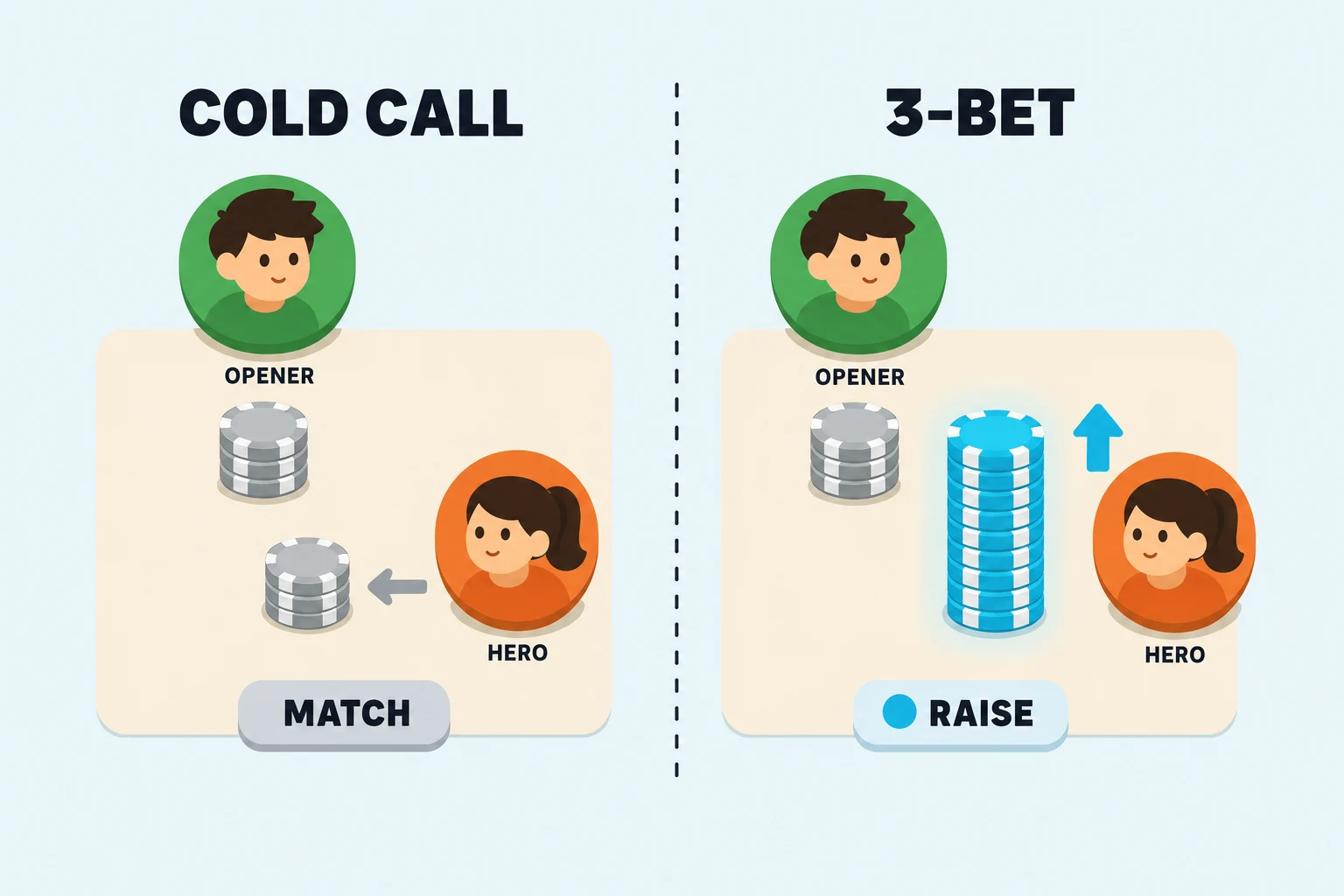
The action folds to a player who opens, then comes to you. Cold call when your hand plays clean in position, has decent equity against the opener’s range, and there is nobody dangerous left to act. 3-bet when at least one of four conditions kicks in: someone behind you can squeeze, you are out of position and capped, the opener’s range is wide enough to attack, or your hand is strong enough to want the dead money. Cold call vs 3-bet is one decision with four switches.
The shortcut, in one line
If your hand wants to see the flop and the seats behind you are tight, cold call. If your hand wants the dead money, the initiative, or the seat behind you can squeeze you off the pot, 3-bet.
Quick-reference table
The defaults below assume ~100bb effective stacks at 6-max no-limit hold’em cash, opener sizes around 2.5–3bb, and the seat behind you is unknown but not crazy aggressive. Adjust off the defaults when you have a real read.
| Hand | vs UTG open (you in CO) | vs CO open (you on BTN) | From SB vs CO open | From BB vs CO open |
|---|---|---|---|---|
| AA, KK, AK | 3-bet | 3-bet | 3-bet | 3-bet |
| QQ, JJ | 3-bet | 3-bet | 3-bet | 3-bet |
| AJo | Fold | 3-bet | 3-bet or fold | Call |
| KQs | Call | 3-bet | 3-bet | Call |
| 99, TT | Call | 3-bet | 3-bet | Call |
| 22–77 small pairs | Call (set-mine) | Call | Fold | Call |
| 76s–T9s suited connectors | Call | Call | Fold | Call |
The pattern is consistent. Tighter opener seat narrows your attack. Later your seat widens it. Out-of-position seats fold or 3-bet rather than flat. The big blind calls most things because it is closing the action and getting a price. Poker Skill’s lesson on the button against a cutoff open asks the button column’s question hand by hand, with fold, call and 3-bet all on offer.
Why cold call vs 3-bet breaks down this way
A 3-bet does four things at once. It builds the pot when you are ahead. It folds out the worse-but-not-yet-folding slice of villain’s range so weaker hands stop drawing on you cheaply. It claims the initiative — you will be the one firing the c-bet on the flop, which is worth real money on most boards because of range advantage. And it shrinks the field, which protects your equity when you have a hand like AJ that does not want to see a 4-way flop. Cold-calling does the opposite of each. It builds a smaller pot, lets worse hands realize equity, hands the initiative to villain, and invites the rest of the table in. That is fine when your hand benefits from those tradeoffs. It is a leak when it does not.
Three hands that show the pattern
KQs in the cutoff vs UTG open
You have K♠Q♠ in the cutoff. UTG opens to 3bb. The button and blinds are unknown but not maniacs.
Cold call. KQs has too much equity to fold and not enough to 3-bet for value. UTG’s open range from a tight player is roughly TT+, AJs+, AQo+, KQs, and against that, KQs has only about a third of the equity. That is not the side of the value 3-bet equation you want to live on. Worse, if you 3-bet KQs and UTG 4-bets, you have an awkward fold with a very playable hand.
What KQs wants is a flop, in position, with the chance to flop top pair or a strong draw and let UTG continuation-bet into you. That is a flat. The one thing to watch for is the button cold-calling behind and turning a heads-up flop into a 3-way flop where your fold equity drops. If the button is loose-passive, your KQs is still fine. If the button is a known squeezer, fold or 3-bet instead.
AJo on the button vs cutoff open
The cutoff opens to 2.5bb. You have A♥J♣ on the button. The blinds will play normally.
3-bet. AJo is the textbook value 3-bet on the button against a wide cutoff opener. Against a typical CO range (something like 22+, A2s+, A9o+, K9s+, KTo+, Q9s+, QTo+, J9s+, T9s, 98s, 87s), AJo has roughly 51–53% equity and dominates the meaningful slice of villain’s range: A-x suited under AJ, K-jack-suited, Q-jack-suited, the offsuit broadways below A-Q. Make it about 3x the open: open 2.5, 3-bet to 8. You are in position, so your sizing can be smaller than it would be from the blinds.
If villain 4-bets, fold. AJo runs poorly against a 4-bet range that is almost always QQ+, AK at small stakes. Do not get attached. The 3-bet wins on the times villain folds (you collect the dead money) and the times villain calls and you out-flop with top pair or a Broadway draw, both of which happen often enough to make the play print money in the long run.
99 in the small blind vs UTG open, big blind still to act
UTG opens to 3bb. The hijack, cutoff and button fold. You have 9♠9♥ in the small blind.
This is the spot where the cold call kills you. The big blind still acts after you and closes the action. If that player is a competent regular, your flat shows weakness, the squeeze comes (usually to about 12bb), and you have to fold a hand you wanted to play. Even when you do not get squeezed, you are guaranteed to play the flop out of position, often three-way, with a hand that wants either a heads-up pot or the initiative.
The two clean options are 3-bet to about 11–12bb, or fold. The 3-bet folds out the marginal hands behind, isolates UTG, claims initiative, and lets you decide flop strategy with one opponent and a defined range. The fold gives up a slightly profitable spot to avoid a messy multiway one. Which you pick depends on the table. What you do not pick is the cold call, because the cold call is the worst of the three options against any player who knows what a squeeze is.
When the rule lies to you
The defaults above assume four things that are not always true. When any of them breaks, the call/raise decision flips.
Stacks are not 100bb. Deeper (150bb+) makes set-mining and suited-connector flats much sharper because the implied-odds upside scales. Shallower (under 60bb effective) collapses the value of speculative flats and pushes more hands toward 3-bet or fold; you are not getting paid off enough on a set to make 22 worth a call.
The opener is not normal. Against a known nit who folds to 3-bets too often, widen your 3-bet bluff range and stop flatting hands like KTs that have decent equity but no fold-equity reason to flat otherwise. Against a maniac who opens 40% and barrels every flop, tighten up. Flat your strong hands and let villain hang himself, because 4-bet bluffing a maniac just hands him your stack.
The seat behind is unknown. If a known squeezer is left to act, the cold call disappears as an option for marginal hands. Either 3-bet first or fold; do not invite the squeeze.
You are in a tournament with ICM pressure. ICM compresses calling ranges and pushes more decisions toward fold or shove.
A live-play pattern you can run in three seconds
Under time pressure, run the four-question check before you act.
- Players left behind. Two or more competent players still to act? The cold call is dead unless your hand is so strong you are 3-betting anyway.
- Position. In position relative to the opener? You can flat. Out of position? You are closer to 3-bet or fold.
- Opener’s range. Wide and weak? More 3-bets. Tight and strong? Fewer; lean toward call or fold.
- Your hand. Strong enough to want the pot bigger and heads-up (3-bet for value), weak enough that calling realizes more equity than 3-betting (cold call), or in the gap where neither works (fold)?
If two or more answers point to 3-bet, 3-bet. If two or more point to call and you have position, call. If the answers contradict, default to fold; the spots the rule disagrees with itself are the spots beginners lose money in.
Where this fits in your decision
The cold-call-vs-3-bet question is the hinge of preflop strategy. Once you can pick cleanly, the next questions get easier: what to do with marginal hands when defending the big blind, how to size a 3-bet by position, when to mix bluff 3-bets into the range. None of those are answerable without a clean call/raise default to compare against. If the raise half still feels unfamiliar, the 3-bet, explained covers what it is and why it beats calling so often.
FAQ
Is it ever right to cold call from out of position? Yes, mainly from the big blind, where you are closing the action and getting an excellent price. From the small blind it is almost always wrong against a competent table — the flat caps your range, surrenders initiative, and gives the big blind room to squeeze. From the cutoff or middle position with players still behind, the answer is almost never. Pick 3-bet or fold instead.
What is the difference between a cold call and a flat call? Cold call usually means calling a raise without having any money in the pot yet — you were not the original raiser and you were not in the blinds. A flat call is the broader term for calling instead of raising; the blinds defending against an open are technically flat-calling, not cold-calling. The decision logic is the same; the labels just track who put money in first.
When should I 3-bet for value vs 3-bet as a bluff? Value-3-bet your top of range — JJ+, AK, AQs+, KQs — when you expect to get called or 4-bet by worse. Bluff-3-bet hands at the bottom of your fold-equity-needing range — small suited Aces, suited connectors, weak suited gappers — when the opener folds enough that the fold equity alone makes the play profitable. The middle of your range (KQo, AJo from outside the button, KJs vs UTG) is usually a fold or a flat, not a bluff 3-bet.
Should I cold call with pocket pairs to set-mine? Only when you can win a pot at least 10 times your call. At 100bb that math is tight, and it gets tighter when the opener is a tight player who will fold his overpair on a low flop. On the button against a wide cutoff opener with deep stacks, set-mining 22–77 is fine. From the small blind with the big blind left to act behind, set-mining is a leak; the squeeze risk eats the implied-odds edge.