


Blind Defense
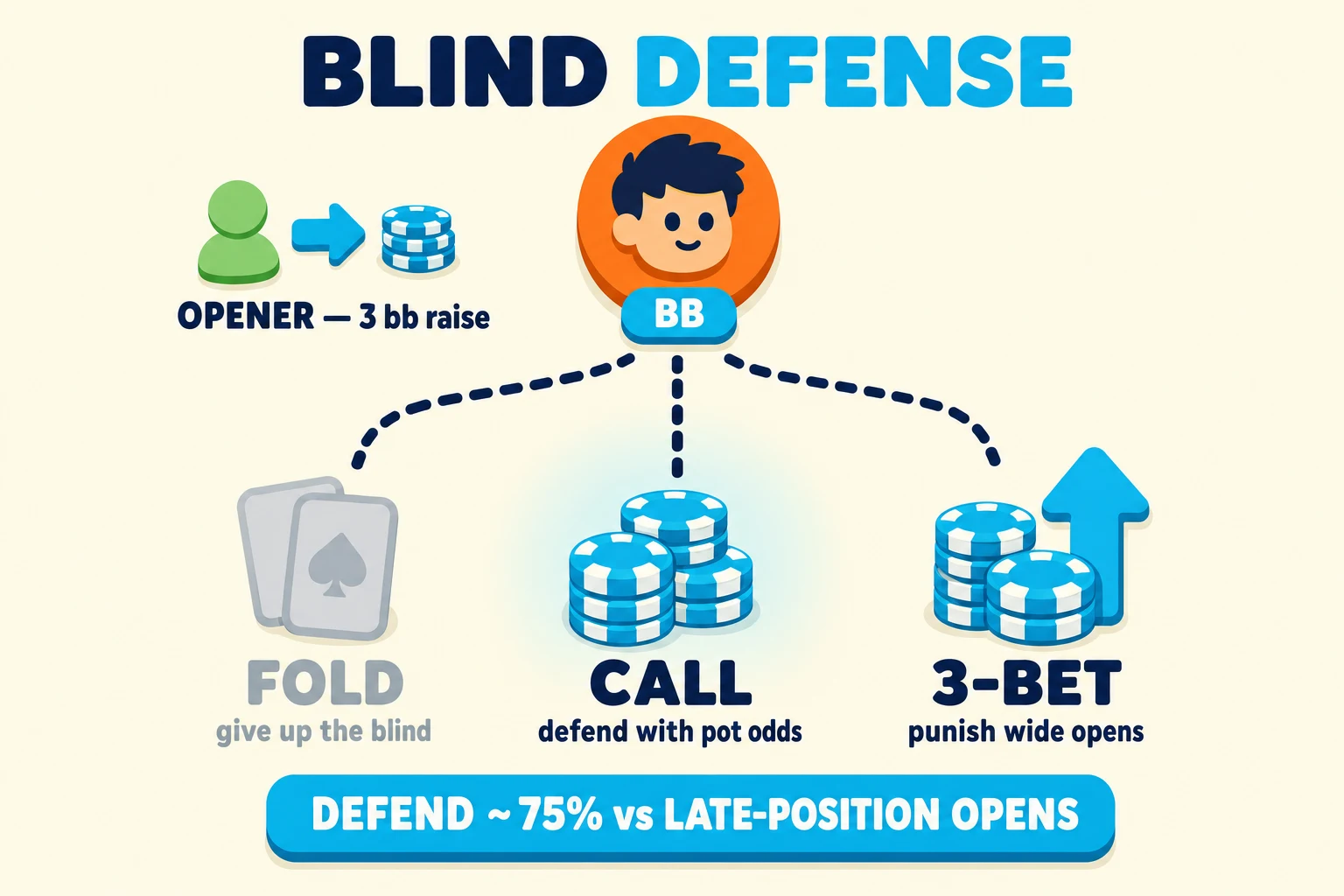
Calling or 3-betting from the big blind to keep openers from stealing for free. Better pot odds let you defend wide, especially against late-position raises.

Practice this in Poker Skill. Against an under-the-gun open, the Big Blind: Call or Fold lesson has you defend 8♠ 8♥ and Q♥ J♥ but fold A♦ 5♥, a weak offsuit ace.
Get the free appBlind Defense
Why defend the big blind Blinds are forced bets placed before cards are dealt; the big blind equals two small blinds. Because you already invested, the call often costs less relative to the pot, giving you better pot odds. The big blind also acts last pre-flop, so you see opponents’ actions before deciding. Strong players routinely continue with a large portion of hands, sometimes up to roughly 75%, mixing calls and selective aggression. Defend enough to deny easy profits, but avoid widening so much that you keep walking into losing post-flop spots.
Preflop defense: constructing a practical range Build a core defending range that balances raw equity and post-flop playability. Include:
- Broadways (high cards like KQ, AQ) that often make strong top pairs.
- Suited connectors (e.g., 76s, 98s) that gain value on connected or suited boards.
- Small-to-medium pocket pairs (22-99) for set-mining, the play of calling to flop three of a kind.
- Strong offsuit high cards (A8o+, KQo) used selectively for top-pair potential.
Use flat-calls (calling a single raise) with speculative hands that want to see a flop cheaply. Use 3-bets (re-raises) with hands that fold out equity-denying holdings or do well heads-up, such as AK and AQ. Include suited broadways as occasional isolators against frequent stealers.
Practical preflop steps:
- Against late-position openers, widen: call more with suited connectors and speculative holdings.
- Against early-position opens, tighten: favor broadways and medium pairs with clear post-flop value.
- Mix occasional 3-bets to remain unpredictable and punish hyper-aggressive stealers.
Adjustments by opponent type and position. Versus aggressive stealers in the small blind or the late seats, widen your defense and add extra calls and occasional re-raises to deny easy profits. Versus a tight, deep-stacked opener, play more selectively and favor hands that perform better out of position post-flop, like strong broadways and medium pairs. Stack depth matters: with shallow stacks, prefer binary decisions (fold or shove/3-bet), since post-flop maneuvering room shrinks. With deep stacks, favor speculative calls that lean on implied odds and post-flop skill.
Postflop plans from the big blind Decide your post-flop line before you call pre-flop: will you pursue value, bluff-catch, or fold to pressure?
- If the in-position opponent checks the flop, you can take the lead on certain turns with polarized bets, small bluffs or big value bets. For example, call 98s versus a late open; flop J-7-3 rainbow; raiser checks; take the turn lead when a harmless card appears.
- Use bluff-catchers (hands you call with against bluffs but won’t value-bet) and pot-control lines when the raiser shows heavy aggression.
- Read board texture: connected and suited boards favor your speculative holdings; dry boards favor the raiser’s value hands, so be cautious with marginal holdings.
Advanced tactics and pitfalls to avoid. Tactical plays like check-raises, donk-bets (betting into the bettor), and occasional overbets only work when your range supports them. Don’t forfeit the blind too easily; your forced investment makes many hands cheaper to continue. Equally, avoid over-defending with pure junk; habitual over-calling loses chips fast against focused aggression. Mix aggression and caution to stay hard to read while still extracting value.
Quick checklist
- Defend the big blind regularly but selectively; include broadways, suited connectors, and pairs.
- Adjust your range by opponent position, aggression, and stack sizes.
- Plan post-flop lines before calling pre-flop: value, bluff-catch, or fold.
- Mix calls and 3-bets to avoid predictability; use advanced bets sparingly and balanced.