
Bluff-Catch
What a bluff-catcher is and why it matters
A bluff-catcher is a hand that loses to an opponent’s value hands but beats their bluffs. In practice: it’s strong enough to call when you expect frequent bluffs, but too weak to call for value. Bluff-catching matters most on late streets, especially the river, when opponent ranges often polarize - leaving mostly very strong hands or pure bluffs. Calling the right bluffs prevents opponents from profiting by bluffing too often and protects your long-term win rate.
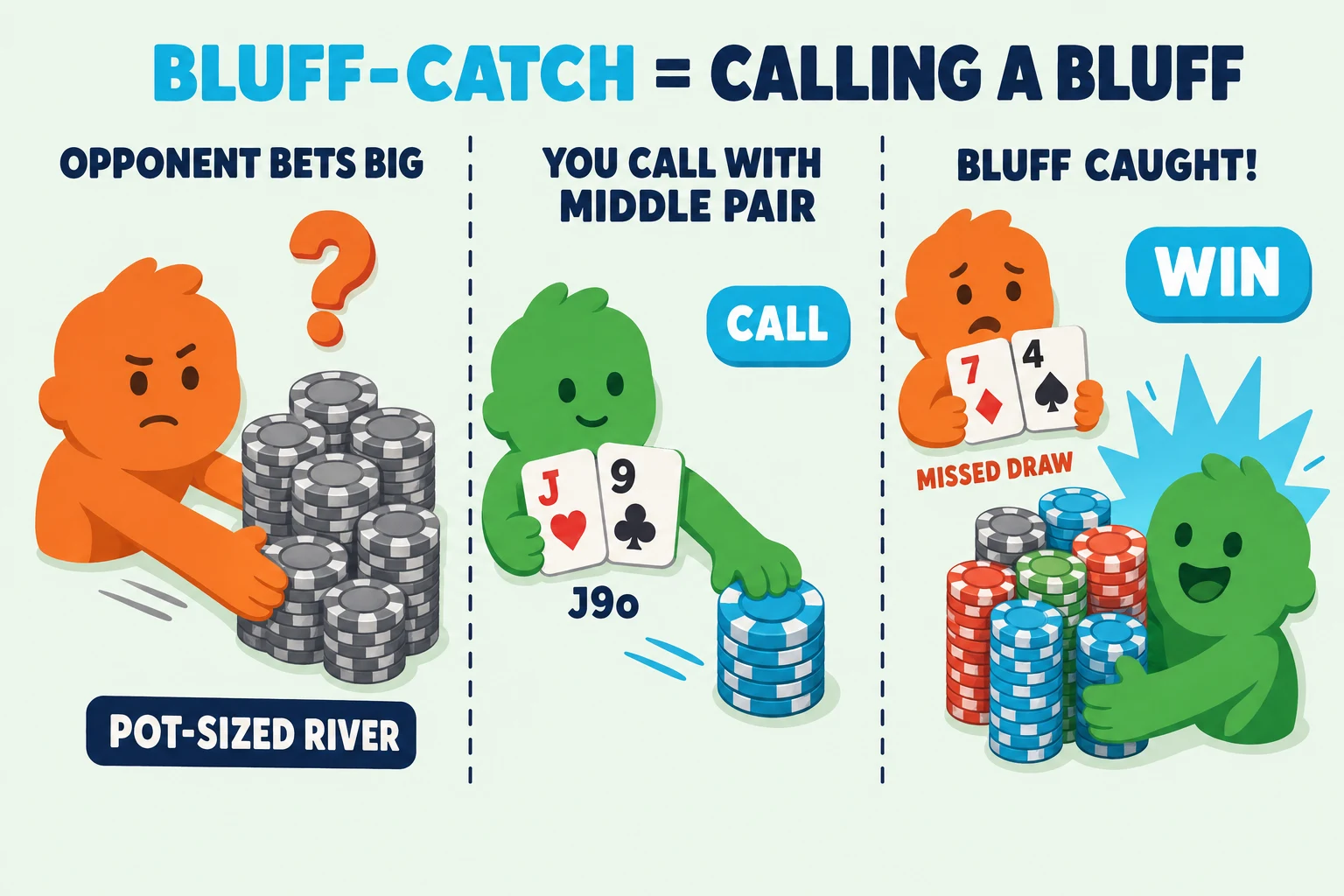
Spot selection: when to consider calling as a bluff-catcher
Use these steps to judge a bluff-catch spot:
- Range polarization: Favor rivers where board development removes many medium hands. Example: on A♦ 9♣ 3♠ 7♦ K♠, a large river bet usually signals either a nut/value or a missed-draw bluff.
- Bet size and frequency: Bigger bets and overbets force villains to bluff more often to make bluffs profitable. A huge river bet into a small pot raises the chance part of their range is bluffs.
- Opponent tendencies: Target spots versus aggressive, bluff-prone players. Versus a nitty (very tight) player, the same bet more likely represents value, so calling is less attractive.
- Board texture: Favor boards where many plausible value hands folded earlier, leaving mainly bluffs and very strong hands on the river.
Choosing hands to use as bluff-catchers
Pick hands that beat most plausible bluff lines while minimizing loss to value hands.
- Prefer pairs and overlooked showdown holdings, like top or second pair depending on the board. Example: on K♣ 7♦ 4♠ J♠ 3♦, a pair of sevens can catch many missed straight and flush bluffs.
- Use unblockers: an unblocker is a card in your hand that does not remove combinations of opponent bluffs, making those bluffs more likely.
- Avoid thin showdown hands that lose to a wide swath of value hands and rarely improve. If your one-pair hand sits behind the opponent’s value range, it’s a poor bluff-catcher.
Pot odds, bet sizing, and calling thresholds
Combine pot odds with your estimate of how often the opponent bluffs.
- Quick calculations: If the pot is $100 and villain bets $50, you must call $50 to win $200, so you need about 25% bluff frequency to break even. If villain bets $100 into $100, you must call $100 to win $300, so you need roughly 33%.
- Larger bets force villains to bluff more often, raising the threshold where calling becomes correct.
- Factor stack sizes and commitment risk. If calling the river commits most of your stack, your effective required equity changes - avoid marginal calls that commit you unnecessarily.
Range balance and long-term considerations
Bluff-catching supports a balanced, unexploitable strategy.
- Include enough bluff-catchers so opponents can’t bluff profitably every time.
- Remember: bluff-catching is often marginal or break-even compared with primary value strategies. Don’t sacrifice real value to chase extra bluff-catches.
- Watch table dynamics and adjust your range. If opponents bluff more, widen your bluff-catching range; if they stop bluffing, tighten it.
Quick checklist
- Only call when your hand beats most plausible bluffs and pot odds make it profitable.
- Prefer unblockers and hands that avoid blocking opponent bluff lines.
- Use bluff-catching selectively on late streets when opponent ranges are polarized.
- Adjust calls based on opponent tendencies, bet sizing, and stack commitments.