


Unblocker
An unblocker is a card in your hand that does not reduce the likelihood your opponent holds a target hand. Put simply: if your cards don't "block" the holdings you want the opponent to have, they are unblockers. A blocker, by contrast, is a card that reduces opponent combinations (specific two-card holdings). For example, holding A♠ lowers the chance an opponent has A♠x. Use this concept to judge whether your hand helps value extraction or bluff-catching.
Unblocker - Using unblockers in No-Limit Texas Hold’em
What an unblocker is
An unblocker is a card in your hand that does not reduce the likelihood your opponent holds a target hand. Put simply: if your cards don’t “block” the holdings you want the opponent to have, they are unblockers. A blocker, by contrast, is a card that reduces opponent combinations (specific two-card holdings). For example, holding A♠ lowers the chance an opponent has A♠x. Use this concept to judge whether your hand helps value extraction or bluff-catching.
Why unblockers matter versus blockers
Blockers shrink opponents’ combinations; unblockers leave them intact. That distinction changes strategy.
- For bluffs: blockers reduce the number of hands that can comfortably call, increasing bluff success.
- For value betting and bluff-catching: unblockers keep opponents’ calling or missed-draw hands in their ranges. As ranges narrow on later streets, blockers or unblockers can change the correct play.
Using unblockers for value betting
Value bets target calls from worse hands. They work better when your cards don’t remove the calling hands you want.
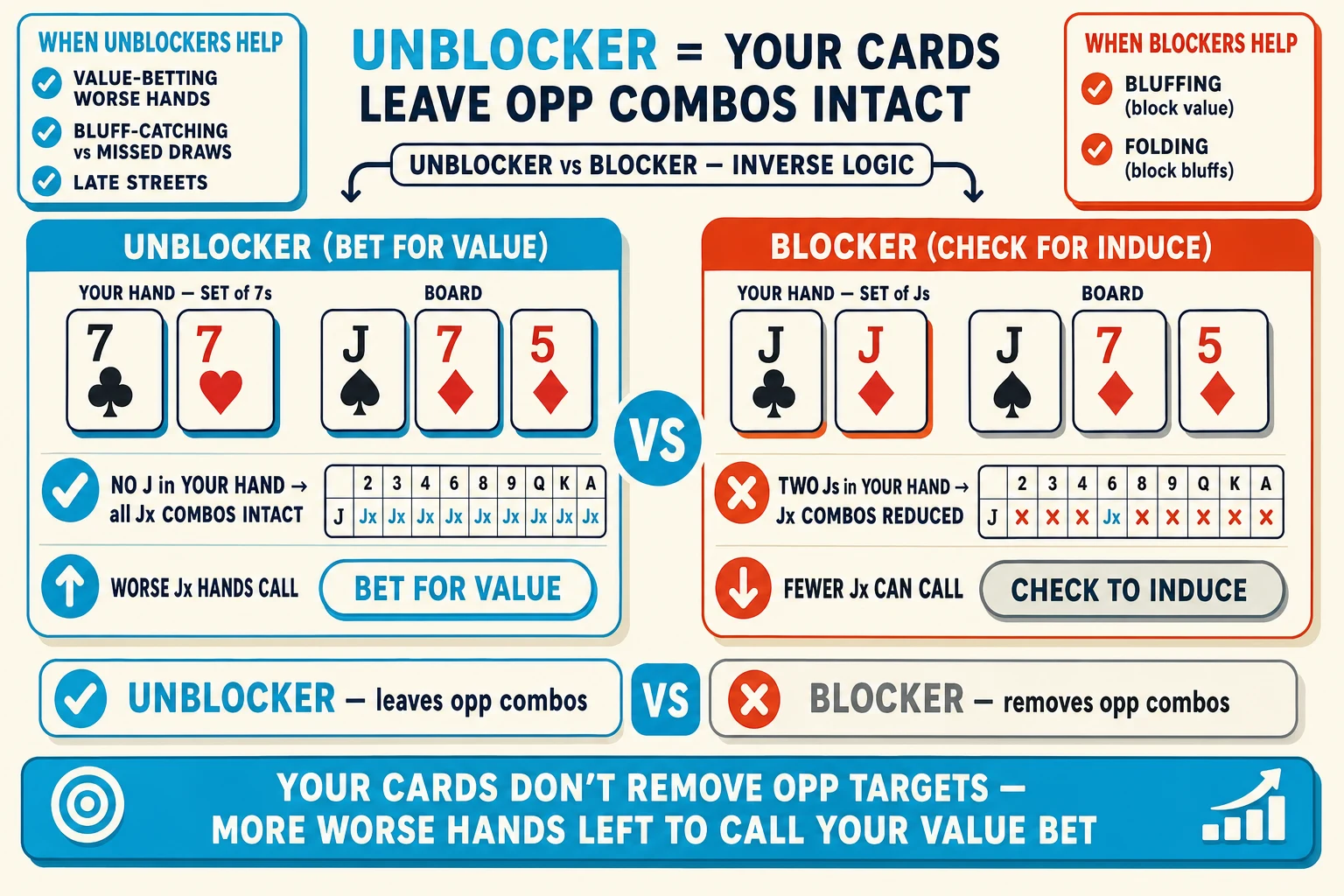
Example: on J♠ 7♦ 5♦ you hold 7♣7♥, a set of sevens. You don’t hold a Jack, so Jx combinations (jack plus any other card) remain possible. Many worse top-pair hands can still call, so bet for value. Contrast: with J♣J♦ (a set of jacks) you block many Jx combos. Fewer worse hands will call, so betting extracts less value. Check to induce bluffs or avoid being called only by stronger hands.
Rule: bet when your hand lacks the key cards opponents need to form calling hands.
Poker Skill’s lessons stop short of counting blocked combinations, but its Value Betting lesson asks the question behind this rule, betting two pair on a quiet flop because worse hands can still call.
Using unblockers for bluff-catching and bluffing
A bluff catcher is a hand that can call bluffs, like a marginal top pair. It works best when it does not block opponents’ missed-draw bluffs.
Example: on A♦ 9♦ 4♦ you expect many missed diamond draws. Holding K♠9♣ (no diamond) leaves missed-diamond combinations intact, making opponent bluffs more likely. Holding K♦9♣ (with a diamond) blocks some missed draws and weakens your call. When constructing bluffs, do the opposite: include blockers that reduce opponents’ strong-calling combinations.
Practical flop example: J♠ 7♦ 5♦
- Bet sets of 7s or 5s; they don’t block Jx combos, so more Jx hands can call.
- Check a set of Jacks; holding a Jack removes many Jx callers and reduces extractable value.
- If your hand removes likely caller combos, prefer checking; if not, prefer betting.
When to prioritize unblockers at the table
Prioritize unblockers in close or marginal spots where small combination differences swing EV. Their importance grows on later streets as ranges narrow and specific holdings matter. Use unblocker checks selectively and focus on spots where opponent lines hinge on a few cards, such as single-card pairs or specific missed draws.
Quick checklist
- Identify the target opponent hand or missed draw before you label a card an unblocker.
- Ask: does my hand remove or leave intact the combinations I want the opponent to hold?
- Prefer value bets and bluff-catches when your hand unblocks the opponent’s calling or bluffing combinations.
- Apply the J♠7♦5♦ template to similar textures and re-evaluate on later streets.