


Two-Tone Board
A two-tone board is a flop with two cards of one suit and a third card of another suit (e.g., J♠ 8♠ 6♥). It's the most common unpaired flop texture and the one that puts a flush draw on every hand chart. Read the suit-count first, then the rank structure: how the cards connect and which player's range carries the flush combos drives almost every postflop decision after the flop bet.
Practice this in Poker Skill. On a third-heart turn, the Good Barrel Cards lesson fires again when the ace of hearts is in your hand, since the scary card gives you the nut flush draw.
Get the free appTwo-tone board: a flop with two cards of one suit
What a two-tone board is
A two-tone board is a flop of three community cards where two share the same suit and the third is a different suit. J♠ 8♠ 6♥ is two-tone. So is A♥ 9♣ 2♥, and so is K♦ 7♦ 4♠. The label tracks suit count only; rank, connection, and pair structure live on separate axes. Two-tone is the most common unpaired flop texture by a wide margin, so most postflop spots you face will sit on this kind of board texture.
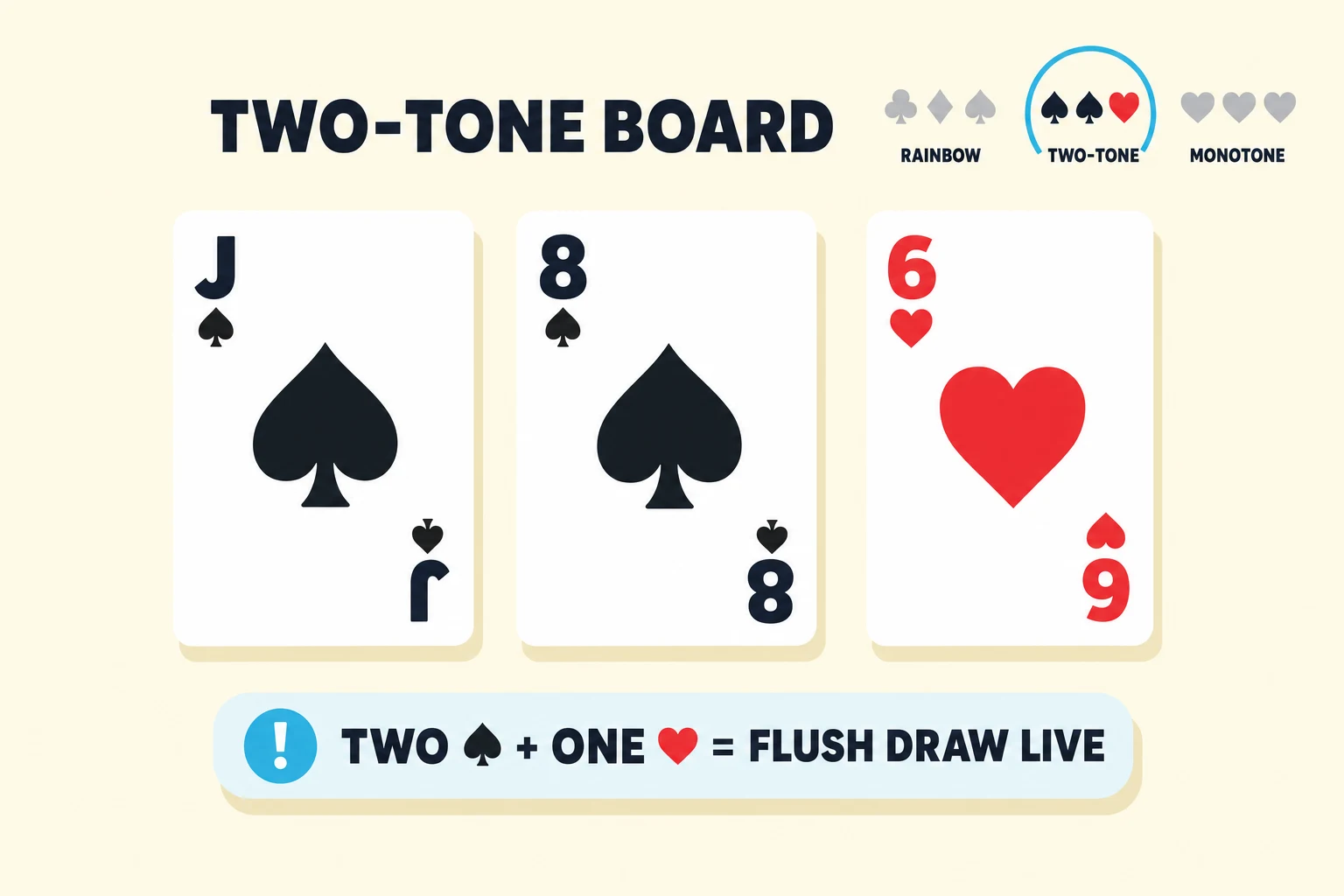
How two-tone differs from monotone and rainbow at a glance
- Monotone: three cards of one suit. A flush is already on the board for any player holding the suit.
- Two-tone: two cards of one suit, one different. A flush draw is live; a flush is not yet made.
- Rainbow: three different suits. No flush draws on the flop; flushes need running cards to come in.
- Two-tone splits into three rank-positioned subtypes: high-mid (top two suited, e.g. A♥ K♥ 8♣), mid-low (middle two suited, e.g. J♥ 6♥ 5♠), and high-low (top and bottom suited, e.g. A♣ 9♦ 2♣). Subtypes change how flush draws sit inside hand-chart combos but not the headline label.
Related terms:
Two-tone vs. monotone vs. rainbow
| Texture | Suit pattern | Flush draws on flop | Share of unpaired flops | Typical IP c-bet sizing in single-raised pot |
|---|---|---|---|---|
| Monotone | All three same suit | A made flush already exists for some hands | ~6% | Small (1/3 pot or min-bet) |
| Two-tone | Two of one suit, one different | Yes — many flush draws live | ~56% | Medium (around 1/2 to 2/3 pot) |
| Rainbow | All three different suits | None on the flop | ~38% | Larger and higher frequency (range-bet territory) |
Two-tone sits between the bookends. The in-position raiser still has a range advantage on most two-tone flops, roughly four to five times as many strong hands as the big blind defender on average, but the live flush draw means equity can swing hard on the turn. That combination justifies bigger sizings than monotone (where the big blind catches a lot more flush equity) and slightly smaller sizings than rainbow (where the in-position player’s range advantage is even larger and turns are calmer).
When two-tone texture matters most
Where the suit count drives the line:
- Single-raised pots, in-position raiser vs. big blind. The classic c-bet decision spot. Range advantage favors the raiser; the live flush draw says don’t get cute with sizing.
- Coordinated two-tone flops (J♠ 8♠ 6♥, T♥ 9♥ 7♣, 9♦ 8♦ 5♣). Flush and straight draws stack. Many “top-pair” hands play closer to a bluff-catcher.
- Multi-way pots. Every extra player adds flush combos to the live ranges. A texture you would barrel heads-up may want a check multi-way.
- Flush-completing turns. The turn that brings a third card of the suit reshapes both ranges — yours, theirs, and the credible river bluffs.
Where it matters less:
- High-card disconnected two-tone flops (A♠ 9♣ 2♠). Flush draws are the only live concern. Top pair plays a lot like it would on a rainbow ace-high board, with a small extra discount for the suit.
- Paired two-tone flops (Q♦ 8♦ 8♣). The pair structure dominates the conversation; suit count moves the line less than the paired card itself.
Example: J♠ 8♠ 6♥, single-raised pot
You open the cutoff to 2.5bb with A♠ Q♠. The big blind defends and the flop comes J♠ 8♠ 6♥. Pot is 5.5bb, stacks ~97bb behind. You hold ace-high with the nut flush draw and a backdoor straight; the big blind has continued with a wide defending range that loves this flop more than they would a rainbow J-8-6.
Flop. A bet near half-pot does the work. You charge the medium pairs, the worse flush draws, and the pure floats. Going much bigger isolates you against the top of the big blind’s continuing range (flush draws to the K and Q, two-pair combos like J-8 and 8-6, and rare sets) without picking up enough extra folds from the bottom of their range to pay for it. Your hand is one of the cleanest barreling candidates in your range: ace-high, the nut blocker, and 9 outs to the flush plus three more to top pair.
Turn 2♠. The third spade arrives. You make the nut flush. Your hand class jumped two tiers, but so did several big blind hands — every K♠x and Q♠x from their defend now has a flush, and so do their two-pair combos that happened to be suited. A pot-sized bet is fine; an overbet to roughly 1.25 pot is also defensible because the turn polarizes ranges. You bet larger now because the river decision swings on whether the big blind has a flush at all, and a big turn bet shapes that river.
Turn 2♣ (brick). The board doesn’t change much. Your top pair plus nut flush draw still has 14 outs to a clear winner. A continuation around two-thirds pot keeps the pressure on, denies free cards to underpairs and one-pair-no-draw hands, and sets up a clean river barrel on the third spade. The size that was roughly half-pot on the flop is bigger now because the big blind’s continuing range is stronger and flush completion stays live.
Common mistakes on two-tone boards
1) Treating two-tone like rainbow
The biggest leak is sizing the same on J-8-6 with two spades as you would on J-8-6 rainbow. The live flush draw flips a chunk of the big blind’s “trash” range into hands with real equity. A small c-bet that works on rainbow gives away free cards on two-tone. Read the suit count first, then size.
2) Overbet-protecting top pair
Big bets with one-pair hands on coordinated two-tone flops fold out the hands you beat and isolate you against the top of the calling range. Most of the value of top pair on these textures comes from showdown, not from blasting three streets. Bet sizes that price draws are fine; sizes that say “go away with everything weaker than two pair” are usually leaking.
3) Ignoring rank structure
Two-tone is a label, not a strategy. A♠ 9♣ 2♠ plays nothing like J♠ 8♠ 6♥. The first one is functionally dry with one suited concern; the second is functionally wet with stacked draws. The same “two-tone” tag covers both. Your sizing has to read the rank structure too.
4) Refusing to barrel scare turns
When the third card of the suit arrives, hero’s instinct is often to slow down with everything that isn’t a made flush. That gives up the entire texture. The strongest two-tone barreling hands are the ones holding the nut flush card itself or a top-pair hand that turned a flush draw — exactly the hands that should keep firing, not check.
FAQ
What is a two-tone board?
A two-tone board is a flop where two of the three community cards share a suit and the third is a different suit, like J♠ 8♠ 6♥ or A♥ 9♣ 2♥. It sits between monotone (all three the same suit) and rainbow (all three different) on the suit-count axis. Two-tone is by far the most common unpaired flop texture in hold’em.
Should I c-bet bigger on two-tone flops?
Usually a notch bigger than your monotone sizing and a notch smaller than your rainbow sizing. The live flush draw means small bets give too much equity for free, but the in-position raiser’s range advantage is smaller than on rainbow boards, so jumbo sizes start isolating against value. A starting point in single-raised pots is around half-pot on disconnected two-tone flops and closer to two-thirds on connected ones, with the same size for value and bluffs so the size doesn’t telegraph strength.
How is a two-tone board different from monotone or rainbow?
Suit count. Monotone is all three same suit, with a made flush already possible. Rainbow is three different suits, with no flush draws live until the turn. Two-tone is the middle case: two cards of one suit, one different, which means flush draws are live but a flush isn’t yet made. The strategic consequence shows up most on the turn, where a third card of the flush suit reshapes both players’ ranges much more than a rainbow turn would.