


Dry Board
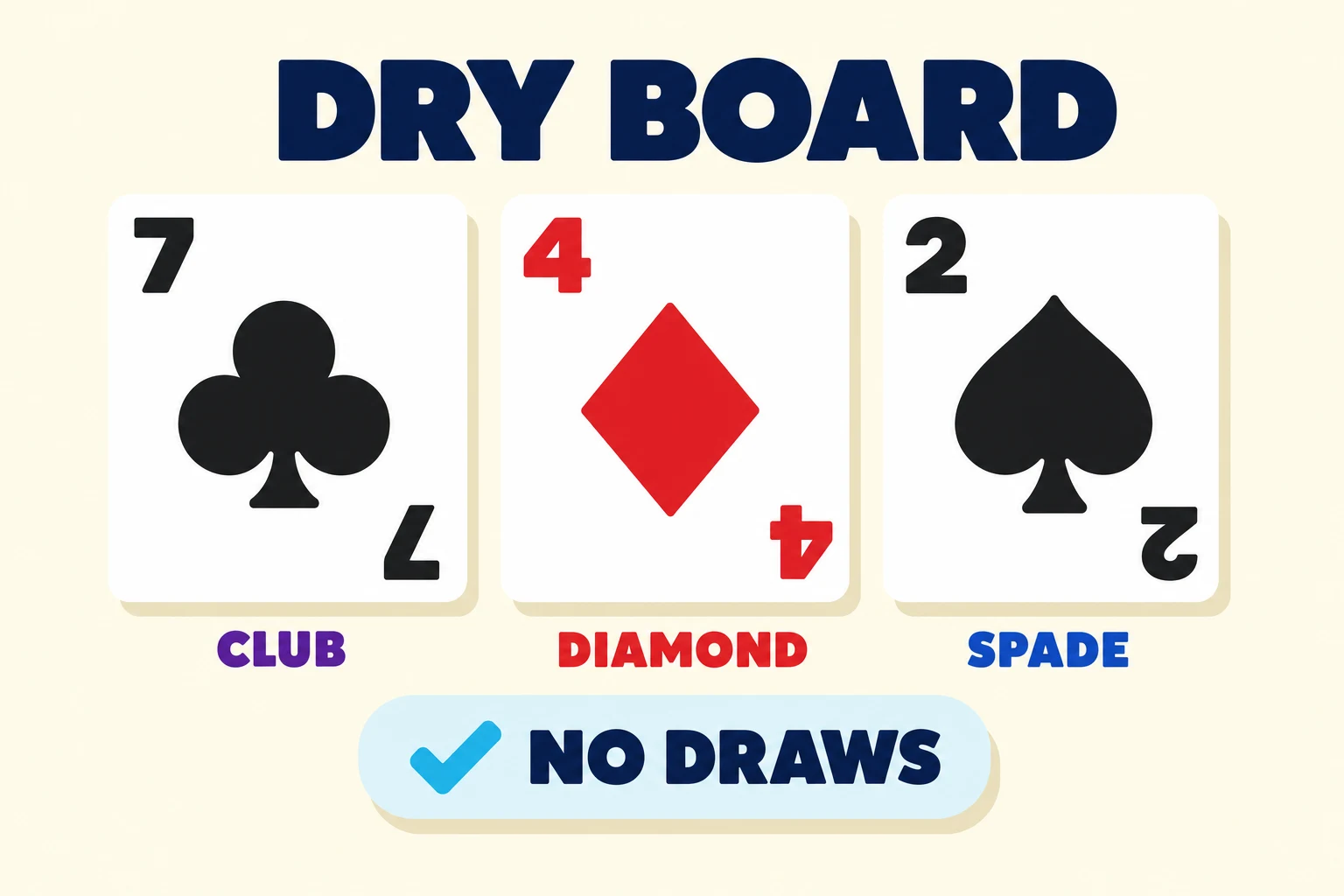
A dry board shows uncoordinated community cards with few flush or straight draw possibilities. The ranks sit widely apart and suits mix, so few opponents hold strong draws. Example: 7-4-2 rainbow. "Rainbow" means each card has a different suit, so flush draws are impossible. Because the cards aren't connected (no 5-6-7, no J-10-9), straight draws are unlikely. Dry boards remove much of opponents' drawing potential and change post-flop play.
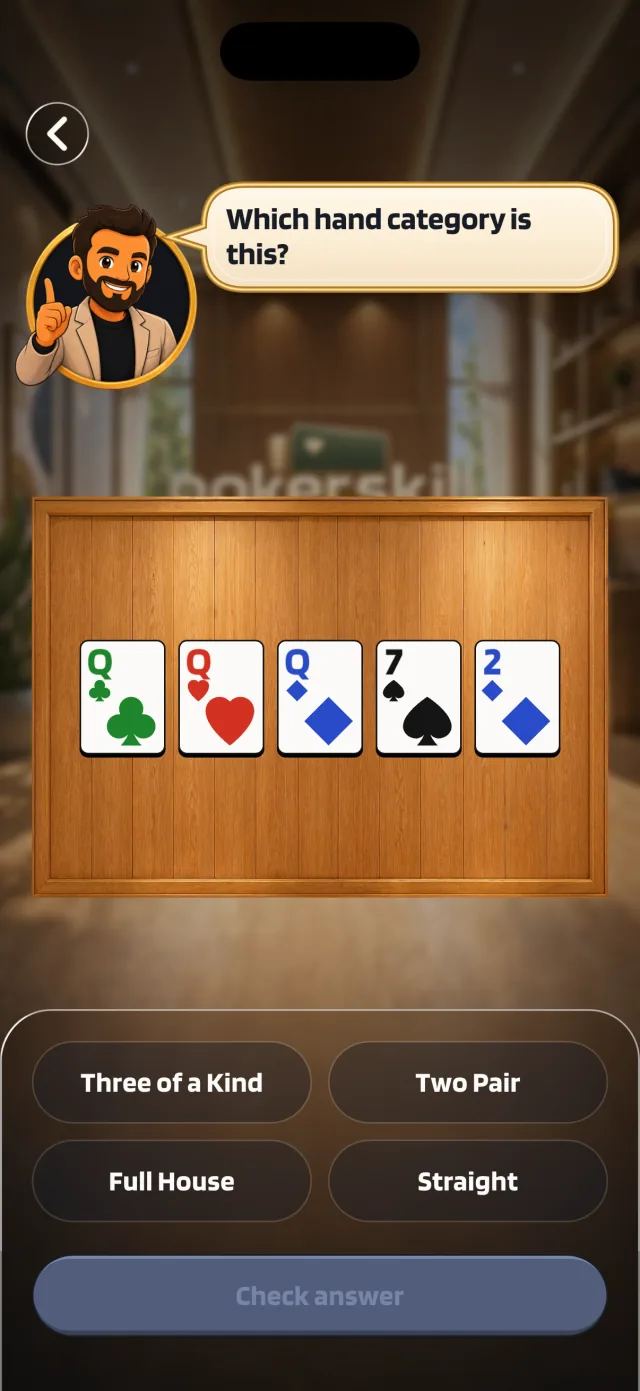
Practice this in Poker Skill. A♠ 6♦ on Q♦ 7♣ 2♠ gets a bluff c-bet in the lesson on missed flops: you have nothing, but with the betting lead on a board that dry, the answer is a bet.
Get the free appDry Board - No-Limit Texas Hold’em
What a dry board is
A dry board shows uncoordinated community cards with few flush or straight draw possibilities. The ranks sit widely apart and suits mix, so few opponents hold strong draws. Example: 7-4-2 rainbow. “Rainbow” means each card has a different suit, so flush draws are impossible. Because the cards aren’t connected (no 5-6-7, no J-10-9), straight draws are unlikely. Dry boards remove much of opponents’ drawing potential and change post-flop play.
Why dry boards favor the pre-flop raiser
The preflop raiser - the player who raised before the flop - usually has the structural advantage on dry boards. Callers’ ranges seldom include hands that hit hard on an uncoordinated flop, so they have fewer reasons to continue. With fewer draws, opponents rarely apply consistent multi-street aggression. That makes a continuation bet, or c-bet, more credible. When you represent strength on a dry board, many marginal calling hands will fold.
Continuation bet sizing and frequency on dry boards
On very dry boards, size c-bets around half the pot to apply pressure with limited risk. A half-pot bet pressures unmade ranges without committing a large portion of your stack.
Practical steps:
- Size roughly 0.5 pot on single-raise pots when the flop is unconnected and rainbow.
- Use the same sizing for strong value hands and bluffs so sizing doesn’t reveal strength.
- Reduce frequency versus opponents who call down light; increase frequency against tight, foldy players.
Example: You raised pre-flop and one player called. Flop K-7-2 rainbow. A half-pot c-bet folds many missed hands (QJ, 88, small pairs) while preserving equity for hands you don’t want to fold.
Bluffing opportunities and representation
Single high-card dry boards (e.g., K-7-2 rainbow) suit bluff c-bets because many calling ranges miss. A well-timed c-bet will often fold out marginal hands and unmade ranges.
Key ideas:
- Represent a range that includes strong hands-top pairs, two pairs, sets-so opponents respect your bet.
- Keep bet sizing uniform; betting the same amount prevents giving away hand strength.
- Use “bullets”-small follow-up bets on later streets-selectively when opponents show weakness after calling the flop.
Example: You c-bet half pot on K-7-2 rainbow and the caller checks the turn 3. A small turn bet (a “bullet”) can fold many hands that connected only marginally pre-flop.
When to be cautious - low paired and deceptive textures
Not all dry boards are safe. Low paired dry boards (e.g., 3-3-8 rainbow) can connect with opponents’ pocket pairs. Callers that survive the flop often retain showdown value and may resist folding.
Adjustments:
- Expect more resistance and be prepared to make disciplined folds rather than over-commit.
- Reduce bluff frequency on low-paired flops; prefer checking back or betting smaller with a plan to release.
- Against sticky or aggressive players, either cut your bluffing or plan a few small follow-ups instead of a big line.
Quick checklist
- Identify dry boards by lack of suits/connectors and minimal draw potential.
- Favor smaller c-bets (about half pot) and uniform sizing across hand strengths.
- Target bluffs on single high dry boards; avoid over-bluffing on low paired textures.
- Watch opponent tendencies and adjust frequency or sizing versus sticky or aggressive callers.
For the full board-by-board c-bet framework, read when to c-bet the flop.