


Suit
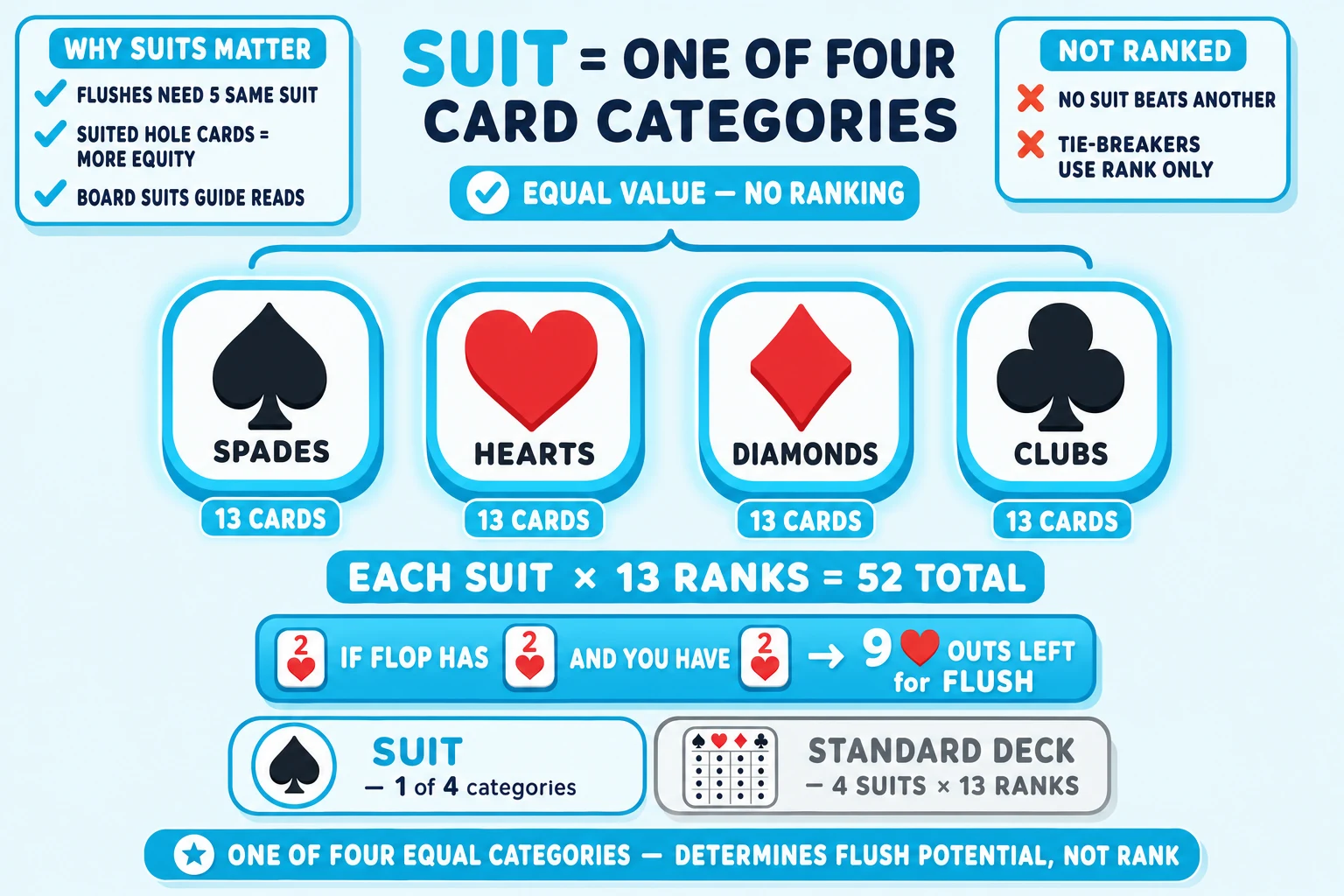
A suit is one of four categories in a standard 52-card deck: hearts, diamonds, clubs, spades. Each suit contains 13 ranks, from ace through king. In Hold'em suits have no ranking order; a spade isn't higher than a heart. Suits matter because they determine which kinds of hands, like flushes, are possible.
Practice this in Poker Skill. In the Straights & Flushes lesson, five diamonds on the board, 2♦ 6♦ 9♦ Q♦ K♦, make a flush with no sequence needed, and any diamond in a player’s hand makes a higher one, because flushes are compared by rank.
Get the free appSuit in No-Limit Texas Hold’em
What a suit is
A suit is one of four categories in a standard 52-card deck: hearts, diamonds, clubs, spades. Each suit contains 13 ranks, from ace through king. In Hold’em suits have no ranking order; a spade isn’t higher than a heart. Suits matter because they determine which kinds of hands, like a flush in poker, are possible.
Why suits matter in Hold’em
Suits change a hand’s potential because some hands require same-suit cards. A flush needs five cards of the same suit, so suit distribution matters. If your two hole cards share a suit, they’re “suited” (for example, A-Q suited). Suited hole cards increase your chance of making a flush versus the same ranks offsuit. Community suits on the flop, turn, and river shape opponents’ draws and made flushes.
Reading suits on the board
Quickly checking board suits is essential for accurate hand reading. Use these steps when action develops:
- Count board suits. Note how many community cards share a suit on the flop, turn, or river.
- Match your hole cards. See whether one or both of your private cards match a suit on the board.
- Consider opponents’ possibilities. Combine visible suits with betting patterns to narrow likely holdings. For example, if the flop has two diamonds and an opponent suddenly bets big, they may be representing a diamond flush draw or a made diamond flush if a third diamond appears.
These quick reads help decide whether a bet represents strength.
Suited vs. offsuit starting hands
“Suited” means both hole cards share a suit; “offsuit” means they are different suits. Practical effects:
- Preflop selection: Players value suited hands more because they can make flushes, justifying slightly wider calling or opening ranges. Poker Skill’s opening chart shows the gap on the button, where every suited queen from Q4s up is a raise but offsuit queens start at Q9o, and in Poker Skill’s button lesson you fold queen-four offsuit as too weak and too easily dominated.
- Postflop play: If you flop a flush draw with a suited hand, plan how many streets you might get to realize that equity. With an offsuit hand you lack that route and must adjust strategy accordingly.
Suited does not guarantee a flush; it only increases the chance compared with an offsuit equivalent.
Suits, outs, and betting decisions
An “out” is any unseen card that improves your hand. On a flush draw, the remaining cards of that suit in the deck are your outs. More same-suit cards still unseen strengthen the draw and make chasing more attractive. Factor suit texture into bet sizing and call/fold decisions. If the board shows three or more cards of the same suit, opponents may already have a made flush; that risk should push you toward cautious sizing or folding. Conversely, with a strong made flush, size bets to extract value or price calls.
Quick checklist
- Verify how many community cards share a suit before committing chips.
- Note whether your hole cards are suited and how many suit outs remain.
- Remember suits are not ranked, but they decide whether flushes and straight flushes are possible.
For where the suit-ranking myth comes from, the two real exceptions, and the worked flush showdown, see poker suits explained.