


Hole Cards
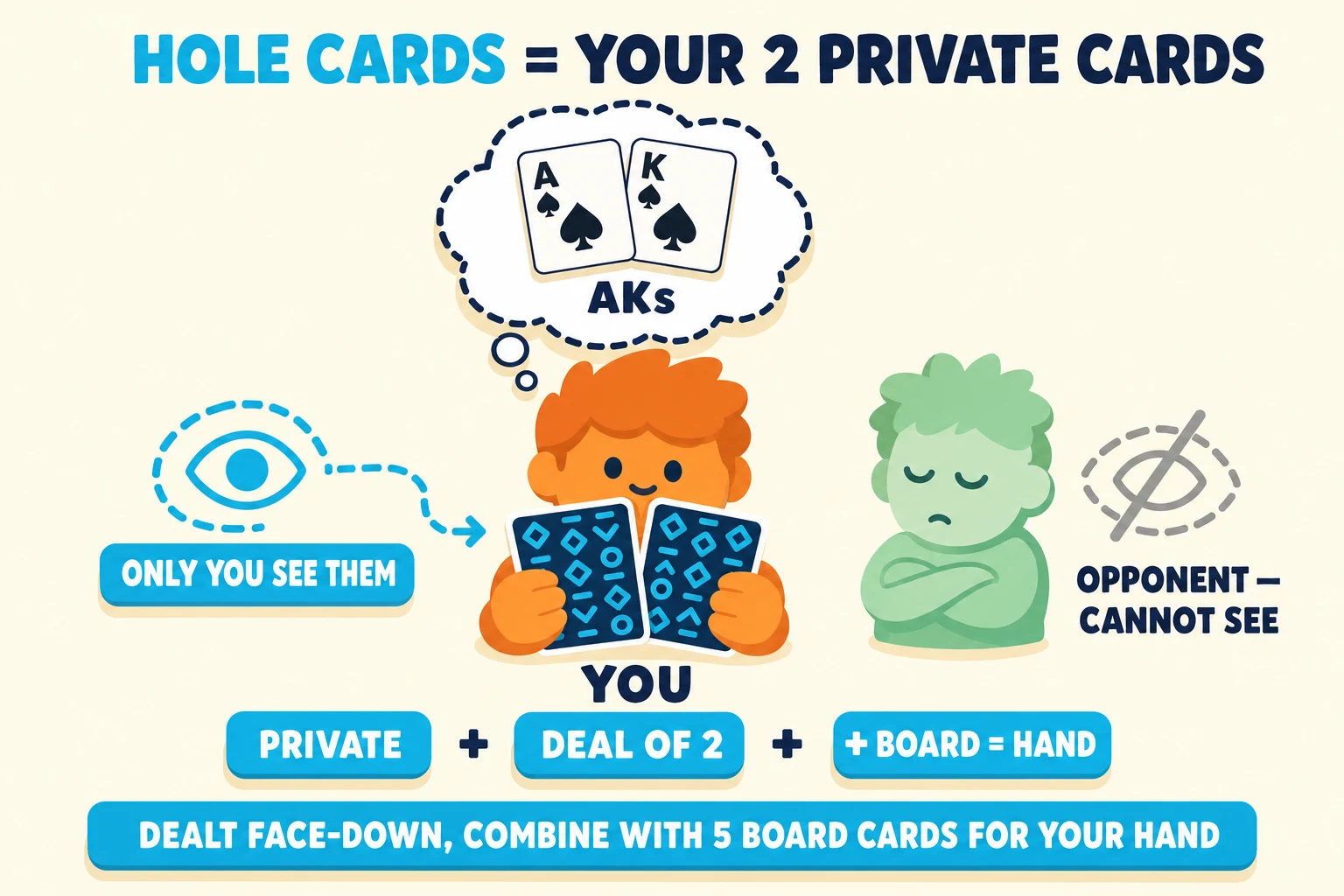
The two private cards each player is dealt face-down at the start of every hand. They combine with the five community cards to form your best five-card hand.
Practice this in Poker Skill. With 4♦ 10♠ on a board of 9♥ 2♠ 7♣ J♣ 8♦, a hand from the Best Five Basics lesson, your ten completes 7-8-9-10-J for a jack-high straight while your four stays out.
Get the free appHole Cards
What hole cards are
The dealer gives each player two private cards at the start of a No-Limit Texas Hold’em hand. These cards are hole cards and remain hidden from other players during betting. You combine your two private cards with the shared community cards to make the best possible five-card poker hand.
Why hole cards determine strategy
Hole cards form the basis for every decision, from pre-flop raises to the river. Their secrecy lets you represent strength or weakness through bet sizing and timing. That ambiguity creates bluffing opportunities, betting to make opponents fold better hands. Opponents use your bet sizes, timing and history to infer what your hidden cards might be.
Hole-card traits to evaluate
When the dealer gives you two cards, check these attributes quickly:
- Strength: how likely the two cards can become a top five-card hand after the board. Stronger combos deserve more aggressive play.
- Suit: suited hole cards (both cards of the same suit) create flush possibilities once community cards appear.
- Connectivity: cards close in rank (for example, 7 and 6) are connected and improve straight chances.
- Pairs: a pocket pair starts as a made pair and can win without improving.
9♠ 9♦ starts as a pocket pair that may hold up depending on the board.
How hole cards interact with community cards
Your two private cards combine with the flop, turn and river to form the final five-card hand. Quick definitions: the flop is the first three community cards, the turn is the fourth and the river is the fifth.
- The flop can immediately improve or weaken your hole-card potential. Example: you hold K♠ Q♠ and the flop comes K♦ 7♠ 2♠: you pair the king and pick up a flush draw.
- The turn and river keep shifting the relative strength of every range at the table; a harmless-looking card can complete an opponent’s straight or flush.
- Community cards are public, so each new card gives opponents more information. Your betting on that card then narrows the range of hole cards they assign to you.
Keep your hole cards secret; your betting after each community card lets you represent many possible holdings without revealing the exact one.
Hole cards and betting in No-Limit play
In No-Limit Hold’em, hole-card traits should guide your bet choices:
- Use strong hole-card potential to bet aggressively and build pots when you expect to win.
- With medium strength or drawing hands, call to control pot size and see more cards.
- With weak hole cards, bluff selectively: use bet sizing that makes your hand story believable.
Example: with suited connectors you might call a reasonable raise to see the flop, then bet if the flop helps or fold if it misses badly and the pot grows.
Quick checklist
- You receive two private, hidden hole cards at the start of each hand.
- Evaluate strength, suit, connectivity and pairs before acting.
- Combine your hole cards with the flop, turn and river to form the best five-card hand.
- Use the secrecy of hole cards to represent strength or execute well-timed bluffs.
- Match your bet sizing to hole-card potential and how the board develops.