


River
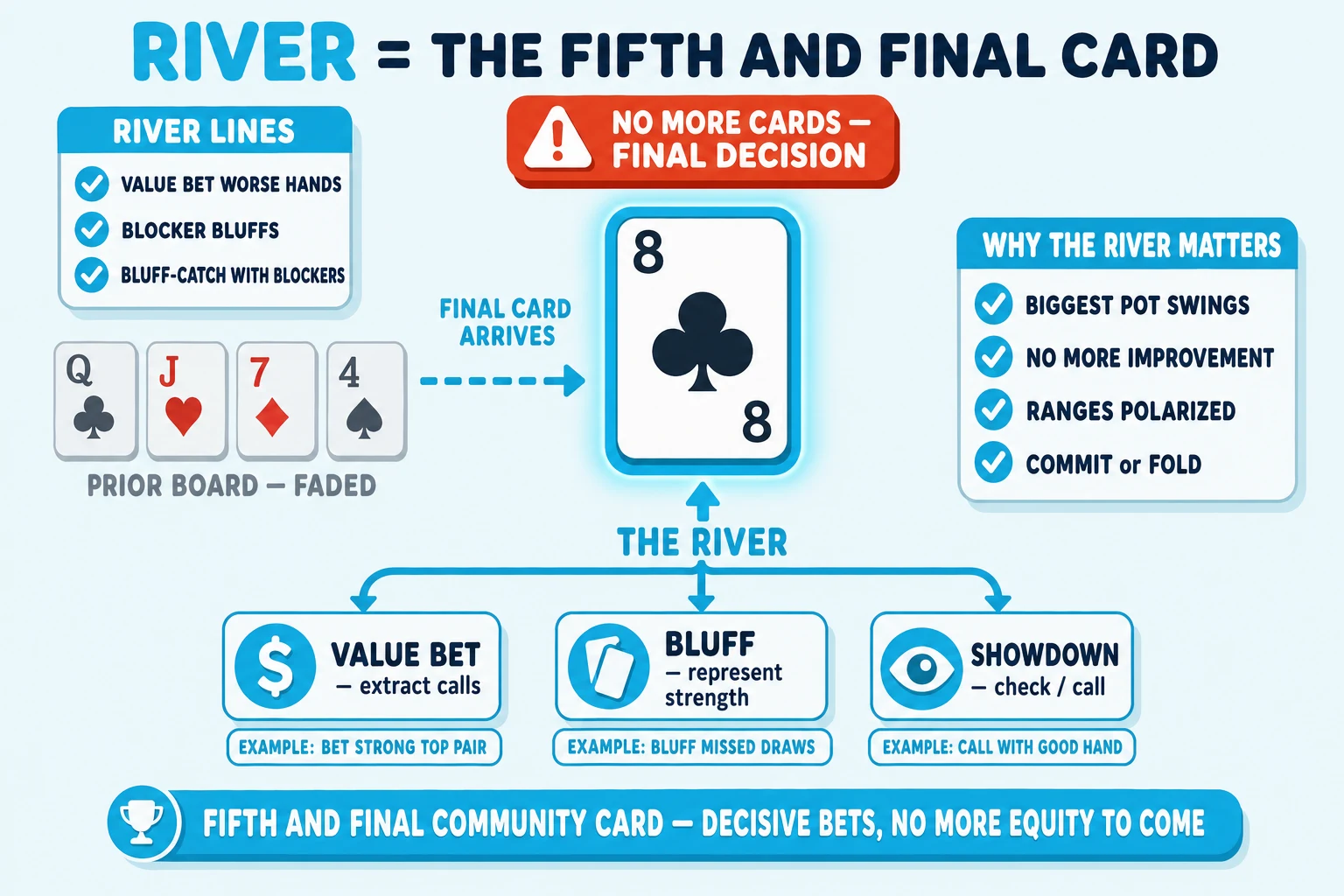
The river is the fifth and final community card dealt face-up in Hold'em. It triggers the last betting round before showdown, when remaining players reveal hands. No more cards will come, so the river finalizes hand strengths for that hand. River decisions often produce the largest chip swings, because the hand can't improve further. A single river bet or fold can decide a big pot on its own. Treat the river as the moment to harvest value or credibly fold marginal holdings.

Practice this in Poker Skill. The Counterfeits on the Board lesson has you rebuild your best five when the river pairs the board and your lower pair no longer plays.
Get the free appThe river can weaken a hand as well as improve it. When the 5♣ pairs the 5♥ on A♠ J♦ 2♦, the river counterfeits A♣ 2♥: the board’s fives replace its deuces, so the best five becomes aces and fives with a jack, and any ace with a king or queen beside it now wins.
The River - Final Decisions in No-Limit Texas Hold’em
What the river is and why it matters
The river is the fifth and final community card dealt face-up in Hold’em. It triggers the last betting round before showdown, when remaining players reveal hands. No more cards will come, so the river finalizes hand strengths for that hand. River decisions often produce the largest chip swings, because the hand can’t improve further. A single river bet or fold can decide a big pot on its own. Treat the river as the moment to harvest value or credibly fold marginal holdings.
Evaluating hands and ranges on the river
By the river, player ranges are much narrower and often polarized by previous action. Polarized means ranges skew toward very strong hands or bluffs, with fewer medium-strength hands. Consider how betting on the flop and turn shaped those ranges; a check-caller differs from a turn raiser. Medium-strength hands-like second pair or weak top pair-tend to perform poorly in large pots. They are rarely best at showdown against polarized ranges by the river. Strong hands become more valuable for value betting and at showdown on the river. Blockers-cards in your hand that make opponents’ strongest combos less likely-also gain value for bluff defense. Read the story the hand has told: who showed aggression, who trapped, and whether the river completes obvious draws. Use that story to place your opponent on a narrow range before deciding.
Value betting and thin value on the river
Every river bet contributes to your long-term win rate, so consistent value betting is essential. Value betting means wagering with a hand you expect to be ahead of part of opponents’ calling range. Thin value bets are wagers with hands only slightly ahead of that calling range. They can feel uncomfortable, but they produce profits over many hands. Steps to value bet effectively:
- Compare your hand to the opponent’s expected range after all previous actions.
- Decide whether opponents will call with worse hands often enough to make a bet profitable.
- Size the bet for the worse hands that will call it.
Bluffing and using blockers on the river
River bluffs carry high risk but yield large rewards when executed correctly. A good river bluff fits the hand’s story and uses blockers to reduce opponents’ strongest combos. Prefer bluffs that:
- Block the nuts or opponent’s most likely value hands; for example, holding an ace reduces combos of ace-high two-pair.
- Tell a believable story from earlier betting, for example representing a draw that completed on the river. Avoid river bluffs when previous action or board texture makes your story implausible, because failure in large pots costs heavily.
Position, lead bets, and out-of-position tactics
Acting in position (IP - acting after your opponent) simplifies river play and gives clear advantages. In position, you can check behind with thin value or size a bet to extract maximum calls. Out of position (OOP - acting before your opponent) forces tougher choices and more precise sizing. Use selective leads, check-raises, or traps based on how ranges match the board. Occasionally a donk bet-a lead into the preflop aggressor-works after a drastic river change. These spots are rare and must align with the hand’s narrative to succeed.
Psychological and tournament implications on the river
River decisions create strong psychological pressure, and many players are conditioned to call. This tendency makes thin value bets profitable but also tempts over-bluffing and mistakes. The ability to tolerate discomfort-folding marginal hands or making thin value bets despite fear-separates winners. In tournaments, river outcomes have amplified effects on stacks, survival, and tournament equity. A single river loss can drastically alter stack sizes, tournament equity, and future strategy. Factor pot commitment, survival, and position in tournament decisions on the river.
Quick checklist
- Does the river complete plausible opponent draws or further polarize their ranges?
- Is your hand strong enough for value, a useful blocker for bluffing, or too weak to continue?
- Consider position, opponent tendencies, pot commitment, and tournament implications before betting, calling, or folding.