


Thin Value
A river value bet where your hand only barely beats the opponent's calling range. Sized small (often 20-40% pot) to invite calls from weaker showdown hands.

Practice this in Poker Skill. The Value Betting lesson has a thin spot to check back: top pair of queens with a ten kicker on a board of paired eights, where better queens and eights call while worse hands fold.
Get the free appThin Value
What thin value is and why it matters
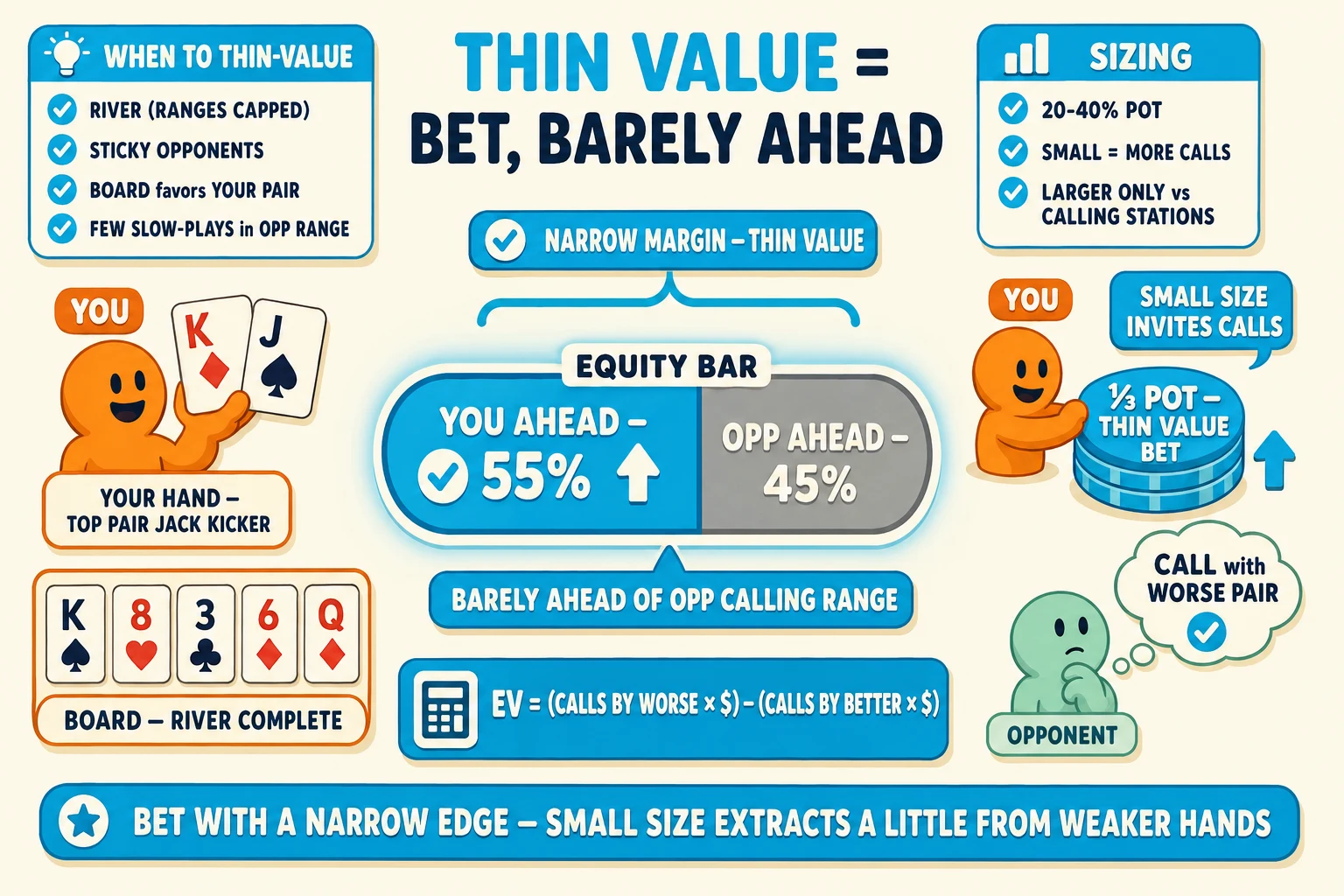
Thin value is a value bet made when your hand sits only slightly ahead of your opponent’s likely calling range. A value bet expects calls from worse hands; thin value means that edge is small but positive.
Thin value matters in No-Limit poker because flexible sizing lets you extract chips from marginal callers. Small edges compound over many hands and separate winners from breakeven players. Think of it as winning an extra small pot on the river that a large bet would have folded out.
Best spots to thin-value (timing and board textures)
You usually apply thin value on the river, the last betting round when ranges are often capped and showdown looms. With no more betting rounds, opponents tend to call with medium-strength hands instead of folding to bluffs.
Choose boards where your hand beats many plausible showdown holdings but loses to relatively few. Example: you hold K♦ J♠ on K♠ 8♥ 3♣ 6♦ Q♦. Your pair of kings beats missed gutters, weaker pairs, and ace-highs, but loses to two-pair, sets, and some Qx hands. If the opponent’s betting line indicates they call rivers with one-pair or showdown high cards, this is a thin-value spot.
Thin value works best versus sticky opponents who call rivers fearing bluffs or who call predictably. It’s less profitable versus very tight or straightforward players.
How to size thin value bets
Pick sizes that invite calls from worse hands without pricing them out. Small “bargain” bets usually work best.
- Target a fraction that keeps worse hands profitable to call, often 20-40% of the pot. For example, in a $100 pot a $25-$35 bet gives medium-strength hands correct pot odds, while $60 often only gets called by better hands.
- Consider stack depth; short stacks reduce viable thin-value sizes because small bets become a larger portion of the effective stack and can force folds.
- Adjust for opponent tendencies: size slightly larger versus calling stations (players who call frequently); size minimal or check versus nits (very tight players).
Reading opponents and ranges for thin value decisions
Before thin valuing, confirm the opponent’s range contains enough worse hands.
- Estimate their range from the betting line. For example, a check on the turn, calling small bets, then checking the river often indicates a capped range with one-pair or missed draws.
- Watch their habits: do they call rivers with medium pairs or fear bluffs? If so, thin value gains positive expected value.
- Ask the EV question: will (calls from worse hands × bet size) exceed (calls from better hands × your loss)? If not, fold.
Risks, table image, and long-term effects
If only better hands will call, thin value loses; accurate reads are critical. Losing thin-value bets occasionally can pay off later: opponents who see you extract small bets may call your future value bets more often.
Balance your approach. Overusing thin value makes you exploitable; mix checks and larger-value lines with stronger hands so opponents cannot adjust profitably and start folding the hands you want to beat.
Quick checklist
- Is the opponent likely to call with worse hands on the river?
- Does the board and betting line leave your hand ahead of many plausible holdings?
- Is the chosen bet size small enough to induce calls but large enough to be meaningful?