


Line
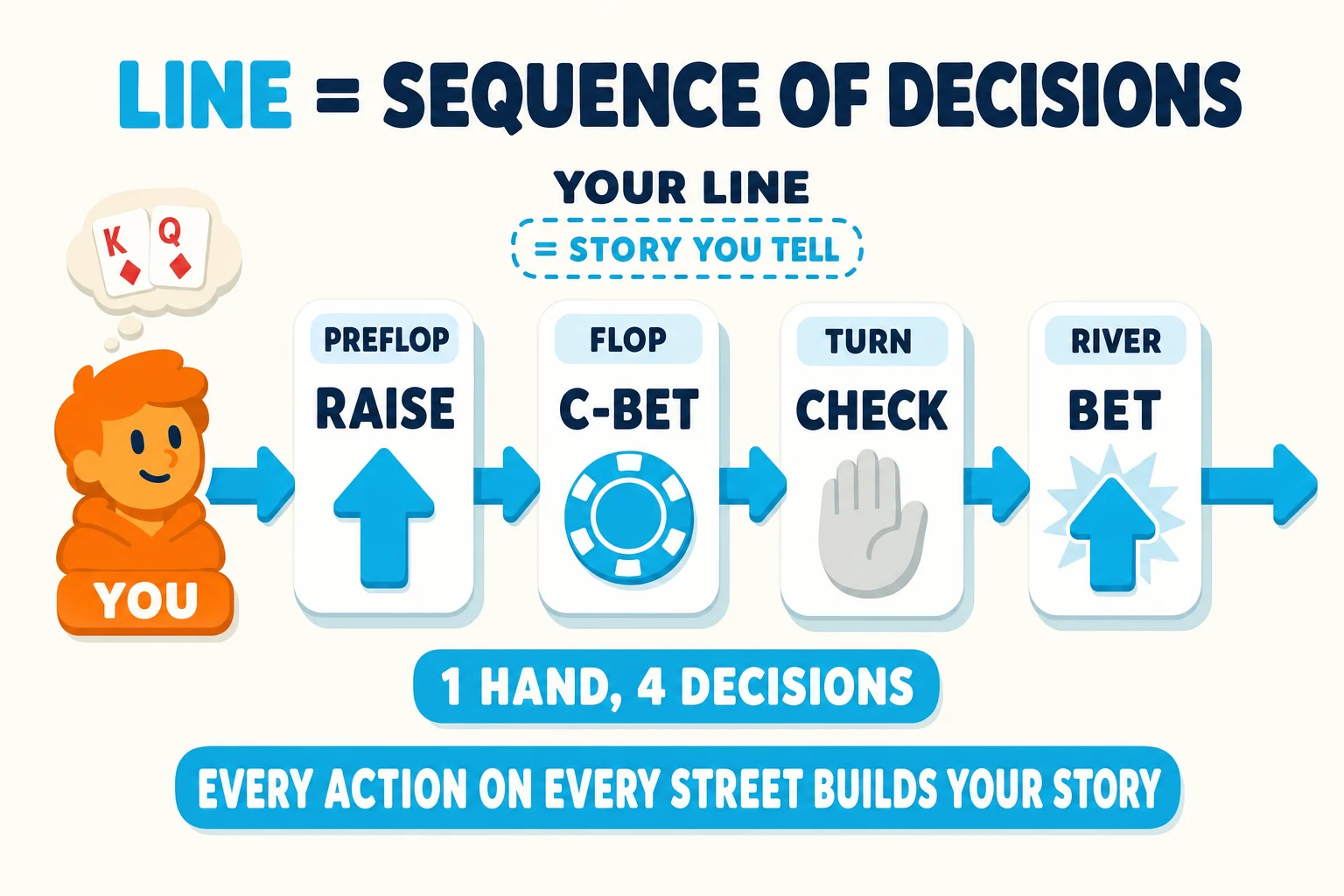
A "line" is the sequence of decisions you make in one hand across pre-flop, flop, turn, and river. It includes betting, checking, calling, raising, and folding actions on each street. Think of it as the story you tell the table with chips and actions.
Practice this in Poker Skill. The turn lessons make you commit to a line on the flop: you list the turn cards that help you and the ones that help the caller, then bet or check when one lands.
Get the free appHow to Think About Your “Line” in No-Limit Texas Hold’em
What a “Line” Is
A “line” is the sequence of decisions you make in one hand across pre-flop, flop, turn, and river. It includes betting, checking, calling, raising, and folding actions on each street. Think of it as the story you tell the table with chips and actions.
Because each street offers new information, a single hand can contain many possible lines. For example, with A♠K♠ you might raise pre-flop, then c-bet a dry flop. A c-bet is a flop bet made after you raised pre-flop to continue your story. You might check a scary turn, or barrel - bet multiple streets - if the turn helps your range. The choices you make early define what lines remain sensible later in the hand.
Common Lines and Simple Examples
- Raise pre-flop -> c-bet flop -> check turn -> bet or check river (mixed value/bluff line). Example: You raise from the cutoff with K♦Q♦ to steal the blinds and build the pot. Flop A♣7♦2♠ is dry, and you c-bet to represent having an ace and win the pot. When the turn brings 9♣, you check to control the pot size. On the river J♦ you must choose to bet for value or to check, based on reads.
- Limp/call pre-flop -> check-call flop -> lead turn (passive-to-aggressive or pot-control line). Limp means calling the big blind pre-flop rather than opening with a raise. You limp with 7♠7♦ in early position and face a raise; you call. On flop 8♣4♠2♥ you check-call to keep the pot manageable while denying draws free cards. The turn brings 7♣ for a set; you lead out to extract value after passivity.
- Small early bets to induce calls -> size up later for value or shove (no-limit leverage). With J♥J♠ you bet small on 9♥6♦3♣ to induce calls from worse hands. If the turn pairs the board or brings a scary card and opponents check, you can size up or shove on the river to maximize equity when ahead.
Why Your Line Matters Strategically
Lines communicate hand strength to opponents, shaping their decisions on later streets. An aggressive, consistent line (raise/c-bet/raise) represents a strong range and can induce folds from medium hands. A passive line like check-call can hide real strength and set up traps for opponents.
Choosing correct lines extracts value when ahead and limits losses when behind. Pot-control lines keep pots manageable with marginal hands, avoiding costly confrontations. Aggressive lines can bluff opponents off better hands and win without showdown.
In no-limit poker, flexible bet sizing magnifies a line’s power and leverage. A single shove can apply pressure or buy the pot, so timing escalation matters immensely.
How to Choose and Adjust a Line
- Position and stack sizes: Late position and deep stacks allow wider aggressive lines like 3-bets and multi-street bluffs. With short stacks, prefer simpler lines such as push-or-fold to avoid complex postflop decisions.
- Opponent tendencies: Against tight players, increase bluff frequency; against calling stations - players who call too often - prioritize value.
- Board texture and hand equity: Coordinated, or wet, boards contain many draws and often favor control or protection lines. Dry boards with few draws favor straightforward aggression and simple c-bets.
If an opponent makes a big flop raise, abandon a planned multi-street bluff or polarize and shove strong hands.
Practical Tips to Execute Better Lines
- Plan a coherent line from the start, deciding whether you represent strength or pure value.
- Be ready to deviate when opponents provide new information through raises or unusual calls.
- Use consistent bet sizing and timing to make your lines credible and harder to read.
- Review hands with alternative lines, asking how earlier bets or checks would change later decisions.
Quick checklist
- Identify your current line before you act on each new street to avoid mistakes.
- Consider position, stack depth, opponent tendencies, and board texture together before choosing a line.
- Choose coherent lines that match the story you want to tell the table consistently.
- Practice a few standard lines and study opponents’ typical responses to each.
- Review past hands to identify moments when an alternate line would have earned more.