


C-Bet
A flop bet by the player who raised pre-flop. It carries the preflop story onto the flop and forces folds from hands that missed, even when your own hand didn't improve.
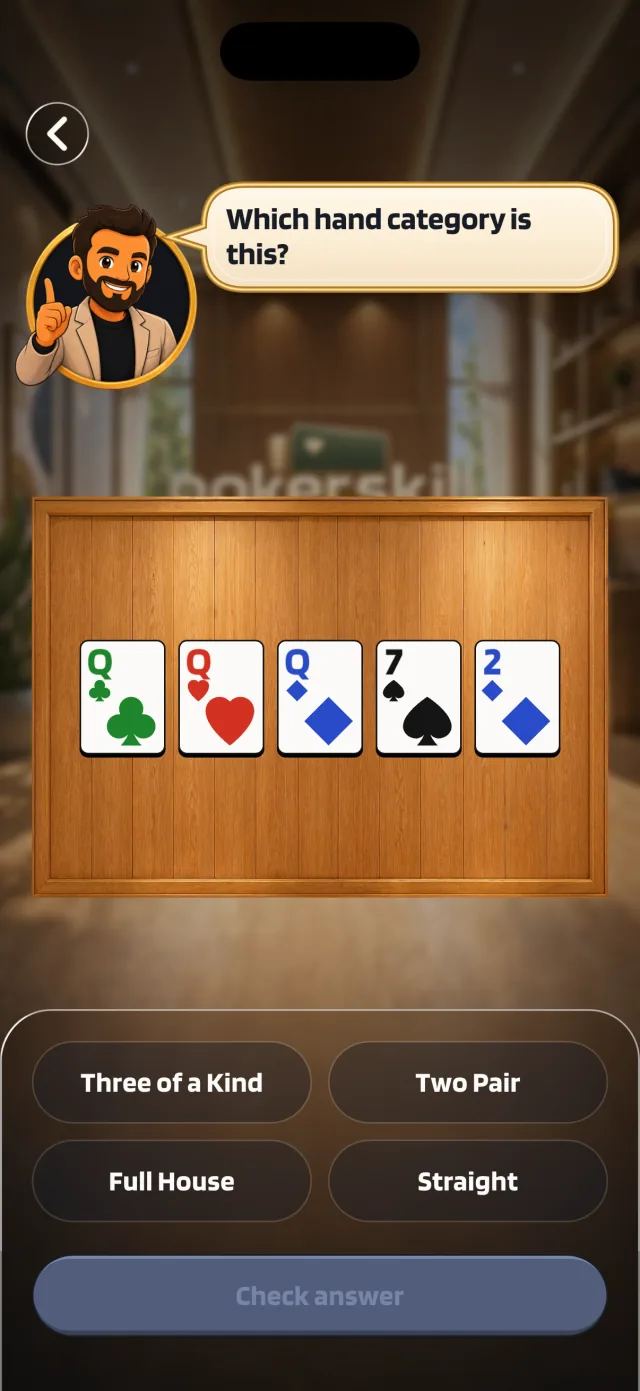
Practice this in Poker Skill. In one of its c-bet lessons you check J♣ T♣ on A♦ 8♦ A♥ as the preflop raiser, since a called bet on that board leaves no clear plan for the turn.
Get the free appC-Bet (Continuation Bet)
What a C-Bet Is and Why You Use It
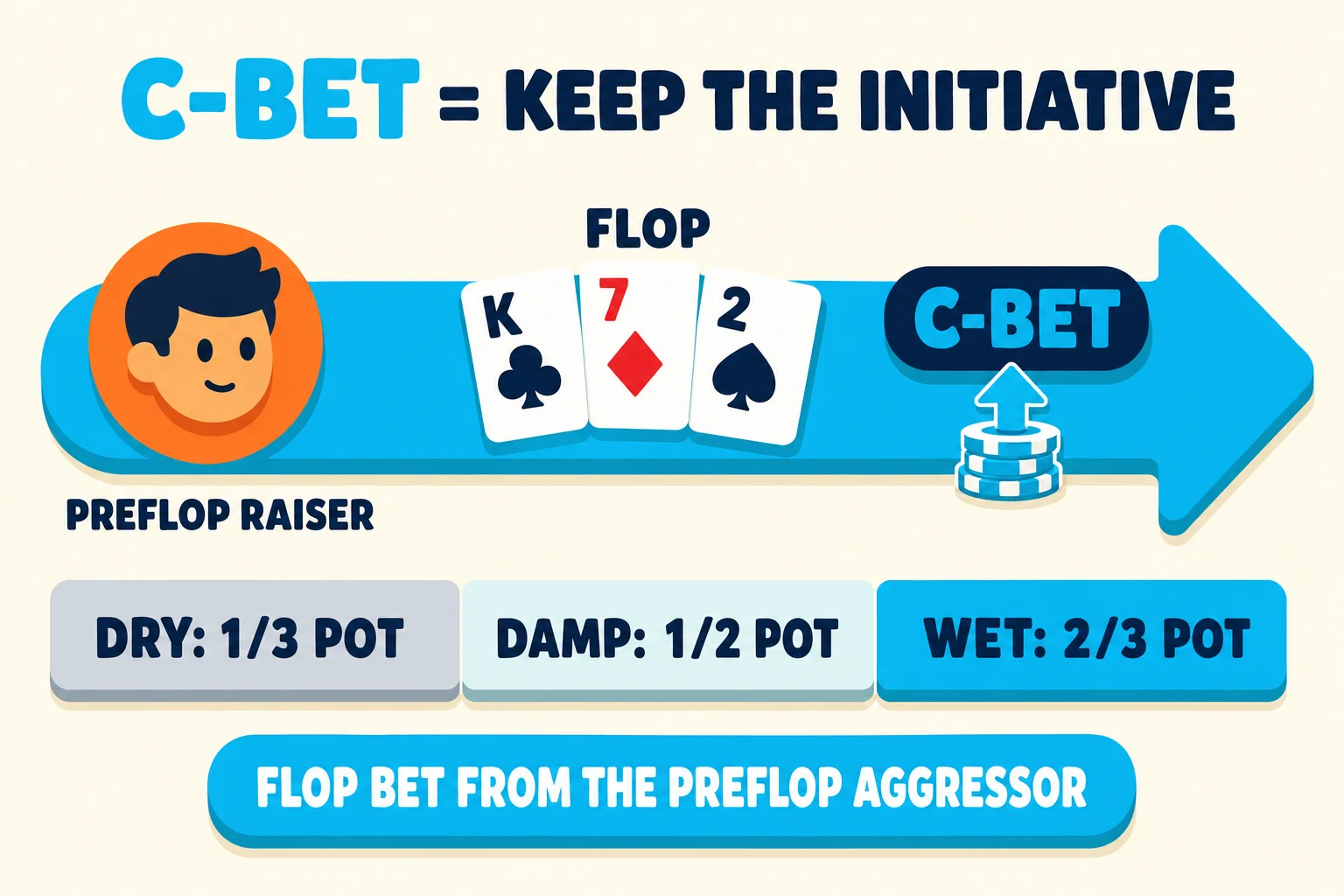
A C-Bet, short for continuation bet, is a flop bet by the player who raised pre-flop. It carries the preflop story onto the flop and pressures opponents to fold hands that missed. Even when your own hand didn’t improve, a c-bet can take the pot before another card is dealt. Your preflop raise already advertised a stronger range than the caller’s, and the c-bet leans on that perceived range.
Example: You raise from late position with K♠Q♠, get one caller, and see K♦7♣2♠ on the flop. A C-Bet represents a king and often takes the pot, even without top pair every time.
For the board-by-board strategy split, read when to c-bet the flop.
Key Factors to Decide Whether to C-Bet
When choosing to C-Bet, weigh three main factors:
- Opponent tendencies. Versus frequent callers or “sticky” players who rarely fold, C-bets lose value. Versus tight or exploitable players who fold to aggression, C-bets gain value. Example: Versus a loose caller who defends wide pre-flop, bluff C-bets on many flops will be called. Versus a tight player, the same bluff often wins the pot.
- Board texture. Dry flops (low, unconnected cards or a lone high card) favor C-bets because they rarely improve calling ranges. Wet or coordinated boards (connected cards or many flush/straight draws) require caution because more hands can continue. Example: A♣8♦3♠ is a dry flop. J♠10♠9♣ is wet and hits many ranges.
- Range interaction. Consider how the flop connects with your perceived raising range versus the caller’s likely holdings. C-bet more when the flop favors your range. Check or use selective bets when it favors the caller.
How to Size Your C-Bet
Match your size to the board’s draw density. The cheat sheet:
| Board texture | Example flop | C-bet frequency | Default size |
|---|---|---|---|
| Dry, high card | K♦7♣2♠ | High, most of range | 1/3 pot |
| Dry, paired | J♥J♦5♠ | High | 1/3 pot |
| Damp, some draws | J♠8♦6♥ | Medium | 1/2 pot |
| Wet, two-tone and connected | 9♥8♥4♣ | Lower, polarized | 2/3 pot |
| Caller-favoring, low connected | 7♣6♣5♦ | Lowest | Often check |
- On dry boards, small bets deny only a little equity but win the pot often; betting bigger risks more to fold out the same hands.
- On wet or coordinated boards, size up to charge the many draws that want to continue.
- Always factor in stack depth and opponent willingness to continue; deeper stacks or stubborn callers may need sizing adjustments.
Stack Depth Changes the Plan
Stack-to-pot ratio (SPR) decides what a c-bet is building toward. At a low SPR (around 2 to 3, common in 3-bet pots), a normal c-bet sets up a simple bet, bet, shove line, so committing hands can just bet. At a deep SPR, a flop c-bet on its own never gets stacks in, so plan the turn and river before firing: getting check-raised deep costs far more than it does shallow. Same bet, different futures.
Example: If the flop offers many draws, raise your bet to make draws pay more to see the turn. On a single-card, unconnected flop, a modest bet preserves chips while still threatening the pot.
Using C-Bets for Bluffs and Value
Balance bluff and value lines.
- Bluff when the board disfavors most of the caller’s range. Prefer hands with blockers (cards in your hand that reduce opponents’ strong combinations) or with backdoor potential (possible draws on later streets). Example: Holding A♣5♣ on K♦7♣2♠, your ace blocks many strong ace-containing hands, and backdoor clubs let you barrel turns.
- Value-bet when the flop improves your hand and your range advantage means opponents will call with worse. Example: You hit middle pair on a dry board against an opponent whose calling range is wide; bet for value.
Mix bluffs and value to avoid predictability and exploit opponents who fold too often.
Planning Multi-Street C-Bet Strategies
Before betting the flop, plan turn and river actions.
- Use double or triple-barrel sequences when the runout and opponent tendencies support continued pressure. Plan how later cards change range interactions.
- Reassess every street: note opponent reactions, pot size, and how turn or river cards alter equities.
- Be ready to give up when the opponent shows strong resistance or when later cards complete obvious draws.
Example: You C-Bet a dry flop and face a raise on the turn after a scary card. Often you should release a bluff unless you hold strong equity or meaningful blockers.
Checking the flop is not automatically giving up either: a check can hand the opponent room to bluff at a pot you are still able to win. Deal yourself enough flops in a poker training app and you find out how many of your c-bets the board never actually asked for.
Quick checklist
- Maintain initiative but avoid automatic C-bets; evaluate opponent and board each time.
- Match your sizing to board texture and opponent tendencies.
- Use blockers and backdoor equity when selecting C-bet bluffs.
- Plan multi-street lines before betting the flop, and be ready to adjust.