


Barrel
Successive bets across streets to apply pressure: flop bet, turn barrel, sometimes river. Each street raises the price for marginal hands to keep paying.
Practice this in Poker Skill. The Hold the Plan lesson tests when to fire the turn barrel: K♦ 10♣ on 7♦ K♣ 5♠ keeps betting when the J♥ changes nothing, while 9♦ 7♦ on 3♥ 9♣ 6♥ stops when a king brings the third heart.
Get the free appBarrel (No-Limit Texas Hold’em)
What a barrel is - definition and basic purpose A barrel is successive betting across streets-typically flop, turn, then river-to apply pressure and induce folds. It often begins with a continuation bet (a bet by the preflop raiser), continues with a second barrel on the turn, and can finish with a triple barrel on the river. Each bet represents strength, builds the pot when you have it, and forces opponents with marginal hands to fold or pay to see more cards.
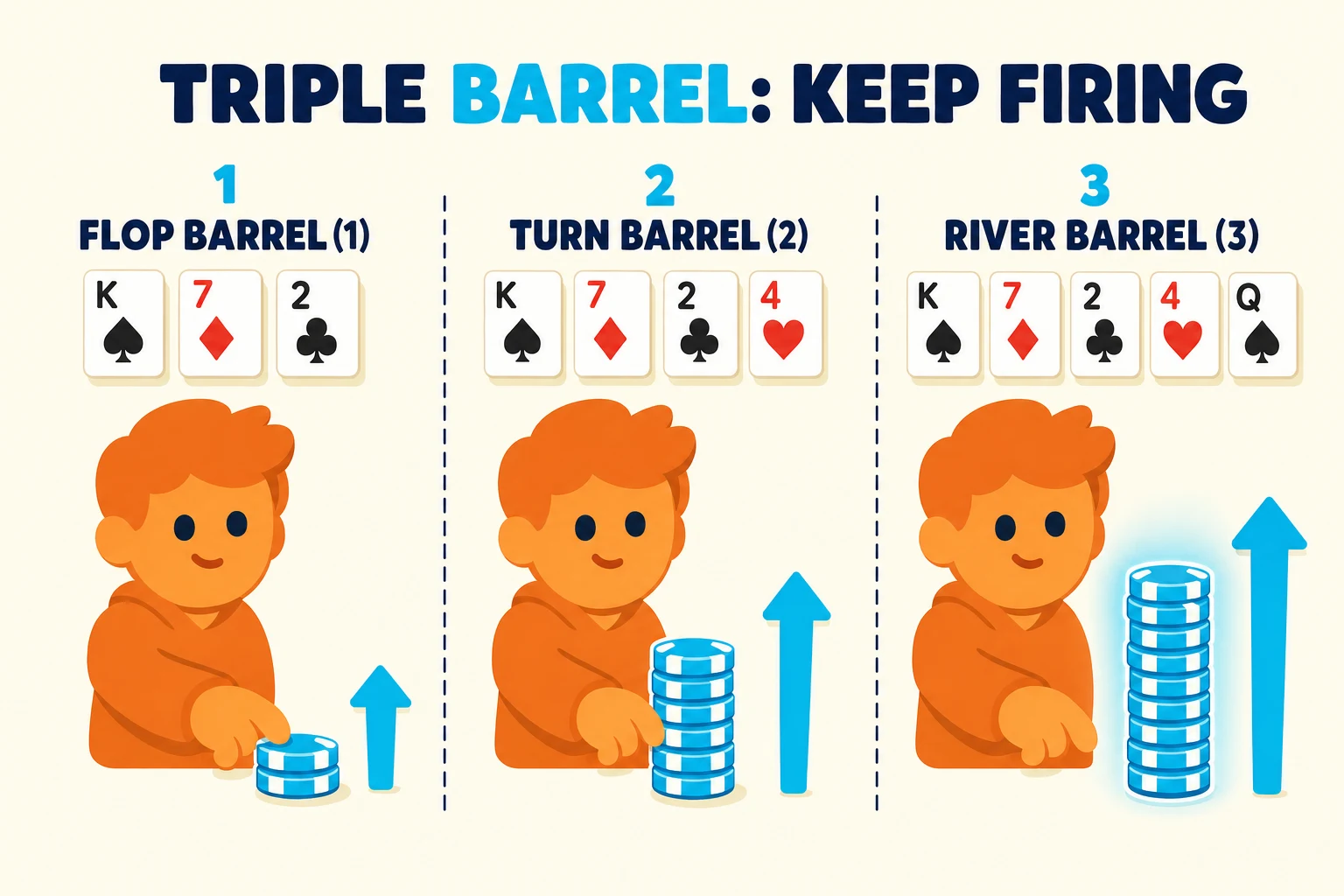
When to barrel - common spots and timing Start with a flop continuation bet, then decide whether to fire a second barrel on the turn and a third on the river. Good spots include:
- Dynamic or draw-heavy boards where opponents hold many weak made hands and you have outs (cards that improve your hand). You can c-bet as a semi-bluff (a bet with a draw) and barrel later if the turn is safe.
- Boards that change in favor of your perceived range. Example: you c-bet a king-high flop after raising preflop; a blank turn often lets you represent two pair or trips on a turn barrel. Barrel more when opponents show post-flop weakness (checks, quick calls) and less against calling stations (players who call too often).
Why No-Limit enhances barrels - structural advantages No-Limit lets you size bets freely, maximizing fold equity and pressure. You can bet nearly any amount-up to an all-in-to force tough decisions. That flexibility lets you:
- Force opponents to risk large portions of their stacks and make painful calls.
- Build big pots when you hold the best hand and extract maximum value.
- Mix bluffs, semi-bluffs, and value bets to stay unpredictable and deny reads. Because you can vary bet sizes and threaten all the chips, well-timed barrels are more powerful than in fixed-limit games.
How to barrel effectively - tactics and sizing
- Have a plan from the flop. Decide whether your flop c-bet protects, extracts value, or functions as a bluff with backdoor draws; let that plan guide your turn decisions.
- Reassess on the turn. Consider board texture, pot commitment, and opponent tendencies. If the turn completes many draws, reduce bluff frequency; if it’s a blank, a second barrel often folds out one-pair hands.
- Size to create decisions without overcommitting. Bet large enough to make calling unattractive for hands you want to fold. Avoid overbetting so you don’t become pot-committed when behind. Use barrels as semi-bluffs on draw-heavy boards-you either win the pot immediately or realize equity if called. Keep your betting line coherent; observant opponents will exploit inconsistent sizing.
Practical considerations - opponents, board texture, and formats Barrel success depends on reads, stack depths, and how community cards develop. Tight players fold more often, making them better bluff targets, while loose callers require stronger value hands to continue. Coordinated boards favor made hands and reduce bluff opportunities; disconnected boards often allow more bluffing. Both tournaments and cash games rely on barreling, but stack depth and tournament ICM (payout structure) influence how often you should risk large portions of your stack.
Quick checklist
- Start with a clear flop plan (bet or check).
- Reassess on the turn: board texture, opponent tendency, and pot commitment.
- Size barrels to pressure without overcommitting; consider semi-bluffing when drawing.