


Bad Beat
A bad beat is when a hand that was a clear favorite at the moment the chips went in loses because of a card or runout that came after. The losing line was correct; the runout just sat where it sat. A bad beat is not a cooler: in a cooler the loser was already behind.
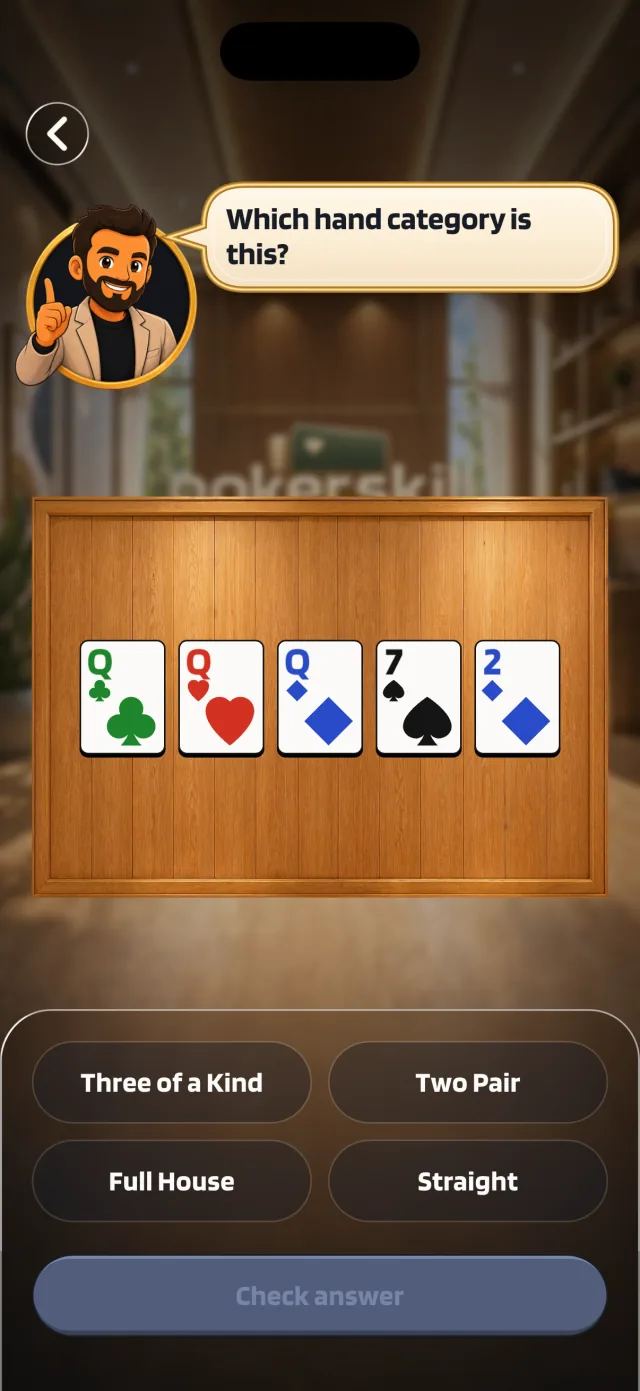
Practice this in Poker Skill. On the turn, the Counterfeits on the Board lesson shows A-8 losing after it was ahead, when a second king leaves both players with aces and kings and the other hand’s queen kicker beats the eight.
Get the free appBad beat: when a strong favorite loses to a later card
What a bad beat is
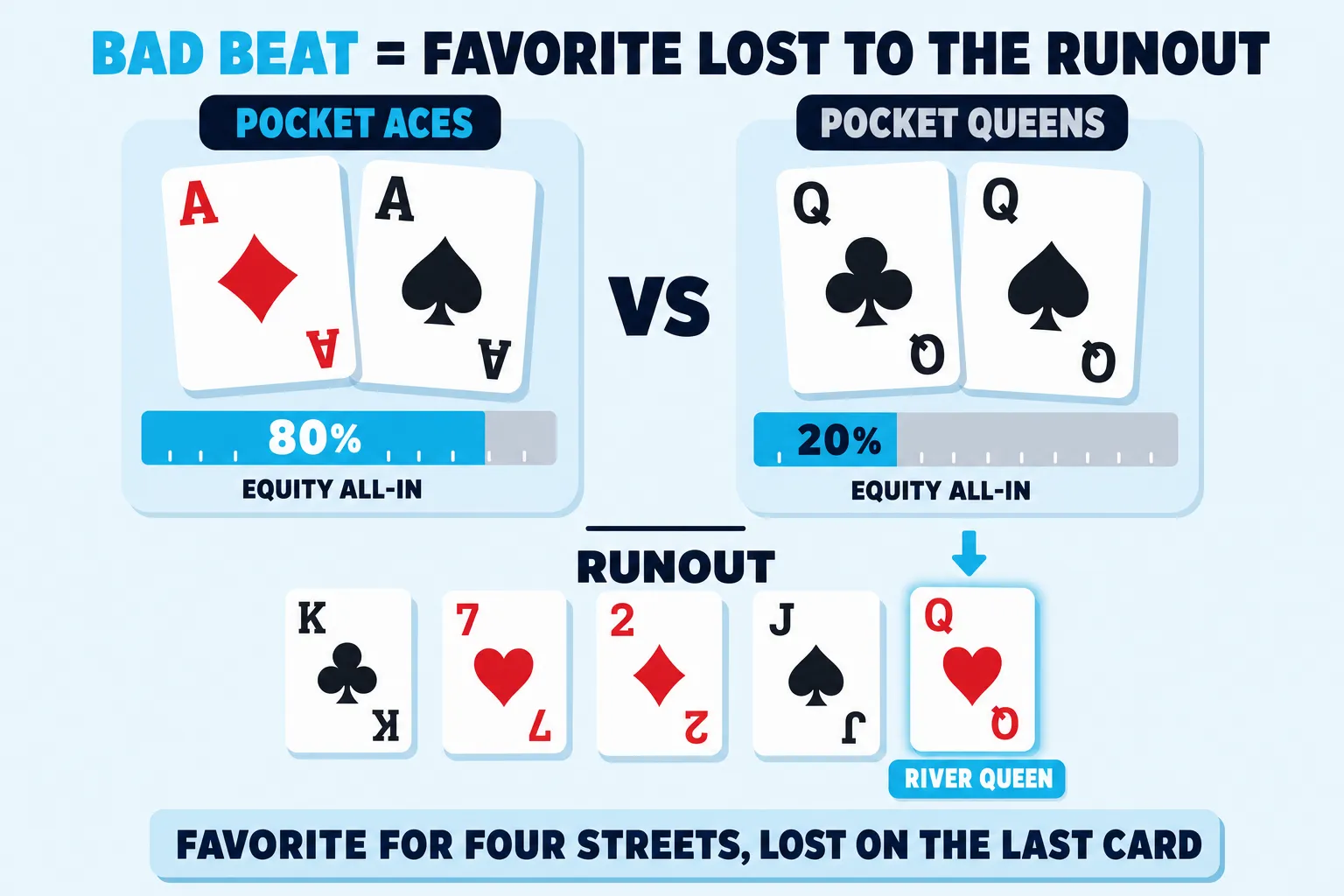
A bad beat is a hand where a clear favorite gets the chips in good and then loses because of a card or runout that arrived after the money was committed. The losing decisions were correct given what each player knew; the favorite just did not hold. The textbook version is pocket aces all-in preflop against pocket queens at 100 big blinds. AA was about an 80% favorite, QQ caught a queen on a later street, and a hand the favorite was supposed to win five times out of six went the other way.
Related terms
A useful way to keep the term honest:
- Bad beat = you were ahead when the chips went in, and a later card overtook you.
- Cooler = you were already behind when the chips went in, and a fold was never available.
- Suckout = the underdog catches the card they needed. From the loser’s seat, the suckout is often the event inside the bad beat.
- Overplay = you only thought you were ahead. The opponent’s range had you beat the whole time. This is not a bad beat, even though it ends with you losing chips.
The face-up test draws the line: if both hands turned over before the runout, was I the favorite? If yes, the loss was a bad beat. If no, it was a cooler when a fold was never available, or an overplay wearing bad-beat clothing when one was.
Bad beat vs cooler vs suckout vs runner-runner
The same losing pot can wear four different labels. Naming the right one is how a hand goes from “I ran bad” to “I learned something.”
| Frame | Were you the favorite when chips went in? | Was a fold available? | Where the equity moved |
|---|---|---|---|
| Bad beat | Yes, usually a heavy favorite | No, the call or shove was correct | A late card flipped a hand the favorite was supposed to win |
| Cooler | No, you were already behind | No, but the loss was unavoidable | Equity was already with the winner before the runout started |
| Suckout | The underdog hits | Sometimes, depends on the bet that was called | The underdog caught a card their range needed |
| Runner-runner | Yes, heavy favorite at the time | No, the call was correct | The underdog needed both turn AND river, and got both |
A bad beat is rare and unavoidable. A cooler is rare and unavoidable. A suckout is the underdog’s side of the same coin. Every bad beat the favorite takes is a suckout for the player on the other side. A runner-runner is the most painful kind of bad beat: it took two cards in a row to do the damage.
An overplay is none of the above. It is common and fixable, and most “bad beat” stories at home games belong in the overplay column once a careful review walks the hand back.
When a hand really is a bad beat
These are the matchups poker books point at as canonical. Each one is rare on its own; the long sample explains why a serious player still meets them.
- Pocket aces cracked by a one-card spike. AA against an underpair is roughly an 80% favorite. The two-outer hits 4-5% of the time on any single street. With both turn and river to come, the underpair has roughly an 8% chance to spike a set. AA loses the hand it was supposed to win four times in five.
- Top set cracked by a runner-runner straight or flush. The set holder is a heavy favorite on the flop. A backdoor draw the underdog turned into a real draw on the turn and then completed on the river is the classic two-card bad beat. The flop favorite was over 90%; the runout still found a path.
- Two-pair cracked on the river by a higher two-pair when the board pairs. Both players make two pair when the river pairs the board, and the higher kicker plays. The losing hand was ahead through the turn; the river pair flipped it.
- A flopped favorite with a draw against it that runner-runners. Top pair top kicker on a dry flop has 80% or more against a single-overcard hand. When both unlikely cards arrive in sequence and complete a backdoor straight or flush, the favorite gets run down.
- Pocket aces against a multi-way field. AA against three random hands wins about 64% of the time, not 85%. Multiway pots make every all-in look more like a bad beat after the fact, because the favorite’s edge was thinner than head-up math suggests.
A non-example for contrast: an overpair like JJ stacking off on a low connected board to a check-raise. The check-raising range is heavy with sets, two pair, and combo draws that have JJ crushed or close. The overpair was rarely the favorite when chips went in. Calling that loss a bad beat is the most common version of mislabeling.
Example: pocket aces lose to a turned-and-rivered set
The shape of a real bad beat, walked at 6-max NLHE cash, 100bb effective.
Setup: You open A♦A♠ to 2.5bb from the button. The big blind 3-bets to 11bb. You 4-bet to 25bb. They 5-bet jam for 100bb. You call. Cards on their backs: your A♦A♠ vs their Q♣Q♠.
The math at the all-in:
- AA vs QQ runs about 80% / 20% with five cards to come.
- The pot at the moment of call is ~125bb (your 25 + their 100 + dead small blind). You’re putting in another 75bb to win 125bb. Break-even equity = 75 / (75 + 125) = 37.5%.
- EV(call) ≈ (0.80 × 125bb) − (0.20 × 75bb) ≈ 100 − 15 ≈ +85bb vs folding. The call is a clear chip-EV win.
The runout:
- Flop K♣ 7♥ 2♦. No queen, no draw. Your AA now has roughly 92% equity with two cards to come. QQ has only the two remaining queens as outs, and the 7♥ kept the board dry.
- Turn J♠. Still no queen. Your equity climbs to about 95.5%. QQ has 2 outs out of 44 unseen cards on the river, about a 4.5% chance to hit.
- River Q♥. QQ spikes a set on the last card. The hand you were over 95% to win on the turn, you lose.
Why this counts as a bad beat: the chips went in with you holding more than 80% equity. Every street after the all-in increased your edge until the river card arrived. The losing line was correct against the jam range. The runout did the damage on its own.
What changes the label: if your hand had been A♦K♥ instead of AA, the same Q♥ river is not a bad beat. AKo against QQ all-in is a 43% underdog at the start, and losing the hand was the 57% case the math told you to expect. Same painful river card, different label, because the equity at the all-in was different.
The losing line is reasonable. The cards just sat where they sat.
Common mistakes when labeling a hand a bad beat
1) Calling every cooler a bad beat
A cooler is two strong hands meeting and the loser already drawing thin. KK losing to AA preflop is the textbook cooler, not a bad beat. KK had ~18% equity the whole time. The runout did not change anything; the matchup was bad before the chips moved. Mixing the two terms flattens two very different lessons into one shrug. The fix for a real bad beat is acceptance and bankroll math; the fix for a cooler is the same. The fix for the cases that wear bad-beat clothing but are actually overplays is a different fold next time.
2) Counting an overplay as a bad beat
Take the overpair on a coordinated low board, called down through three big bets and shown two pair plus the gutshot. That loss is not a bad beat, even if a card the player did not want came on the river. The opponent’s range had the overpair beaten or close on the flop. The face-up test catches this: if you would not make the same call against the same range with both hands face up, the label was wrong. Most home-game bad-beat stories live here.
3) Letting the bad beat justify the next ten hands
After a real bad beat, the next ten hands are where the actual damage happens. The instinct is to win the chips back; the bad-beat label becomes a permission slip for looser calls and bigger bluffs. Strategy books are loud on this one. The recommendation across the poker corpus is the same: control the emotional reaction, refocus on the current hand, and consider walking away if the tilt is real. A bad beat costs you one pot. Tilt costs you the rest of the session. In a live room, taking the beat quietly is also the custom; the guide to poker etiquette covers what regulars expect at showdown and after it.
4) Ignoring effective stack
A bad beat at 100bb is a bad beat. The same sequence at 250bb is sometimes something else, because deeper money makes the looser call on the underdog’s side more clearly a mistake. As stacks deepen, the underdog has more reason to fold, and the favorite’s “I had to call” framing earns more of its keep. Stack depth changes which losses honestly get the bad-beat label.
FAQ
Is a bad beat the same as a suckout?
Not exactly. A suckout is the underdog catching the card they needed; that catch is the event most bad beats are built on, but the two terms describe different sides of the same coin. From the favorite’s seat, the loss is a bad beat. From the underdog’s seat, the win is a suckout. Some suckouts are not bad beats; when a 35% underdog hits, the favorite was barely ahead and the math had been close all along. Real bad beats need a heavy favorite to start.
How rare are real bad beats?
Rarer than the noise around them suggests. AA all-in against QQ wins about four times in five, so the bad-beat case is one in five. AA against KK preflop wins about four times in five too. Across a full session of poker, the favorite holds far more often than they get cracked. Phil Gordon’s math from the Little Green Book is the cleanest version: a player who gets it in with AA against KK ten different times in a tournament has only about a 12% chance of winning all ten. The other 88% includes at least one bad beat. Bad beats feel rare in a single session and feel inevitable across a year.
Should a bad beat change how I play the next hand?
No. The previous hand has already paid out, and the next hand has its own decision. The whole point of putting chips in good is that the long run rewards the favorite. Real bad beats are almost free of moral content. The cards landed where they landed. The same is not true of the next hand if the player is rattled, which is why every poker book covers the tilt question alongside the bad-beat question. Treat the bad beat like a rake bill: a cost of doing business that does not change which decision is correct now.