


Overpair
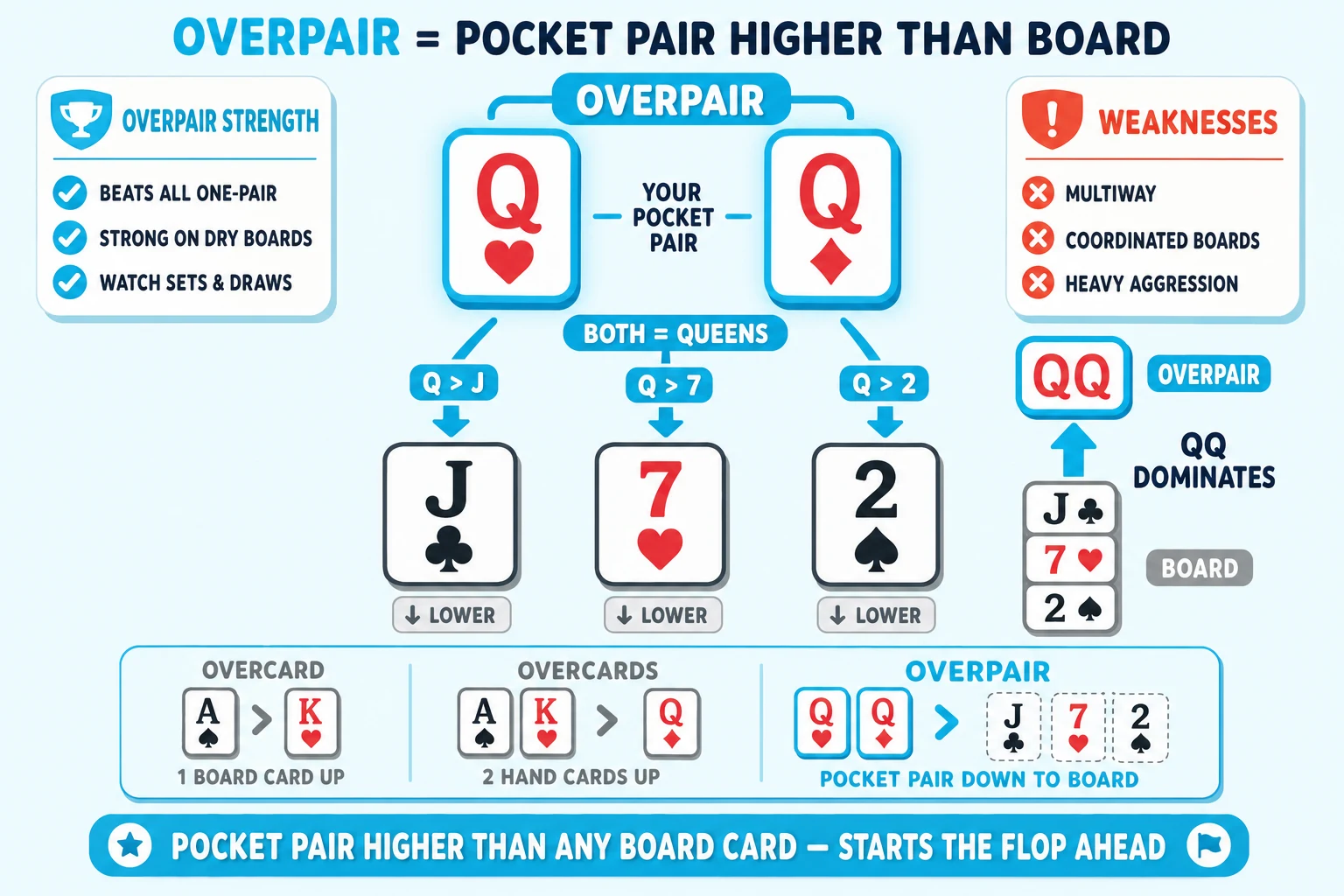
An overpair is a pocket pair higher than every card on the flop, the first three community cards. For example, Q♥Q♦ on a 7♣-6♣-2♦ flop is an overpair to the board. If the flop contains a king and you hold QQ, you no longer have an overpair. Common pre-flop holdings that often become overpairs include TT through AA, since they usually rank above most flop cards.
Practice this in Poker Skill. The Value Betting lesson bets the overpair for two reasons, with queens over a jack so overcards don’t draw cheap and kings over a two-club flop to charge the flush draws.
Get the free appOverpair: definition and how to play it
What is an overpair?
An overpair is a pocket pair higher than every card on the flop, the first three community cards. For example, Q♥Q♦ on a 7♣-6♣-2♦ flop is an overpair to the board. If the flop contains a king and you hold QQ, you no longer have an overpair. Common pre-flop holdings that often become overpairs include TT through AA, since they usually rank above most flop cards.
Why overpairs are strong and when they’re most valuable
Overpairs start the hand ahead of almost all one-pair hands and many drawing hands. They shine on dry, uncoordinated boards with low, disconnected cards and few straight or flush possibilities. For example, KK on a 9♦-4♠-2♣ flop faces very few hands that beat it, and almost no straight or flush draws to worry about. Overpairs perform best in single-raised pots because fewer opponents reduce the chance someone flopped a set or two-pair. Conversely, overpairs lose value on connected or coordinated boards like 9♠-8♠-7♣, where straights, two-pairs, and multi-card draws are common.
Quick jargon: a set is when an opponent holds a pocket pair and pairs it with a flop card, producing three of a kind. Two-pair is when an opponent pairs a hole card with a board card and also pairs another board card.
Pre-flop and post-flop lines with overpairs
Use aggressive, value-oriented lines while protecting equity.
- Pre-flop: Raise with premium pairs (AA, KK, QQ, JJ, TT). Raising uses your equity and narrows the field, lowering the chance someone sees a cheap flop and hits a set.
- Post-flop on dry boards: Continue betting for value and protection. Betting charges drawing hands to see more cards and builds the pot when you are likely ahead.
- On suspect boards or against multiple opponents: Size bets to make draws costly but avoid committing your whole stack without confidence. If the board becomes dangerous later, be willing to reduce investment.
Example line: You raised pre-flop with JJ and one opponent called. Flop: 8♣-3♦-2♠. A continuation bet gains value and charges any backdoor draws.
When to be cautious or fold an overpair
Overpairs decline in value in multi-way pots because the chance someone flopped a set or two-pair rises. Heavy post-flop aggression - multiple raises or check-raise lines - on a coordinated board often signals you are behind, and folding can be correct even with a strong pair. Against a single tight opponent who suddenly applies pressure on a board that fits their range, be prepared to release the overpair rather than chase.
Balancing GTO principles with exploitative adjustments
GTO play recommends mixing actions - sometimes checking or calling with overpairs - in spots where the board interacts with opponent ranges. Mixing keeps your strategy balanced and harder to exploit. Against loose or inexperienced players who call too often, lean exploitatively into straightforward value-betting and larger sizes. Adjust your line based on opponent tendencies and table dynamics rather than following a rigid script.
Checklist:
- Confirm your pocket pair is higher than every board card before treating it as an overpair.
- Prefer aggressive sizing pre-flop and post-flop on dry boards and in single-raised pots.
- Tighten or fold in multi-way pots and against heavy, credible aggression.
- Mix lines for balance, but increase value bets against frequent callers.