


Board
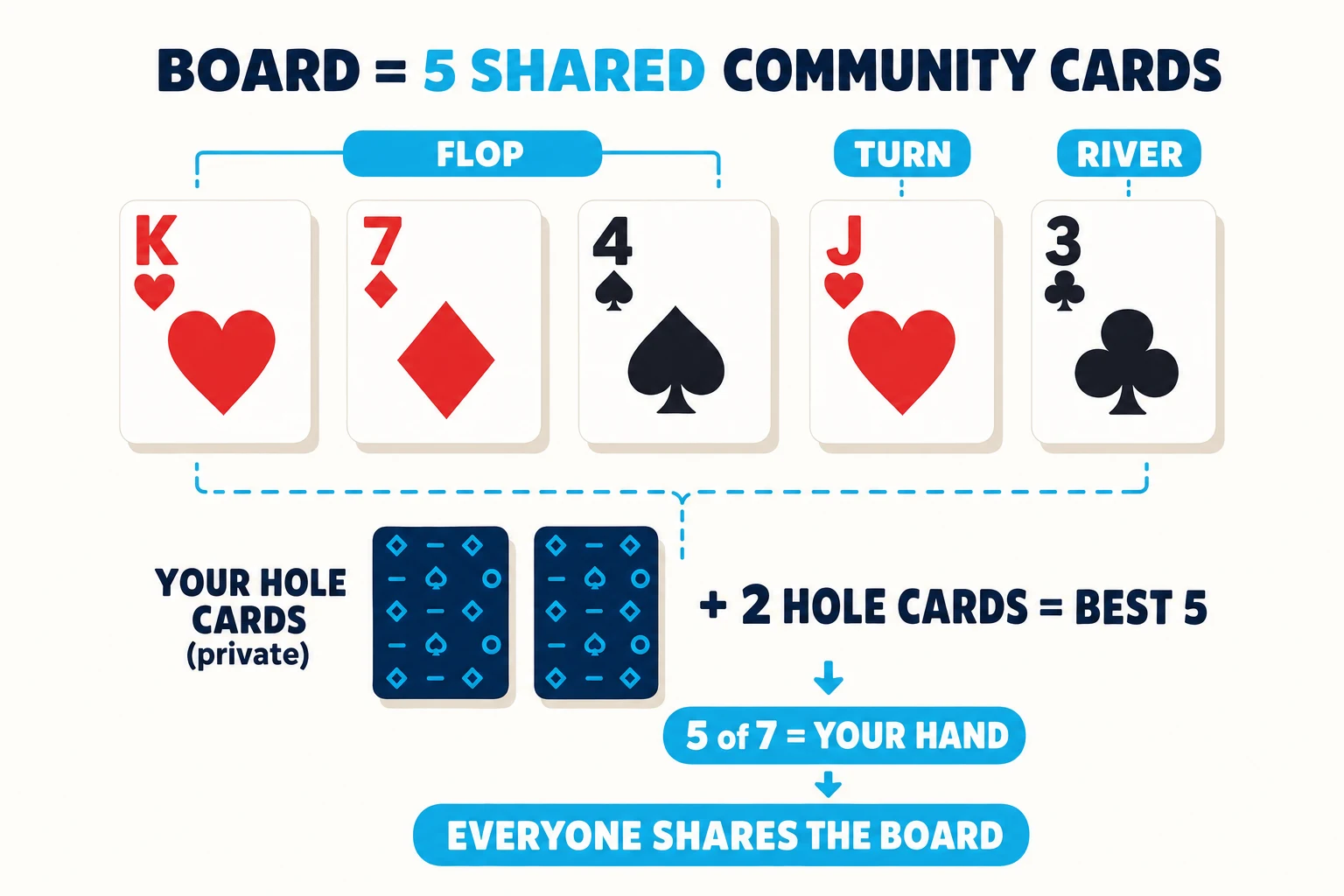
The board is the five community cards dealt face-up in the center of the table. Each player uses those cards with their two private hole cards to form the best five-card poker hand. Hole cards are the two cards dealt face-down to each player at the start of the hand. The board is revealed in three stages: the flop, the turn, and the river. Because everyone shares the board, each new card changes available hands, ranges, and strategy.
Practice this in Poker Skill. Comparing your hole cards to the board is what the board-reading lessons practice, asking you to pick your best five cards from seven, spot when the board itself plays and catch a turn card that counterfeits two pair.
Get the free appBoard in No-Limit Texas Hold’em
What the board is
The board is the five community cards dealt face-up in the center of the table. Each player uses those cards with their two private hole cards to form the best five-card poker hand. Hole cards are the two cards dealt face-down to each player at the start of the hand. The board is revealed in three stages: the flop, the turn, and the river. Because everyone shares the board, each new card changes available hands, ranges, and strategy.
The Flop - three cards that reshape a hand
The flop is dealt after the first betting round and consists of three community cards placed face-up. These three cards suddenly create new ways to improve hands and often change relative strengths. Example flop: 4♥4♦J♥. If you held 4♠4♣ preflop, you now have trips (three of a kind). If an opponent held J♣9♣, they have top pair; the 9 serves as their kicker to break ties. If you began with A♠K♠, this flop leaves you with no made hand and forces a decision about continuing. The flop also reveals paired or coordinated cards - here, a board pair and two hearts - which signals possible sets, straights, or flushes.
The Turn - the fourth community card
The turn, called Fourth Street, is the fourth community card dealt after another betting round. The turn refines hand quality and narrows the realistic holdings opponents can have. One turn card can complete or eliminate draws, pair the board, or give someone a dominating holding. Because only one new card arrives, the turn often becomes a street for more nuanced betting: extract value from improved hands, represent strength if the card helps your perceived range, or fold if the board grows dangerous. Always reassess how the turn changes your made hand and which draws remain live.
The River - the final card and final decisions
The river, or Fifth Street, is the fifth and final community card dealt after the last betting round before showdown. Showdown is when remaining players reveal hole cards to determine the winner. The river finalizes all hand-making possibilities and usually decides which hands can win at showdown. If the river completes an obvious draw, strong value bets are appropriate; if it misses likely draws, bluffing may become more plausible. Make your river decision based on the completed board and the range of hands you assign to opponents.
Using the board to shape strategy
Consistently read the board and update your plan as each card appears. Two basic steps help:
- Compare your hole cards to the board to identify made hands (pairs, two pair, sets, straights, flushes) and live draws (outs that can improve your hand on later streets).
- Consider which opponent ranges the visible community cards favor - for example, paired boards help sets; coordinated boards favor straights and flushes.
Don’t cling to preflop assumptions. Use each new community card to update betting, bluffing, and folding plans. Remember that all five board cards are shared, so plan for showdown knowing an opponent may use only the board or combine it with one or both hole cards.
Quick checklist
- Confirm the current board stage (flop, turn, or river) and how many community cards are live.
- Compare the board to your hole cards to identify made hands and potential draws.
- Consider which opponent ranges the board favors and how that affects your line.
- Re-evaluate betting and bluffing options after each new community card.
- Remember all five board cards are shared by every player when planning showdown strategy.