


Bluffing Range
A bluffing range is the slice of a betting or raising range made up of the hands you choose to bet so better hands fold. It is a hand set, not a single action — the bluffs that pair with your value bets to make the whole range hard to play against. Position, board texture, sizing, blockers, and the value side decide which hands belong inside it.
Practice this in Poker Skill. On the flop, draws fill the bluffing range in the Polarized Continuation Bets lesson: 9♦ 7♦ on K♦ 8♠ 6♦ bets with a straight draw and a flush draw, while 9♠ 6♠ on A♣ Q♥ 3♥, holding neither, checks.
Get the free appBluffing Range: the hand set you bet to make better hands fold
What a bluffing range is
A bluffing range is the slice of a betting or raising range made up of the hands a player picks to bet so better hands will fold. It is a hand set, not an action. The single act of representing strength with a weak hand is a bluff; the bluffing range is the collection of hands inside a betting range that take that role on a given street, sizing, and board. Out of every hand a player can have at a decision point, some bet for value, some bet as bluffs, and the rest check or fold. The bluffing range is just the second slice.
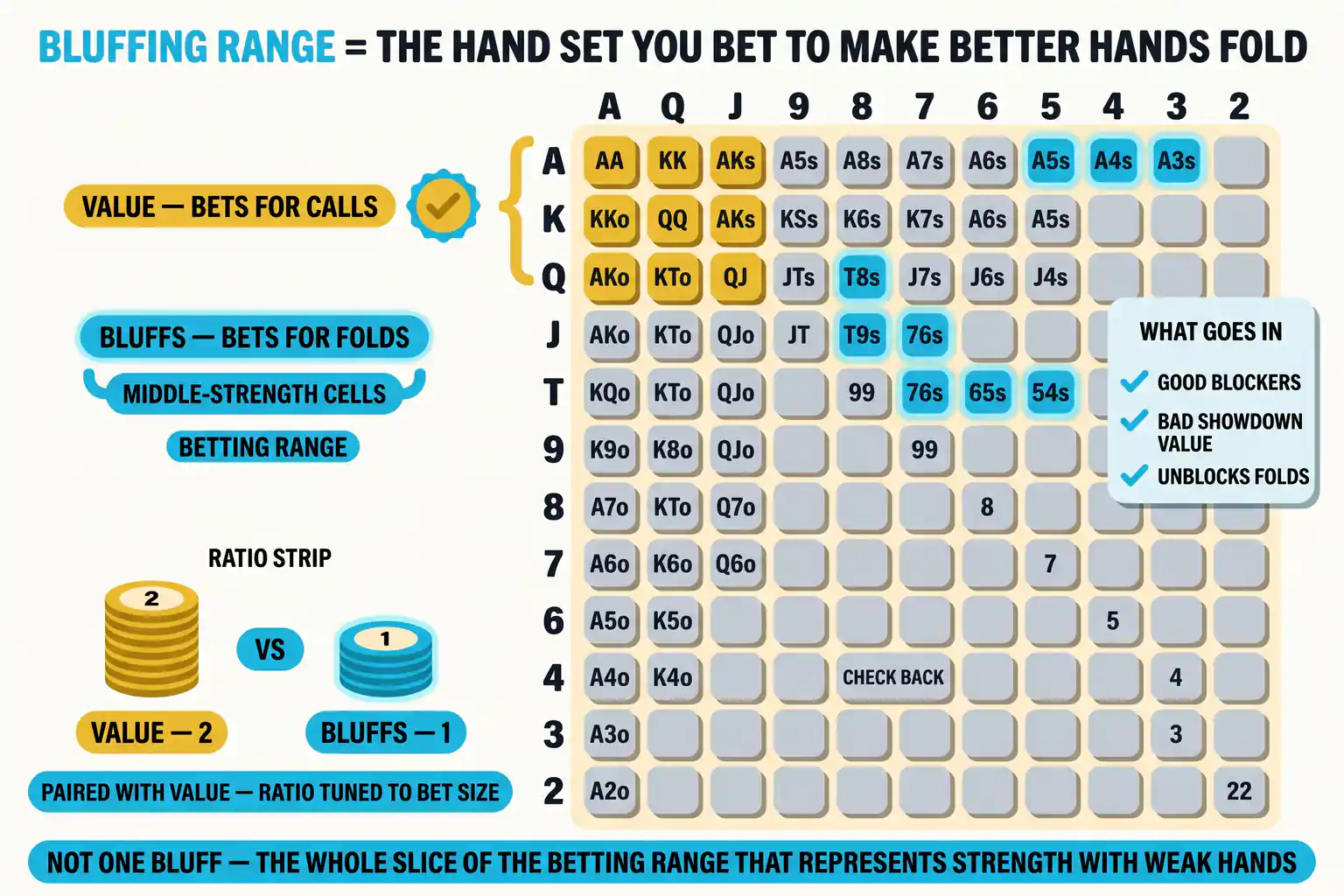
The shortcut: a single bluff is one action with one hand. A bluffing range is every hand that takes that action in a given spot, considered together with the value bets it pairs with. Solver outputs and modern strategy plan the whole slice at once because bluff frequency, hand selection, and value pairing only make sense as a group.
Bluffing range vs the neighbors people confuse it with
Several terms live close to “bluffing range” and they are not interchangeable. Each one points at a different lever.
| Term | What it names | What it does NOT name |
|---|---|---|
| Range | The full set of hands a player could hold | Which fork each hand takes |
| Bluffing range | The slice of the betting range that bluffs | The single act of bluffing |
| Bluff | A single bet meant to make a better hand fold | A whole hand set — one action, not a group |
| Pure bluff | A bluff with no realistic showdown improvement | The other half of a bluffing range that still has outs |
| Semi-bluff | A bluff with a draw that can improve later | The pure-bluff half of the same range |
| Fold equity | The chance the opponent folds to the bet | The hands that earn that fold equity |
| Blockers | Cards that remove combos from the opponent | A whole bluffing range — one selection criterion |
| Polarized range | A barbell of nuts plus bluffs, no middle | A guarantee — most polarized ranges contain a bluffing range, but not every bluffing range is in a polarized shape |
| Bluff-to-value ratio | The proportion of bluffs to value in a betting range | Which hands fill each side |
| Frequency | How often an action is taken in a spot | Which combos take the action |
The distinctions worth keeping straight:
- A bluff is the action; a bluffing range is the hand set. Conflating them turns a strategy decision into a single guess.
- Pure bluffs and semi-bluffs are kinds of bluff candidates a bluffing range can include. A given bluffing range can be all pure bluffs, all semi-bluffs, or any mix; the mix depends on street and board.
- Bluff-to-value ratio is the size of the bluffing range relative to the value side. The ratio sets how many bluffs belong in the slice; the bluffing range is the answer to which specific hands fill those slots.
- Polarized describes a betting range’s shape (nuts plus bluffs, no middle). A bluffing range is the bluff half of that shape. Merged ranges have weaker bluffs and thinner value, so the bluffing range inside them looks different.
- Blockers and unblockers are how individual combos earn their seat in the bluffing range, not the range itself.
What goes inside a bluffing range
Five inputs do most of the selection work. None are about the bet’s existence; that decision is already made. The question is which hands should fill the bluff slots inside the betting range.
- Showdown value. Hands that already win at showdown some of the time are bad bluff candidates because betting forces out everything they beat. Bottom pair often plays better as a check than a bluff. The bluffing range is built from hands that gain more by being represented as strong than by being checked down.
- Blockers and unblockers. A hand that holds a key card from the opponent’s continue range is a strong bluff candidate. Blockers cut into the value combos the opponent would call with; unblockers leave the missed-draw and folding combos intact, which keeps the bluff’s fold equity high.
- Board texture and equity-when-called. On wet boards, semi-bluff candidates carry their own equity and stay in the bluffing range deep into the hand. On drier or rivered runouts, the bluff slots fill with pure bluff candidates that have no outs but credible blockers.
- Position and the line so far. Acting last makes more bluffs viable because the previous action narrows the opponent’s range. Out of position, the bluffing range tightens; only the hands with the best blockers and the most credible story keep their slot.
- The value side. The bluffing range exists to pair with a value range. If the value range is thin or absent, the bluffing range collapses with it; there is no point representing strength when the strong hands aren’t there to back the line. Pairing is the whole point of the slice.
When the bluffing range matters most
The concept earns its keep in three places.
- River decisions facing a polarized bet. With no more cards to come, the hand sets on each side narrow sharply. The river bluffing range is built almost entirely from hands with the right blockers and zero showdown — usually missed draws that block the opponent’s value combos and unblock their folds. The bluff-to-value ratio tells you how many of those bluffs to include; the bluffing range is the list of which combos.
- Big bets and overbets. An overbet increases the price the caller is asked to pay, which lets the bettor include more bluffs without becoming exploitable. The bluffing range grows alongside the sizing, but the kind of bluff inside it shifts toward stronger blockers because the opponent’s continuing range is narrower and more defined.
- Flop and turn semi-bluff slots. Earlier streets favor draws as bluff candidates because they keep equity when called. The flop and turn bluffing range is mostly draws and combo holdings; the river bluffing range is mostly missed-draw blockers. Watching the bluffing range evolve street-by-street is what street-by-street planning looks like in practice.
It matters less in spots where the right plan is rarely to bet. A check-down line on a bricked river has no bluffing range to speak of; the range simply checks. Calling stations also flatten the concept: if the opponent never folds, the bluffing range shrinks toward zero because there are no folds to be earned.
Example: river polarized bet
6-max NLHE cash, 100bb effective. You raise the button to 2.5bb, the BB calls. Flop A♠ T♠ 4♦ — you c-bet small, BB calls. Turn 7♠ — you check back. River 2♣. Pot is $14, BB checks, you bet $14 (pot).
The hand sets on this river divide cleanly:
- Value range: AK, AQ, AT (top pair top kicker and two-pair Tx combos), and the few flushes you got to the river without raising the turn. These are betting for calls from worse Ax and weaker flushes.
- Bluffing range: missed spade draws that block AA-better and unblock the busted draws BB folds. K♠Q♠ and J♠T♠ are the cleanest examples; they hold the King-of-spades or top-pair-with-spade blocker, they whiffed the flush, and they no longer have showdown. K♠Q♠ also blocks A♠K and A♠Q, making BB’s strongest calling range smaller.
- Not in the bluffing range: small pairs that turned into pair+blocker holdings on the river (66, 55) — they have showdown and prefer to check. Naked offsuit ace combos like A6o that have showdown value but block the wrong combos.
The bet itself is one action; the bluffing range is the set of combos behind it. The bluff-to-value ratio at pot says roughly one bluff per two value bets, so the bluffing range here is sized to keep BB indifferent between calling and folding their bluff-catchers.
Example: flop and turn semi-bluff slots
Same seats. You raise the button to 2.5bb, the BB calls. Flop is 9♠ 8♠ 5♥. The BB checks. The flop bluffing range here is built from semi-bluff candidates because the texture is wet and almost every bluff candidate has equity when called.
- Value range: sets and overpairs (99, 88, 55, JJ-AA), some 98s and T7s as thin value.
- Bluffing range: flush-draw combos like A♠Q♠, K♠J♠, Q♠J♠; open-ended draws like 76s, T7s when not used as value; the strongest backdoor combos with overcards plus a backdoor flush.
- Mostly checks back: offsuit overcards with no draw, naked weak pairs that prefer pot control.
If you bet the flop and BB calls, the turn changes what stays in the bluffing range. A 2♣ that bricks every draw shrinks the slice: flush draws stay (they still have nine outs and threaten the river), but the weakest backdoors usually give up. A spade turn keeps the flush-draw bluffs in but adds new bluff candidates (newly-made gutshots with a spade) and lets the value side bet bigger. The bluffing range is moving as the street advances; it is not a fixed list.
Common mistakes
1) Picking bluffs by hand strength instead of blockers
The intuition “I’ll bluff because my hand is too weak to win” turns hand-strength into the selection rule. The right rule is which combos most cut into the opponent’s calling range and least cut into their folding range. Bottom pair often feels like a clean bluff candidate and is usually a worse one than a busted draw with a better blocker. Bottom pair beats some of the hands you are trying to fold out.
2) Bluffing without a value range
A bluff without a value side is a bet that opponents only need to read once. Range vs range is symmetric: if the betting range is all bluffs, the opponent’s correct response is to call wider until the bluff frequency stops working. The bluffing range is defined relative to its value pair; if the value side is empty, the bluffing range collapses too.
3) Treating every street the same
The flop bluffing range is mostly draws; the river bluffing range is mostly missed-draw blockers; the turn bluffing range is somewhere in the middle. Carrying a flop semi-bluff approach into a river spot fills the bluffing range with hands that prefer to check, and the bet stops representing strength because the line no longer makes sense.
4) Ignoring sizing when picking bluffs
A bigger bet earns more folds and lets the bluffing range be larger, but the kinds of bluffs inside it shift toward stronger blockers because the opponent’s continuing range narrows. A small bet earns fewer folds and asks for fewer bluffs, but the bluffs that remain can have weaker blockers because the caller’s range is wider. Same hand, different sizings, different decisions about whether it belongs in the bluffing range.
FAQ
How do I build a bluffing range from scratch?
Start by naming the value range. The bluffing range is defined relative to the value side, so without it there is nothing to pair against. Once the value range is named, ask three questions in order: which hands have no showdown to give up, which of those have the cleanest blockers to the opponent’s value combos, and which of those unblock the opponent’s folding combos. The bluffing range is the intersection — hands that lose at showdown, block calls, and unblock folds — sized to the bluff-to-value ratio the bet’s price implies.
Is a bluffing range the same as a polarized range?
No. A polarized range is a shape — top of range plus bluffs with no middle. The bluffing range is the bluff slice inside that shape. Merged or linear ranges contain bluffs too, but the bluffing range inside them is built from different hands (closer to the bottom of the betting range, with thinner blockers) because the value side is wider and shallower. Polarized describes the silhouette; the bluffing range describes the bluff cells.
How does a bluffing range differ from a single bluff?
A single bluff is one action with one hand at one moment. A bluffing range is the set of hands a player would bet for the same reason in the same spot. The action is what the opponent sees; the range is what makes the action defensible. Solving for ranges first and assigning specific combos second is what separates a planned bluff from a reactive one.
Why do solvers care about the bluffing range and not just one bluff?
Solvers compute a strategy for every hand a player can have at once. They do not know which combo is held. Their answer to “should I bluff here?” is a frequency assigned to each hand class, and the bluffing range is the union of every hand class assigned a non-zero bluff frequency. Thinking in bluffing ranges is what lines up human play with what solvers are actually solving.