


Range
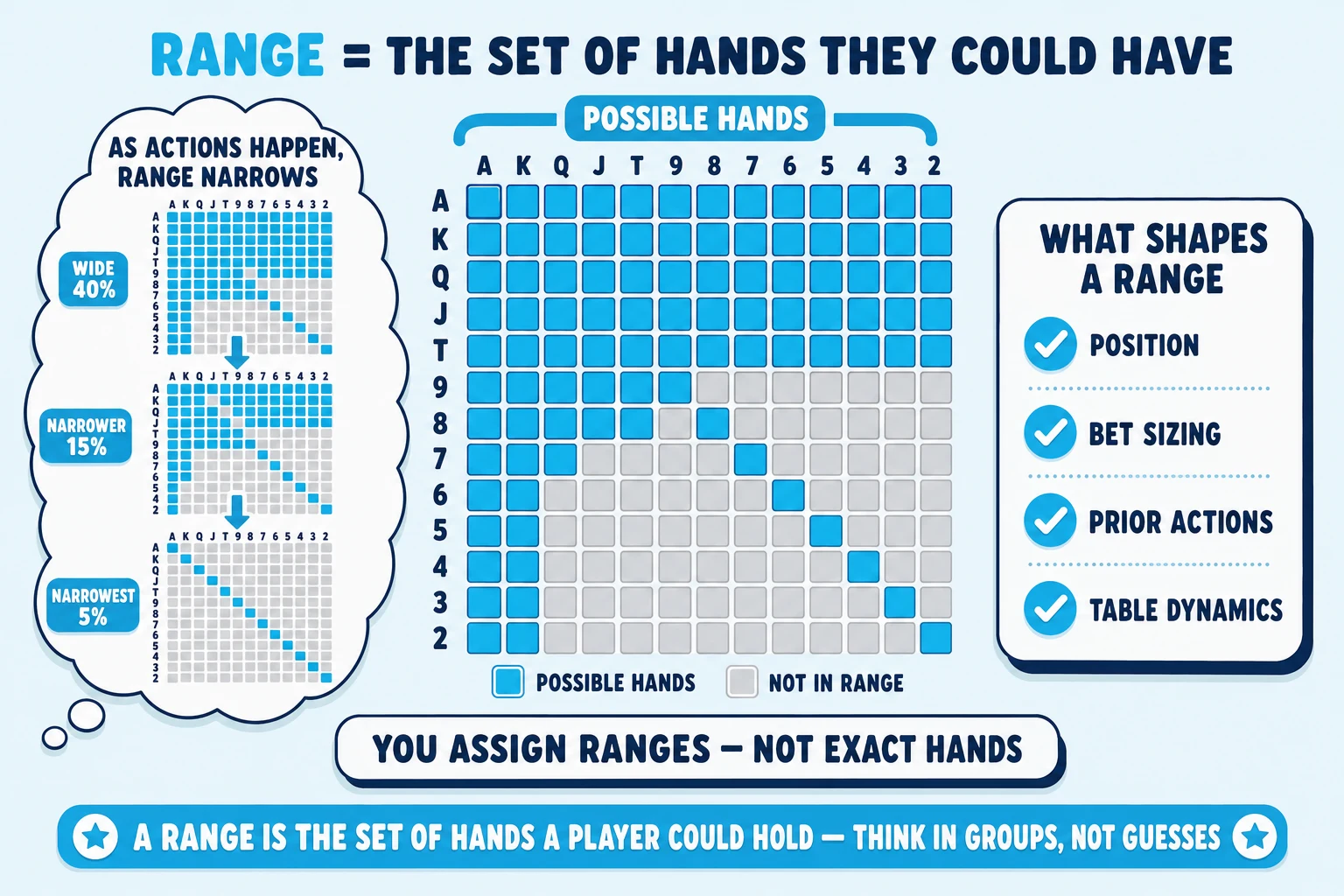
The full set of hole cards an opponent could plausibly hold given their actions, position, and table dynamics. Think in groups of hands, not single guesses.
Practice this in Poker Skill. The big-blind lessons put range reading into practice, 3-betting suited ace-jack against a button’s wide opening range but folding offsuit queen-ten against a tight under-the-gun open.
Get the free appRange: Hand Ranges in No-Limit Texas Hold’em
What a hand range is
A hand range is the set of possible hole cards a player could hold. You assign a range from their actions, position, and table dynamics. Thinking in ranges means considering groups of hands rather than guessing one exact holding: all pocket pairs, the big aces, the suited connectors. Ranges let you evaluate bets, calls, raises, and folds against many possible opponent holdings at once. Bet size, seating position, stack sizes, and opponent tendencies all shape those ranges. A UTG (under-the-gun) open implies a tighter range than a button open; an early-position large raise rarely includes speculative hands like 76s. For how to write a range down, count its combinations, and cut it street by street, read poker ranges.
Why ranges matter at the table
No-Limit poker allows any bet size, so a single bet affects many hands in a range. When you size a bet, you influence how multiple hands will respond, not just one specific holding. Assigning ranges improves reads: a preflop 3-bet from the blinds narrows possibilities toward stronger hands. On a K-Q-3 flop, a 3-bettor’s range will contain more kings and queens than a caller’s, which may include more speculative holdings. Making decisions by range makes them more defendable and mathematical. Instead of “I think he has AK,” ask “How does my range fare versus his range on this board?” Then compare equities and future betting to justify calls or folds.
Constructing pre-flop ranges by position
Use position-based baselines: early seats require tighter ranges; late seats open much wider. Build sensible opening and defending ranges with these steps:
- Start tight in early seats: include premium pairs and broadway hands (example grouping: AA-99, AK, AQ).
- Expand in middle position: add medium pairs and more broadway combinations.
- Open widest from late positions (cutoff, button): add suited connectors (consecutive suited cards like 9♠8♠), lower pairs, and suited aces (A5s, A4s).
Example: From the button you might open hands you’d never open UTG, such as 76s or K9s, because positional advantage lets you play post-flop more freely. Always adapt: passive tables let you widen ranges; frequent aggressive 3-bettors should make you tighten openings.
Using ranges after the flop
When the flop (the first three community cards) appears, evaluate your entire range and your opponent’s range against that board texture. Ask which hands in their preflop range connect, which miss completely, and which become bluffs. Use opponents’ post-flop actions to narrow ranges. Example sequence:
- Villain raises preflop from the cutoff: assign a stronger opening range than from earlier seats.
- Flop is K-7-2 rainbow; villain bets. That bet shifts the range toward kings and strong king-draw hands.
- They check instead. Strong kings and deliberate bluffs become less likely, and probability shifts toward medium pairs or missed hands.
Update ranges again on the turn and river as bets and card runouts provide new information.
Practical range adjustment and tools
Be flexible: revise your range read as new bets and community cards arrive. Use range charts to keep your own decisions consistent. Charts give a baseline that helps prevent emotional drift.
Concrete habits:
- After each meaningful action, define an opponent’s range in simple groups (premium, medium, draws, air).
- Compare your range equity (how often your range wins) versus that opponent range before committing chips.
- Adjust preflop ranges by position, stack size, and table tendencies.
- Narrow and revise ranges on each street using bets and board texture.
Quick checklist
- Define an opponent’s range after each meaningful action.
- Compare your range equity vs that opponent range before committing chips.
- Adjust pre-flop ranges by position and table dynamics.
- Narrow and revise ranges on each street using bets and board texture.
- Use charts or quantified guidelines to keep range construction consistent.