


Villain
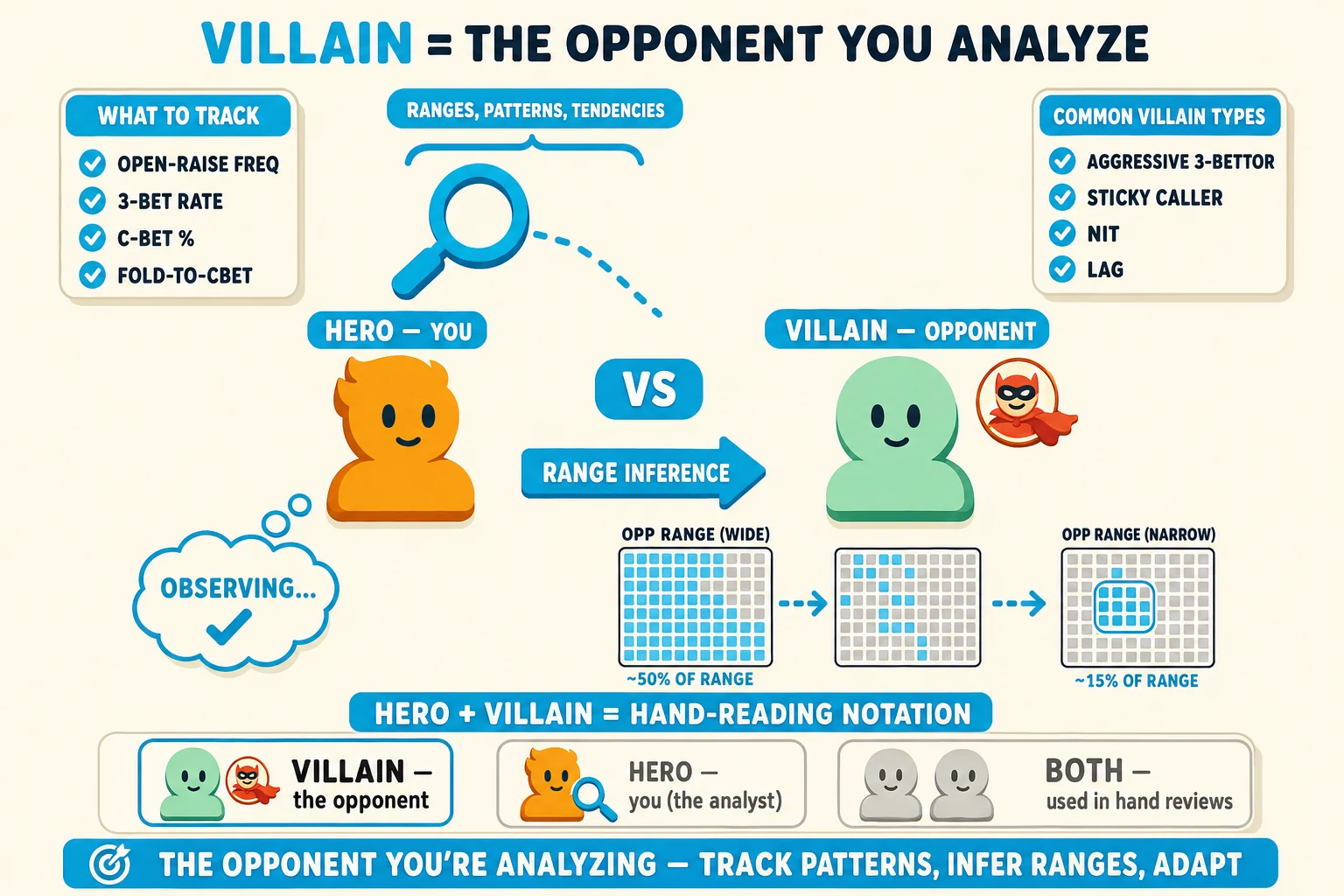
The Villain is the opponent the Hero (the player in focus) analyzes in a hand. The Villain can be a real seat at the table or a hypothetical opponent used to explore decisions. In hand-reading and strategy, the Villain is central. You infer their likely holdings (range), betting patterns, and how those shape your responses.
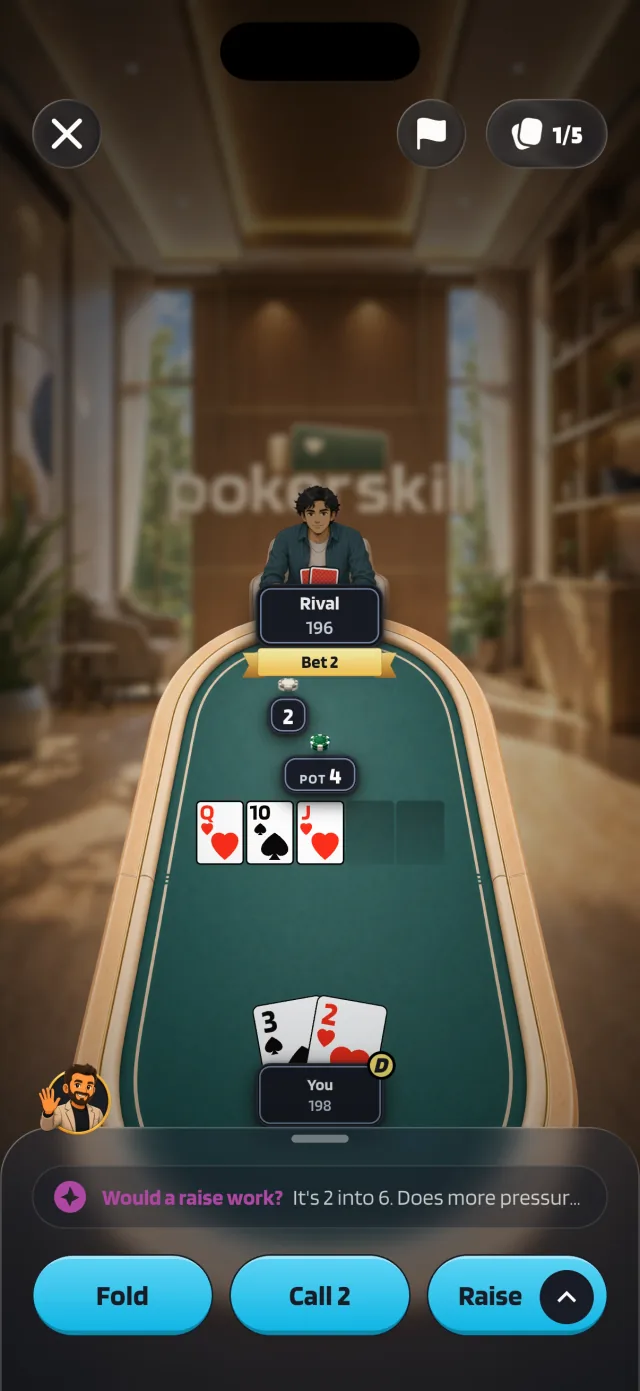
Practice this in Poker Skill. In Practice vs AI, the villain’s seat goes to an AI opponent, heads-up or two of them at a three-player table, and the hands are played in full.
Get the free appVillain (No-Limit Texas Hold’em)
Who is the Villain?
The Villain is the opponent the Hero (the player in focus) analyzes in a hand. The Villain can be a real seat at the table or a hypothetical opponent used to explore decisions. In hand-reading and strategy, the Villain is central. You infer their likely holdings (range), betting patterns, and how those shape your responses.
Common Villain behaviors
Villains in No-Limit Hold’em commonly show a few recognizable tendencies:
- Aggressive betting: frequent 3-bets (preflop re-raises) and continuation bets (c-bets, a flop bet by the preflop aggressor). Frequent 3-bets force tougher preflop decisions with hands like KQ or small pairs.
- Wide, high-frequency betting: many Villains bet over 70% of their range, putting money in on most boards instead of checking or folding.
- Sticky calling: these players call down with weak pairs or chase gutshot draws (a one-card inside straight). On a J-9-4 flop, they might call river bets with middle pair or a missed straight draw.
- Calm psychological pressure: they maintain composure while firing large bets. That composure pushes opponents to fold marginal hands or make rushed calls.
How the Villain shapes Hero decisions
Villain tendencies directly influence the Hero on every street:
- Range construction: if a Villain bets roughly 70% of their range, adjust calling and raising frequencies to account for many bluffs and thin value hands.
- Street-by-street choices: an aggressive Villain forces more fold/call/raise decisions on flop, turn, and river. If they c-bet most flops, decide whether to float (call intending to bet later), defend, or fold.
- Strategy selection: adapt exploitatively or stay balanced based on observed patterns. Against an over-bluffer, call down more and value-bet thinner. Against a player who rarely bluffs, tighten and avoid bluff-catching.
Adjusting and countering the Villain
Use concrete steps against an aggressive, capable Villain:
- Range balancing: defend with a mixed range to avoid predictability. Include draws and strong hands, and sometimes 3-bet with both bluffs and value. Versus a frequent 3-bettor, include AK and suited connectors in your 3-bet range.
- Selective aggression: pick high-leverage spots to 3-bet or raise when their range looks weak (late-position opens, short stack, or clear fold tendency). Don’t auto-shove; favor spots where position and stacks help.
- Exploit sticky tendencies: when they call down too often, value-bet thinner on turn and river with medium-strength hands. Conversely, if they rarely fold, cut back on bluffs.
Villain effects in cash games and stakes
In cash games like $5-$10NL, an aggressive Villain changes table flow. Frequent 3-bets and high c-bet rates force opponents into more high-impact decisions, increasing variance and demanding tighter long-term adjustments. Since these Villains mix bluffs with real value, continually observe and update reads. What worked in hour one may be countered by hour three. Record tendencies, adapt ranges, and pick your spots.
Checklist:
- Identify the Villain and record observable tendencies early in a session.
- Track aggression frequency and common bet types (3-bet, c-bet, over-betting).
- Balance ranges and select high-leverage spots for counter-aggression.
- Exploit clear sticky or calling tendencies while avoiding predictable over-folding.