


3-bet
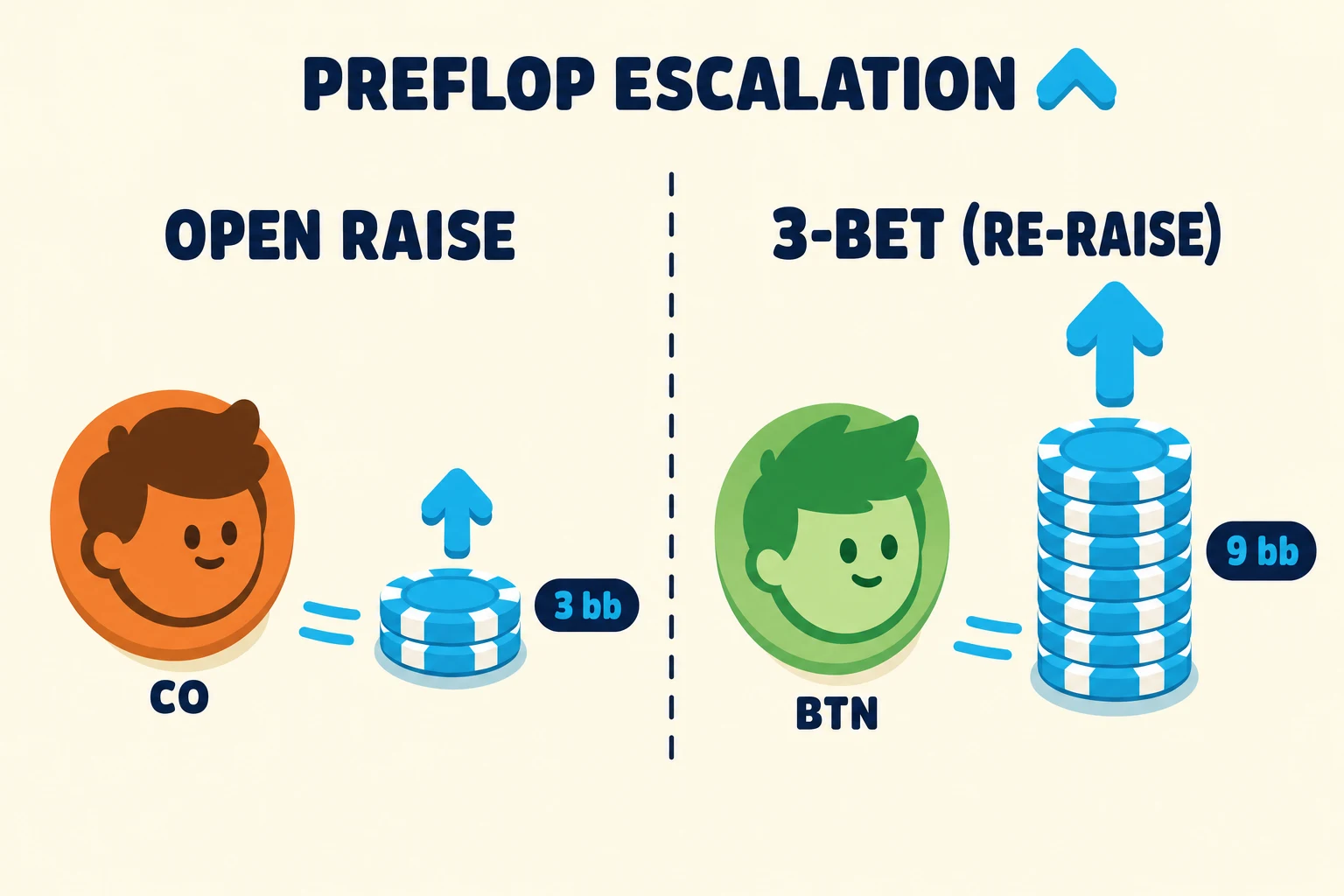
A 3-bet is a re-raise of an opening raise: open, raise, re-raise. It signals strength, sets the pot size you want, and pressures the opener into harder preflop and postflop choices.
Practice this in Poker Skill. Position shapes the re-raise in the Response to Opens lessons: A♦ J♦ 3-bets a wide button open from the big blind, and Q♥ J♥ 3-bets a cutoff open from the button.
Get the free app3-Bet: Preflop Strategy in No-Limit Hold’em
Definition and why a 3-bet matters
A 3-bet is a re-raise of an opening raise: open raise, then a raise, then a re-raise. In No-Limit Hold’em it usually signals strength, claims the initiative, and sets the pot size you want for postflop. If an opponent opens to 3 big blinds and you re-raise to 9 bb, you triple the price, pressure marginal calls, and force the opener to choose between folding, calling out of position, or 4-betting back. That single decision tree is most of why 3-bets matter.
For the late-position decision tree, read Cold call vs 3-bet: which to pick in late position.
Choosing hands and using position to 3-bet
Position - where you act relative to others - is central to preflop strategy. On the button or cutoff you can widen your 3-bet range and include more bluffs and speculative hands. Acting last post-flop gives you more information and more control over pot development. Out of position, tighten up and favor premium hands and blocker cards (cards that reduce opponents’ chances of holding specific strong hands). Against tight openers, prefer strong pairs and high cards. Balance your range with top value hands (AA, KK, QQ), high-card combos (AK, AQ), and a few suited connectors or suited broadways for board coverage when in position.
Constructing 3-bet ranges: polarized vs linear
Two common 3-bet constructions exist. A polarized range mixes top value hands with clear bluffs, denying opponents comfortable medium-strength calls. A linear range concentrates on strong hands near the top of your range and minimizes speculative bluffs. Use polarized 3-bets to put pressure on opponents who fold too often. Use linear 3-bets against frequent callers or when you prefer straightforward equity without complex bluffs.
Sizing your 3-bet and the tactical effects
3-bet size determines how opponents respond and how committed you become if called. Larger 3-bets fold out more marginal hands but risk more chips when called. Smaller 3-bets invite wider calls and keep the pot manageable. Size relative to the opener and effective stacks, and be consistent to mask exact range. Vary sizing exploitatively when you intend pure value or a light squeeze. Use size to shape opponents’ post-flop commitment and punish players who misread your strength.
Facing a 3-bet: fold, call, or 4-bet?
When someone 3-bets you, evaluate position, stack depth, opponent tendencies, and hand playability. A simple framework:
- Fold: release hands with poor post-flop playability or where pot odds and position are unfavorable.
- Call: continue with hands that keep equity and implied odds post-flop - suited combos, broadway cards (AK, AQ, KQ), and medium pairs - especially in position.
- 4-bet: re-raise with top value hands or selected bluffs when exploitative; use blockers and read opponent folding frequency. Consider stack depth, since deeper stacks favor speculative calls while shallower stacks amplify commitment.
Playing 3-bet pots
Once a 3-bet gets called, the money is deep relative to the stacks and small edges compound. For the longer treatment of why the play took over and which hands make it, see the 3-bet, explained. Many players fold too much to large pre-flop 3-bets, so continue aggression when you have clear value or good bluffing opportunities. If called, play with initiative: continue with hands that have equity (draws, top pair) and with blockers that hinder opponents’ strong holdings. Avoid flatting marginal hands pre-flop only to surrender on the flop, and use flat calls only when you have a planned post-flop line or when stacks and reads justify multi-street play.
Quick checklist
- Define your 3-bet intent: value, exploitative pressure, or balanced bluffing.
- Tighten 3-bets out of position; widen them in position or versus wide openers.
- Construct polarized versus linear ranges based on opponent behavior.
- Size to maximize fold equity while preserving post-flop maneuverability.
- When facing a 3-bet, consider position, stacks, opponent tendencies, and hand playability before folding, calling, or 4-betting.