


Polarized Range
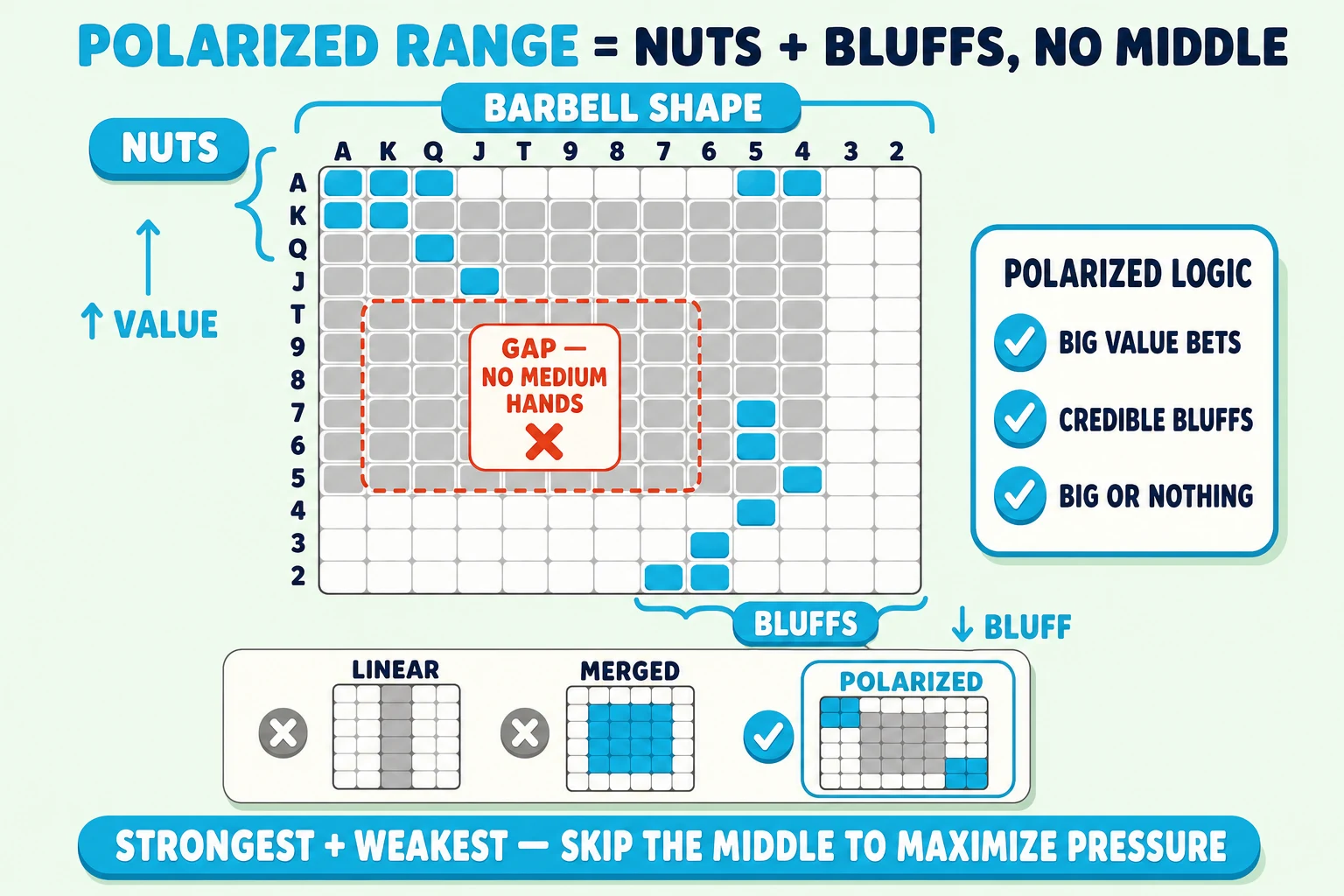
A polarized range in No-Limit Hold'em includes your very strongest hands and your weakest bluffs. It intentionally avoids medium-strength holdings that neither value bet profitably nor bluff credibly. "Range" means all hands a player could have in a given spot.
Practice this in Poker Skill. The Polarized Continuation Bets lesson sorts flop hands into the two ends, betting top pair with the nut flush draw for value and a straight-and-flush combo draw as the bluff, while second pair under an ace checks.
Get the free appPolarized Range
What a polarized range is
A polarized range in No-Limit Hold’em includes your very strongest hands and your weakest bluffs. It intentionally avoids medium-strength holdings that neither value bet profitably nor bluff credibly. “Range” means all hands a player could have in a given spot.
Example: preflop you might 3-bet AA and KK for value. You could also include suited blockers like A5s as bluffs while flat-calling TT or AQ. Postflop, polarization appears when large bet sizes target the top of your range or thin bluffs. You then check or use small bets with medium-strength hands that don’t merit large wagers.
Brief jargon: a c-bet (continuation bet) is a flop bet by the preflop aggressor. A blocker is a card in your hand that reduces opponents’ chances of holding certain strong cards.
When ranges tend to polarize
- Postflop, as betting advances, players often use big bets for extremes and small bets for middling holdings.
- After a called c-bet, a turn that favors the aggressor pushes their betting range toward nuts and bluffs.
- Paired or monotone boards often remove medium-strength draws, leaving defenders with either strong made hands or air.
Concrete example: you c-bet a dry K73 flop and get called. A turn J giving you top pair with a good kicker may prompt a large turn bet representing value. Middle pairs will prefer to check and control pot size instead of joining a large-size line.
How bet sizing drives polarization
- Large bet sizes encourage polarization because they price out medium hands and force tough decisions.
- Use big bets mostly with your strongest value hands and chosen bluffs.
- Small bets or checks let medium-strength hands realize equity and avoid getting dominated.
- Overbets and large turn or river bets force polarization by increasing fold equity and pricing out marginals.
Example: a 75% pot river bet usually belongs to your nuts or chosen bluffs. By contrast, a 20% pot bet can include top pair and weaker hands seeking a call.
Building and recognizing a polarized range
- Select thin-value hands: include nuts and near-nuts, plus thin value like top two pair (nuts = best possible hand).
- Choose bluffs with blockers: pick hands that reduce opponents’ strong-hand combos, like holding an ace against many ace-containing combos.
- Remove medium hands from large-size lines: have medium-made hands check or use small bets to control the pot.
- Read opponents: large turn or river bets on dry boards often signal polarization after a called c-bet.
Counterplay: defending against polarized ranges
- Bluff-catch with hands that beat bluffs but lose to value; this means calling to beat bluffs, not value.
- Avoid overfolding to large polarized bets; call with hands that beat bluffs and fold to value.
- Mix calling and raising frequencies: raise more when opponents over-bluff, tighten calls when they under-bluff.
Quick checklist
- Identify spots where large bets suit the situation and decide whether to polarize.
- Map clear value and bluff candidates, removing medium-strength hands from large-size lines.
- Practice bluff-catching ranges and set clear calling thresholds versus large bets.