


Top Pair
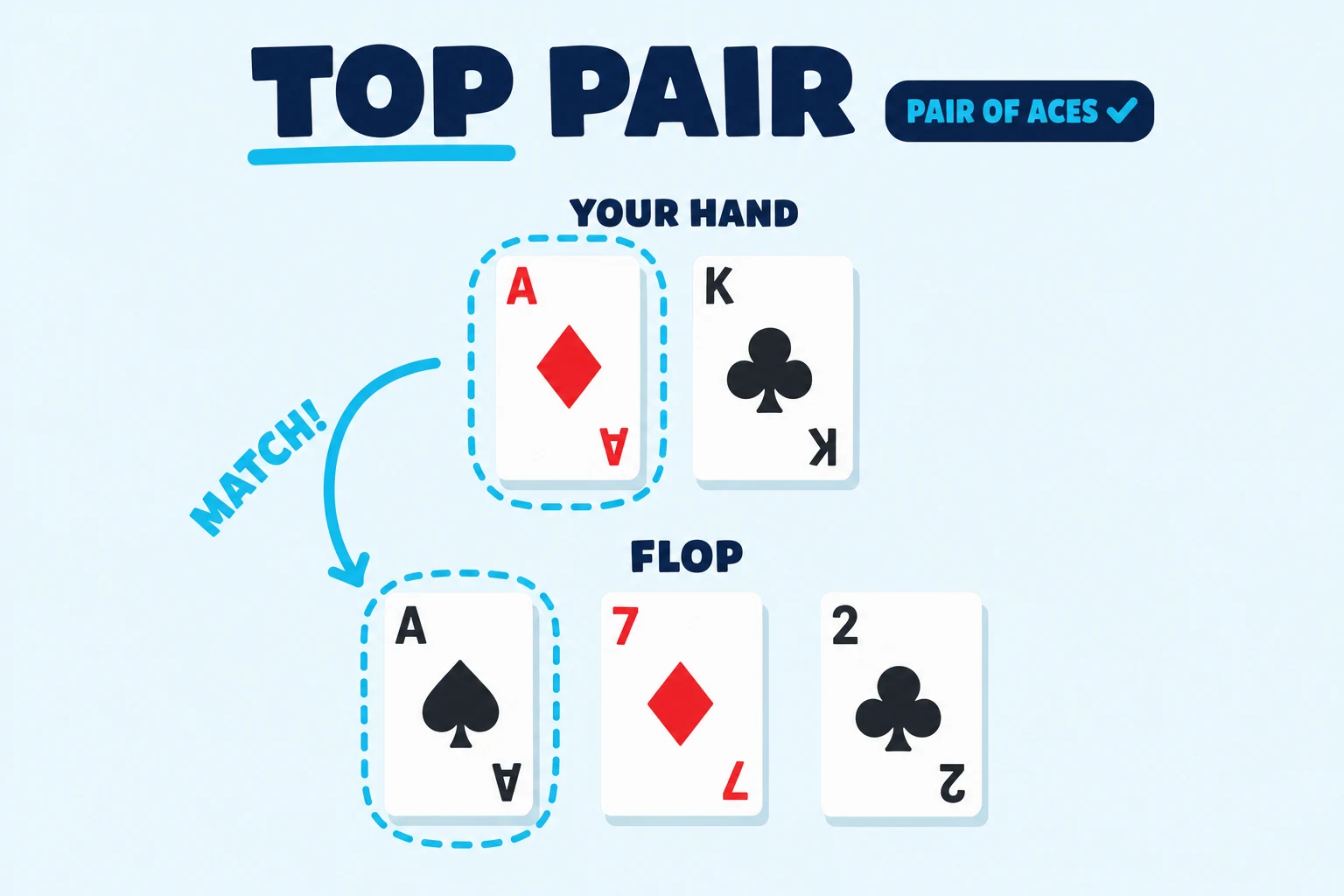
Top pair occurs when one of your hole cards matches the highest community card, forming a pair. Example: you hold A♦ K♣ and the flop is A♠ 7♦ 2♣ - you have top pair (pair of Aces). In No-Limit Hold'em, top pair on the flop is often a strong made hand, especially heads-up or short-handed. Its practical strength depends on how many opponents remain and the board texture. A dry flop like A♠ 7♦ 2♣ favors top pair more than a coordinated J♦ 10♦ 9♣.
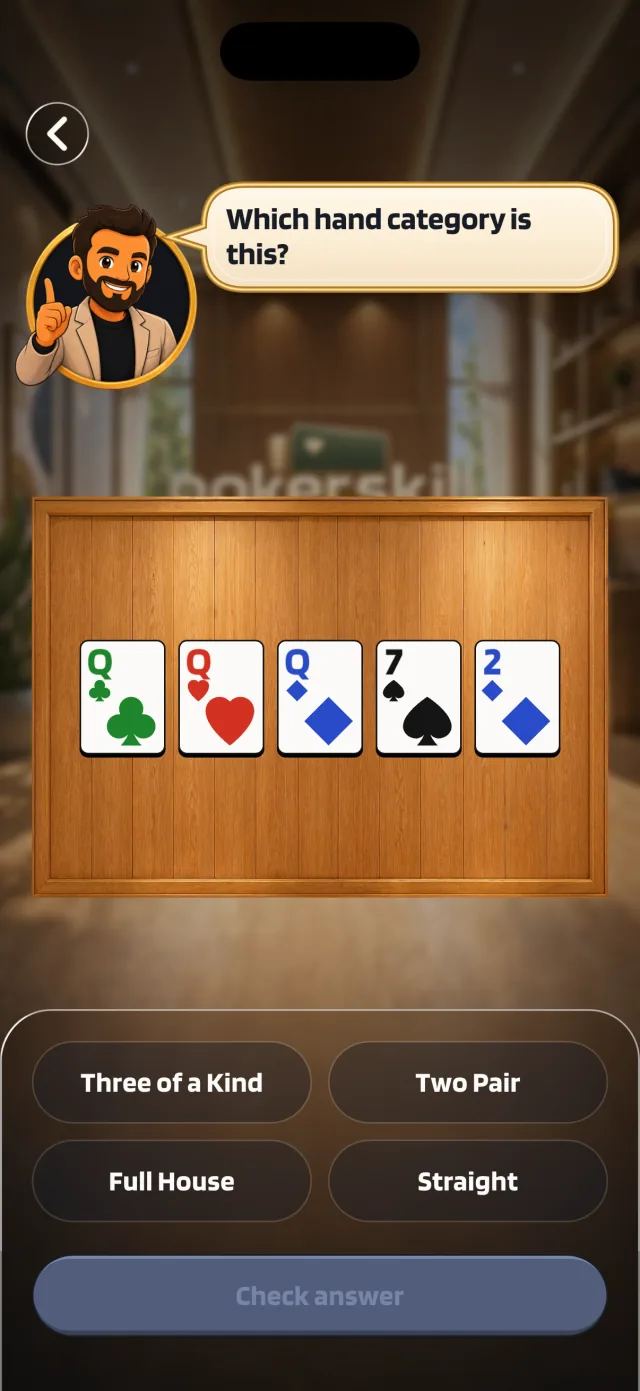
Practice this in Poker Skill. Out of position, the Check-Call lesson takes the pot-control line with top pair of queens, calling the bet rather than folding it.
Get the free appTop pair in No-Limit Texas Hold’em
What top pair is and why it matters
Top pair occurs when one of your hole cards matches the highest community card, forming a pair. Example: you hold A♦ K♣ and the flop is A♠ 7♦ 2♣ - you have top pair (pair of Aces). In No-Limit Hold’em, top pair on the flop is often a strong made hand, especially heads-up or short-handed. Its practical strength depends on how many opponents remain and the board texture. A dry flop like A♠ 7♦ 2♣ favors top pair more than a coordinated J♦ 10♦ 9♣.
Kicker strength and hand quality
The kicker is your other hole card that doesn’t form the pair; it breaks ties. A strong kicker (for example K with A on an A-high board) increases showdown equity and supports aggression. Example: on A♠ 8♣ 3♦, you have A♣ K♦ and your opponent has A♥ 5♠ - your K kicker wins. A weak kicker leaves you vulnerable to being outkicked by another Ace. Top pair can improve to two pair if your other hole card matches another board card. For example, A♣ 7♥ on A♦ 7♠ 2♣ gives you two pair, a clear strength increase.
Position: extract value or control the pot
Position refers to acting order; in-position means you act last and have more information. Out-of-position means you act earlier and must decide with less info.
Practical approaches:
- In-position with top pair: bet or raise to extract value from worse hands and charge draws. Example: with A♣ Q♣ on A♦ 9♠ 4♣, a modest bet charges draws and gets calls from weaker Aces.
- Out-of-position: prefer pot-control lines - check-calling or small bets - since you must react without seeing opponents’ actions.
Use position to choose between applying pressure when opponents call with worse, or keeping the pot small against many draws or strong ranges.
Flop vs turn/river: how top pair evolves
On the flop, top pair often justifies a value bet or raise to charge draws and worse pairs. Later streets can change that value dramatically. Watch for scare cards - turn or river cards that complete obvious draws or make the board more coordinated, such as adding a third suited card or a connected rank. If the turn completes a flush or straight draw, top pair’s relative value drops. Reassess opponent ranges and betting patterns each street to decide whether to continue aggression, slow down, or fold.
Multiway pots, board texture, and risk management
Coordinated or draw-heavy boards (for example 9♠ 10♠ J♥) create many ways opponents can have stronger hands. In multiway pots (three or more players), top pair is less reliable because someone is likelier to hold or make a better hand. No-Limit betting allows heavy pressure with top pair but magnifies risk. Adapt: tighten aggression on scary turns and avoid bloating pots when multiple opponents or coordinated boards suggest you are likely behind.
Checklist
- Confirm one of your hole cards matches the highest board card; you have top pair.
- Assess your kicker strength and the chance to make two pair.
- Note your position; use it to extract value or control the pot.
- Watch for scare cards on the turn and river; update your plan.
- Be cautious in multiway pots and on coordinated boards; manage aggression.