


Short-Handed
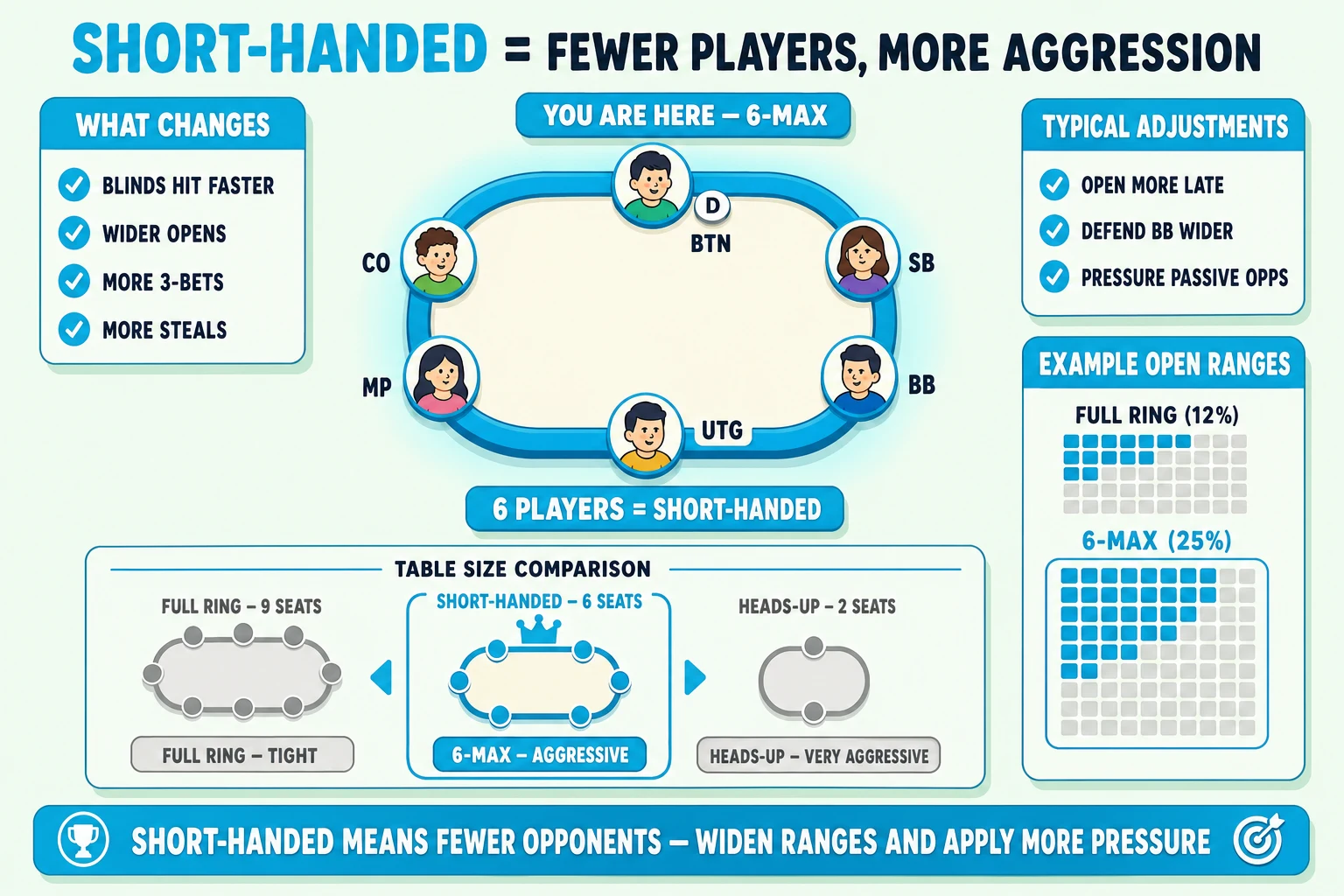
Short-handed means fewer players at the table (6-max or fewer). With fewer opponents, the chance someone holds a premium hand falls, so you must play more aggressively. Blinds-forced bets posted by two players-cycle faster, which penalizes waiting for only top-tier hands. Table dynamics shift quickly; one loose player or a hot streak can alter overall behavior. Readjustment speed and aggression become decisive.
Practice this in Poker Skill. All of the strategy lessons are dealt six-handed, so the ranges they teach, like a button open with suited connectors, are short-handed ranges from the start.
Get the free appShort-Handed (6-max and smaller) - Quick Strategic Outline
Short-handed vs full-ring: What changes?
Short-handed means fewer players at the table (6-max or fewer). With fewer opponents, the chance someone holds a premium hand falls, so you must play more aggressively. Blinds-forced bets posted by two players-cycle faster, which penalizes waiting for only top-tier hands. Table dynamics shift quickly; one loose player or a hot streak can alter overall behavior. Readjustment speed and aggression become decisive.
Example: At a nine-handed table you might fold K9 offsuit from early position; at a 6-max table the same hand can open from late position because fold equity and positional advantage rise.
Preflop: Expanding and using wider ranges
Open a wider range and favor hands that play well after the flop.
- Which hands to open: add medium pairs (66-99), suited connectors (76s, T9s), and broadway cards (KQ, AJ). These hands combine showdown value with postflop maneuverability.
- Defend more from the blinds: versus frequent openers, call or three-bet (reraise) with hands that flop well-suited aces, connected cards, and medium pairs. Use three-bets to seize initiative when appropriate, not only to get value.
- Reraises: three-bet more often as an aggression tool. Versus a loose opener, 3-betting with AJs or KQs builds pots when ahead and forces folds when behind.
Example: Button opens with 9♠8♠. In 6-max this is a standard open; if the small blind three-bets, you can often call or four-bet light depending on the opponent.
Postflop: Aggression, bluffing, and reading opponents
Postflop aggression wins more pots in short-handed games.
- Continuation bets (c-bets): c-bet frequently on flops that favor your perceived range-dry boards where few hands connect are prime spots.
- Semi-bluffs: bet when you have a draw (flush or straight draw) and fold equity. Semi-bluffing combines fold equity with a chance to improve.
- Probes and reraises: versus passive callers, probe with a bet on later streets or reraise to take control of the pot.
- Read opponents: note who folds to aggression, who calls down light, and who over-bluffs. If someone folds often, increase bluff frequency; if they call often, tighten bluffs and value-bet more.
Example: You open with A♦J♦ and flop K♣7♦4♦. A c-bet semi-bluff works well because you hold a backdoor flush and your opponent likely missed.
Position & blind play: When to attack and when to defend
Position-where you act relative to others-gains weight in short-handed play.
- Late position power: attack blinds more from cutoff and button-stealing pressure accumulates and builds stack advantage. (Cutoff is one seat before the button; button is the dealer position.)
- Defensive blind strategy: defend blinds with a wider range, especially suited cards and pairs that can flop well; mix in three-bets to punish frequent stealers.
- Use reraises as punishment: if the cutoff steals often, a well-timed reraise from the blind both wins pots and isolates the stealer.
Example: On the button you can open with hands like Q9s or 54s to exploit tight blinds. If the big blind folds too often, raise more frequently.
Cash vs tournament: Adapting short-handed tactics by format
Format changes the risk calculus.
- Cash games: favor steady aggression and exploitative lines. Deeper stacks increase implied odds, so connectors and small pairs gain value.
- Tournaments: monitor stack sizes and blind structure closely. Tighten when short-stacked to avoid marginal confrontations; widen ranges when you can leverage fold equity to steal antes and blinds.
- Adjust risk posture: tournaments require more survival-aware decisions, while cash games allow greater pressure and maneuvering.
Quick checklist
- Expand preflop ranges but prioritize hands with postflop playability.
- Increase aggression: raise, reraise, and steal more often.
- Defend blinds proactively and exploit positional advantages.
- Bluff and semi-bluff selectively based on board texture and opponent tendencies.
- Monitor stack sizes and blind structure to shift between cash-style and tournament-style lines.