


Semi-Bluff
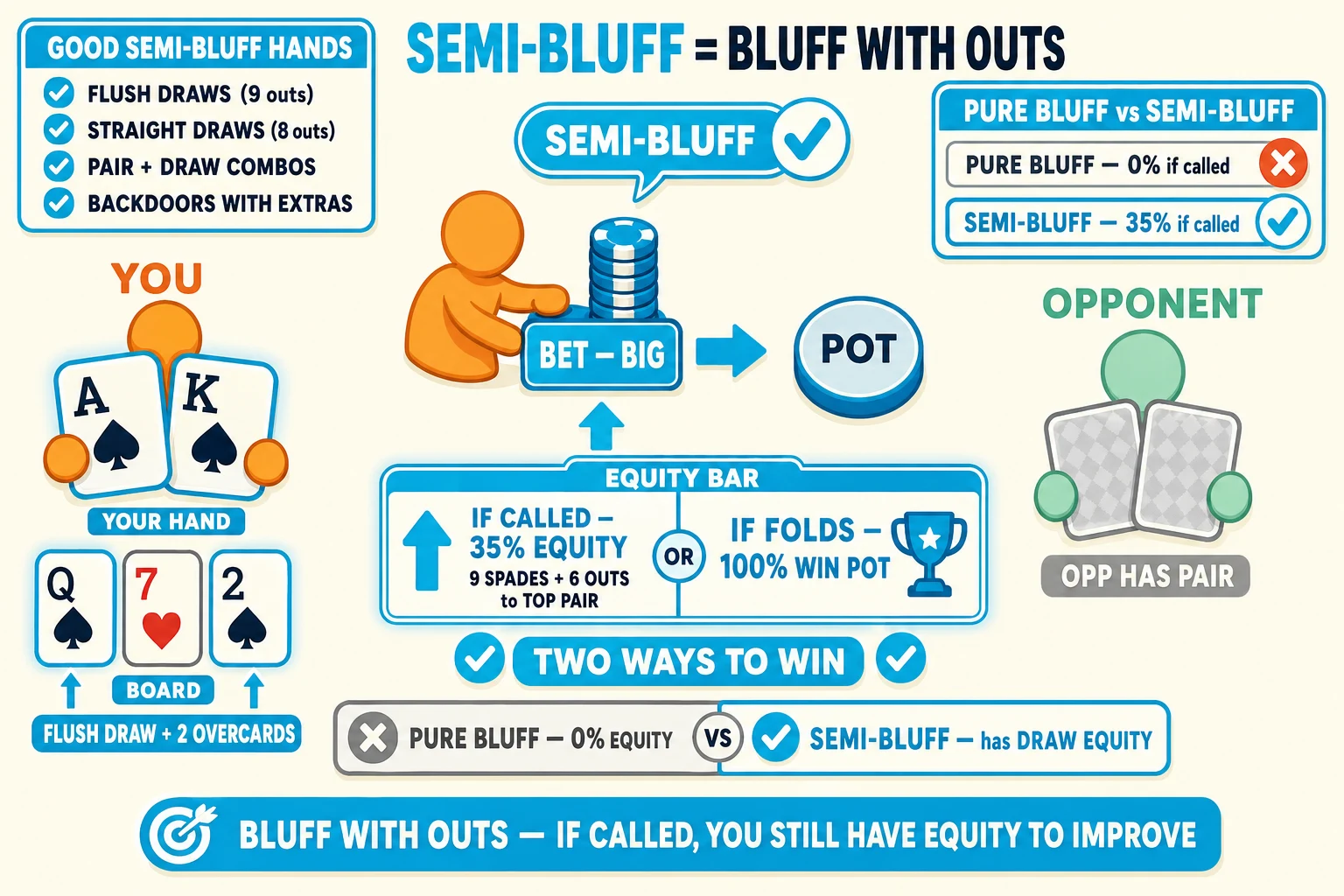
A semi-bluff is a bet or raise with a hand that is not currently best but can improve later. Unlike a pure bluff, where you have little chance to win if called, a semi-bluff gives you two ways to win: your opponent folds, or you hit a draw and win at showdown. Example: you hold A♠K♠ and the flop is Q♠7♥2♠. You lack a made pair but have a flush draw and two overcards. A bet can take the pot immediately or let you complete the flush or make top pair later.
Practice this in Poker Skill. The Bluffing & Semi-Bluffing lesson sorts draws on the flop, betting an open-ended straight draw as a semi-bluff while checking a lone gutshot or a weak flush draw, which play slow.
Get the free appSemi-Bluff
What a semi-bluff is
A semi-bluff is a bet or raise with a hand that is not currently best but can improve later. Unlike a pure bluff, where you have little chance to win if called, a semi-bluff gives you two ways to win: your opponent folds, or you hit a draw and win at showdown. Example: you hold A♠K♠ and the flop is Q♠7♥2♠. You lack a made pair but have a flush draw and two overcards. A bet can take the pot immediately or let you complete the flush or make top pair later.
Why semi-bluffs work: fold equity + outs
Fold equity is the chance your opponent folds to your bet, turning aggression into an immediate win. Outs are the cards that improve your hand on later streets (for example, the nine remaining spades that complete a flush). A semi-bluff combines both: even when called you still have realistic chances to win later. When deciding to semi-bluff, estimate how often your opponent must fold for the play to be profitable. If your bet has little fold equity, you must rely more on your outs; if you have many outs and fold equity, the play becomes stronger. Concrete example: you have 10♠9♠ on a flop of J♠8♥2♣. You have a flush draw and backdoor straight possibilities. A raise here pressures middle-pair hands to fold while leaving you multiple outs to improve.
Choosing hands to semi-bluff
Use hands with real drawing potential:
- Flush draws - four to a flush (usually nine outs unless blockers or paired boards change counts).
- Straight draws - open-ended (about eight outs) or strong one-card draws.
- Pair + draw combos - a small pair plus a flush or straight draw keeps some showdown value.
- Backdoor draws - weaker, but playable when combined with other features. Avoid pure air hands with little chance to improve if called. Prefer holdings that can still win at showdown (pair+draw), since that reduces risk when called.
Position and timing for semi-bluffs
Acting after your opponent matters because it lets you control pot size and gather information before committing more chips. Semi-bluffs work best in position. Out of position can still work when you expect a continuation bet (c-bet - a follow-up bet after taking the lead preflop) or clear postflop weakness. Pick the spot carefully: don’t semi-bluff players who rarely fold or who are already pot-committed. Example: on the turn you’re in position and the opponent checks; a well-timed semi-bluff can take the pot or leave you backdoor outs if called.
Bet sizing, aggression, and risk management
No-Limit games allow larger bet sizes, which increase pressure and fold equity. Use size to force difficult calls, but manage risk: oversized semi-bluffs can cost large portions of your stack when they fail. Guidelines:
- Size bets large enough to push marginal hands off the pot, but not so large a miss ends your game.
- Consider stack-to-pot ratios: with shallow stacks a semi-bluff often becomes a shove; with deep stacks a smaller semi-bluff preserves future play.
Common mistakes and when not to semi-bluff
- Don’t semi-bluff against players who rarely fold or call down with marginal hands.
- Avoid semi-bluffing with almost no outs or when pot odds make calling correct.
- Don’t overcommit with huge bets when your remaining stack or equity doesn’t justify it.
Quick checklist
- Do I have real drawing potential (flush, straight, or backdoor draws)?
- Will my bet create enough fold equity versus this opponent?
- Am I in position or reading clear weakness from the opponent?
- Do stack sizes and pot odds make a semi-bluff a manageable risk?