


Pure Bluff
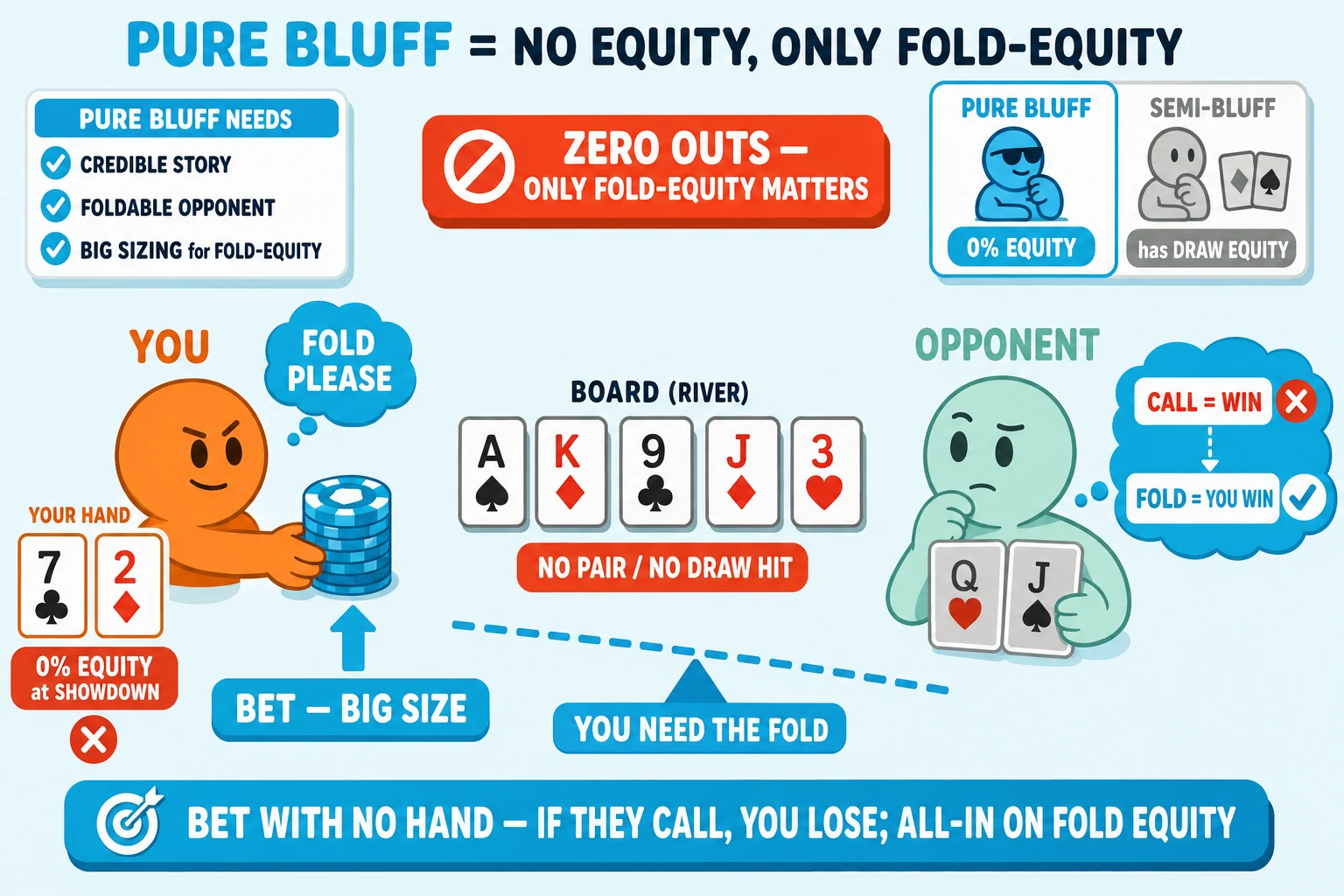
A pure bluff is a bet or raise with a weak or non-existent hand meant to make opponents fold. It cannot realistically win at showdown unless everyone folds before the showdown. A pure bluff relies entirely on fold equity - the chance an opponent folds to your bet - not on cards that can improve your hand. An "out" is any unseen card that can improve your hand; pure bluffs have no outs.
Practice this in Poker Skill. The Bluffing & Semi-Bluffing lesson has a pure bluff on the flop, where a hand with no pair and no draw bets a paired 5-5-8 board because that flop misses the caller too.
Get the free appPure bluff in No-Limit Texas Hold’em
What a pure bluff is
A pure bluff is a bet or raise with a weak or non-existent hand meant to make opponents fold. It cannot realistically win at showdown unless everyone folds before the showdown. A pure bluff relies entirely on fold equity - the chance an opponent folds to your bet - not on cards that can improve your hand. An “out” is any unseen card that can improve your hand; pure bluffs have no outs.
Example: You hold 7♣2♣ and the board runs A♠ K♦ 9♣ J♦ 3♥. You have no pair and no draw. A large river bet here is a pure bluff: you have essentially no chance to win if called, so your goal is to force a fold.
Pure bluff vs semi-bluff
The difference is improvement potential. A semi-bluff contains a drawing hand that can become the best hand later, mixing fold equity with real card equity. A pure bluff has neither.
Concrete contrast:
- Semi-bluff example: You hold A♣ Q♣ on K♣ 7♣ 2♦. You have a flush draw and might bet to take the pot now or win bigger if you hit.
- Pure bluff example: You hold 9♦ 3♦ on a river of A♦ K♦ Q♦ J♣ 8♠. A river shove here is a pure bluff - it only wins if opponents fold.
Timing and board context matter more for pure bluffs because you must force immediate folds; you can’t rely on future cards.
When to use a pure bluff
Pure bluffs are situational. Use them when:
- Opponents are capable of folding decent hands, like tight or risk-averse players.
- The board and your prior betting line credibly represent a strong hand you could plausibly hold.
- Bet sizes create leverage - larger bets increase fold equity in the right spots.
- Stack sizes shape fold equity: deep stacks make folds harder; short stacks increase shove fold equity.
Example: You opened preflop and c-bet flop and turn. The river brings a card that completes a story your line suggested, such as a third diamond after you represented diamonds. A well-timed pure bluff can succeed.
Bluffing frequency and exploitability
Balance pure bluffs with value bets. Bluff too often and opponents call more, exploiting you. Bluff too rarely and you leave value on the table.
On the river, use bluff-to-value ratios and consider the opponent’s minimum defense frequency - the fraction of hands they must continue with to avoid being exploited. Over-bluffing invites punishment; under-bluffing reduces long-term profitability.
Psychological and strategic considerations
Read tendencies: is the opponent a light caller or a folder under pressure? Weigh pot odds, fold equity, stack sizes, and board texture. Build a coherent story with your betting line so your actions plausibly represent a strong hand.
Execution steps:
- Confirm you have sufficient fold equity against this opponent and bet size.
- Ensure the board texture and betting line credibly represent strength.
- Target opponents likely to fold rather than those who call down light.
- Bluff with conviction - hesitation often telegraphs weakness.
Checklist:
- Confirm fold equity before committing chips.
- Make sure the betting line and board tell a believable story.
- Choose opponents and spots where folds are likely.
- Balance bluff frequency with value betting to avoid exploitation.
- Execute cleanly and confidently.