


Push-Fold
Push-fold is the short-stack tournament mode where every preflop decision compresses into one binary fork: shove all-in or fold. Min-raises and small opens stop earning enough at low stack depth, so a chart of position, stack size, and hand replaces the usual open-raise game. ICM pressure on the bubble shifts the call and shove bars away from the chip-EV baseline.
Push-fold: the short-stack mode where preflop collapses to two actions
What push-fold means (quick definition)
Push-fold is the short-stack tournament mode where every preflop decision compresses into one binary fork: shove all-in, or fold. The mode is triggered by effective stack. Once you have roughly twelve big blinds or fewer, normal opens, calls, and post-flop play stop earning enough to justify the chips you put in, so the strategy collapses to a chart keyed on position, stack size in BB, and your exact hand. The chart’s output is one of two things, the rest of the menu falls away, and the day’s reading list shrinks to “is this hand on the chart at this depth from this seat.”
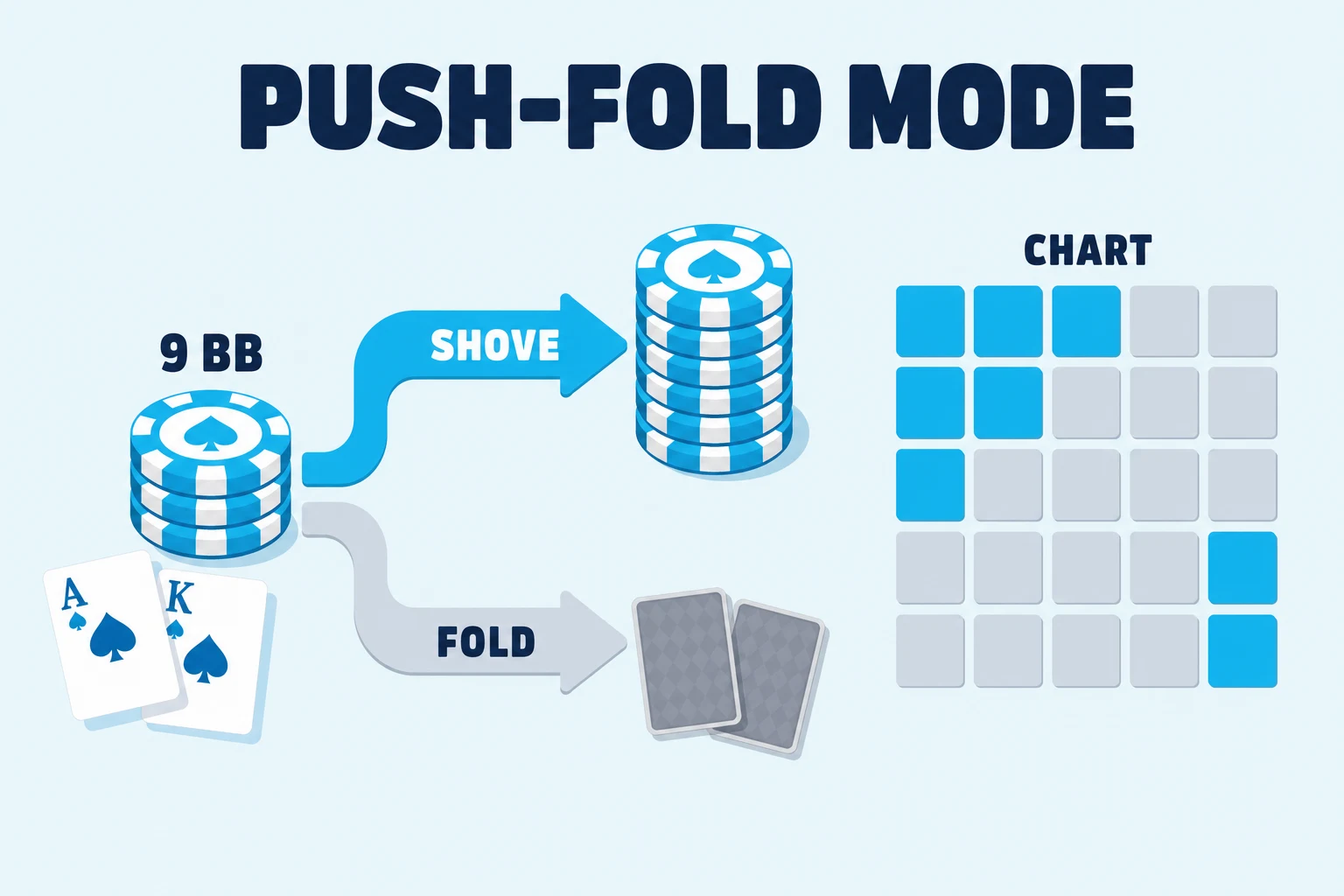
A useful mental shortcut: push-fold is a mode of play, not an action. The action you take inside the mode is a shove or a fold. The chart you use to decide which one is built on the assumption that those are your only options. If you start mixing in min-raises and small opens, you are no longer running push-fold; you are running a different (often more exploitable) hybrid.
Related terms
Push-fold versus shove-fold and Nash push-fold
These three pages travel together but answer different questions. Sending a reader to the right one is half the job.
| Term | What it names | Where it lives | Read when you want |
|---|---|---|---|
| Push-fold (this page) | The short-stack mode of play | the table while you act | the mode itself: when it starts, why min-raises stop, how the chart is used |
| Shove/fold | The action framing of push-fold | the live hand | step-by-step chart-reading and hand-type priorities (blockers, suited connectors, small pairs) |
| Nash push/fold | The equilibrium chart the mode is built on | the study session | the math behind the chart and the solver/app references that generate the ranges |
A reader who asks “what is push fold poker?” wants the mode primer, which is this entry. A reader already in the hand who wants the action checklist wants shove/fold. A reader at home with a solver who wants the equilibrium math wants Nash push/fold. All three exist because the same concept has three honest sub-intents and a single page that tries to serve all of them ends up serving none.
When push-fold mode starts (and ends)
The mode is keyed on effective stack in big blinds, modulated by position and ante presence. Books name the boundaries roughly, not exactly, because the right cutoff depends on how the players behind you are playing.
When the mode is fully on:
- 8–12 BB or fewer in any unopened pot. This is the cleanest push-fold zone in the books. Min-raises and small opens stop being attractive because they often create a raise-fold spot a thinking opponent can attack with a jam.
- Around 5–10 BB across all positions in late stages. Shoving frequencies climb sharply as the stack gets shorter; from the small blind at five BB you can shove most playable hands without needing post-flop play.
- Sub-25 BB in opened pots. When the action is on you and someone has already opened in front, your reshove range often collapses to a binary “all-in or fold” because flat-calling out of position with a shallow stack burns chips you cannot get back.
- In tournaments with a fast structure. Hyper-turbos, satellites, and late-stage MTTs spend most of their hands inside the mode by design.
When the mode is partly off (the in-between zone):
- About 12–25 BB in unopened pots. Min-raise/push/fold and limp/push/fold hybrids start to win at some tables; pure push-fold starts to leak EV against opponents who do not jam wide enough over your opens.
- The small blind from 10 to 17 BB. Solver work treats this as a push/limp/fold zone rather than a pure push/fold zone: limping high-equity hands that can call a jam and shoving the medium-equity hands that struggle to call one.
- Once antes appear. A 12.5% ante can widen a 12 BB cutoff push from roughly 22% of hands to about 33%. Same depth, much wider range, and forgetting the ante is one of the most expensive structural mistakes in this mode.
When the mode is fully off:
- Around 25 BB and deeper in unopened pots. A non-all-in raise size starts to win EV again; the small blind’s open-push range begins to disappear; standard preflop play returns.
- In cash games at any depth. Chips equal dollars, so there is no diminishing chip value driving the move toward all-in commitment, and the table depth keeps post-flop play live.
Example: 9 BB on the button, action folded to you
You have 9 big blinds in a six-max tournament with no antes, the action folds to you on the button, and you look down at A♠ 5♠. The two players left to act have similar stacks.
Reading this in push-fold mode:
- Confirm you are in the mode. 9 BB effective with the action folded to you on the button is squarely inside the pure push-fold zone. There is no useful min-raise size — a 2x open commits about 22% of your stack and creates an obvious raise-fold spot.
- Look the hand up on the chart. A 5 suited from the button at 9 BB is a comfortable shove in the chip-EV chart. Suited Ax has good equity against the calling ranges of the blinds, blocks some of their stronger Ax combos, and plays badly post-flop with a 9 BB stack — exactly the profile push-fold mode wants to commit with.
- Decide: shove all-in. The output is one of two things and the chart says shove. You jam your 9 BB and play out whatever the blinds do.
- Layer the table read. If the big blind has been calling jams much wider than the chart assumes (say, any Ax or any pair), tighten down: drop A 5 suited and keep A 9 offsuit and 9-9. If the big blind has been folding too much, you can widen further than the chart and shove with hands like K 8 suited or J 10 offsuit.
Now change one variable. Move this hand to the money bubble of a flat-paying tournament where five players are still to bust before everyone cashes, and put a covering chip leader in the big blind. The chart did not change, but the mode’s right answer did: under ICM pressure, the chip leader can call your push much narrower than the cEV chart assumes, which means your fold equity goes up. The shove with A 5 suited is still fine; the call with A 5 suited if the chip leader jams over your open is now a clear ICM mistake. The chart is your baseline; ICM is the override.
Common mistakes
1) Limping or min-raising at 8–12 BB out of habit
The single biggest leak in this mode. A player who learned tournament poker at 50 BB tries to “see a flop cheap” with a small open at 9 BB and walks straight into a re-shove they cannot call. Push-fold charts assume the menu is two items. If you start mixing in min-raises and limps, you are no longer running the chart you think you are running, and a thinking opponent who notices will jam over your opens with a wide range and bleed your stack one fold at a time. Pick one mode per session at this depth and stick to it.
Poker Skill’s First In: Don’t Limp lesson builds the no-limp half of this habit at 100 big blinds, where every hand first in is a raise or a fold.
2) Calling shoves wider than you push them
Push wide, call narrow. The natural read at 8–12 BB is to play tight against a shove because your tournament life is on the line; the actual right answer for the short stack is the opposite from the shoving side: aggressive jamming, narrow call-offs. Chart calling ranges are usually meaningfully tighter than chart shoving ranges from the same seat, and the closer you are to the money the more that gap widens. Hands that jam fine become folds when you are the one facing the jam.
3) Forgetting the ante and reading the wrong chart
The ante is part of the mode’s input. A 12 BB cutoff stack with no ante shoves about 22% of hands; the same stack with a 12.5% ante shoves about 33%. That is a different chart — same seat, same depth, much wider range. Players who ignore antes either fold profitable shoves (when antes are live) or shove unprofitable ones (when they are not). Before each hand, count the chips that are already in the middle from blinds and antes; that number drives which chart you are reading.
4) Treating the chart as the answer instead of the baseline
Push-fold charts are built from chip-EV equilibrium math. They assume the player calling your jam has a reasonable calling range and that no payout structure is distorting the decision. Two things break that. First, the table — a big blind who calls any Ace at 9 BB needs you to drop A 5 suited and add 9-9; a big blind who folds too much needs you to widen further than the chart. Second, the bubble — push/fold charts do not apply on the bubble in the way they apply five hundred from the money. Treating the chart as the final answer in either case ships chips back to opponents who have already adjusted around it.
FAQ
Is push-fold the same as shove/fold or Nash push/fold?
Same concept, three honest sub-intents. Push-fold is the mode of play — when it starts, why min-raises stop, how the chart is used at the table. Shove/fold is the same idea framed as the action you take inside the mode and the hand-type priorities for it (blockers, suited connectors, small pairs). Nash push/fold is the equilibrium chart the mode is built on — the math, the solver and app references, and the practical execution recipe inside the equilibrium frame. Most readers searching “push fold” are after the mode primer and click into one of the other two for the next step.
What stack depth should I switch to push-fold?
The cleanest single number from the books is roughly twelve big blinds in an unopened pot. Below that, pure push-fold is usually right; the mode is fully on, and the 10 big blind push/fold charts cover the seats you will be shoving from. Between twelve and twenty-five big blinds you are in an in-between zone where push-fold still wins at many tables but min-raise/push/fold and limp/push/fold hybrids can pick up extra EV against the right opponents. Around twenty-five big blinds and deeper, normal preflop play returns and the open-push range disappears for most seats. The small blind compresses earlier than the other seats — solver work treats ten to fifteen big blinds there as a push/limp/fold zone, not pure push-fold.
Does push-fold work in cash games?
Effectively no, except as a thought experiment for very specific short-stacked formats. Cash games convert chips to dollars one for one, so there is no diminishing chip value driving you toward stack-committing decisions, and most cash tables seat at hundred big blinds or deeper where post-flop play is the whole game. The mode is a tournament artifact: it exists because escalating blinds force stacks down into the eight-to-twelve big blind range where post-flop maneuvering stops being a profitable use of chips, and because the dollar ladder magnifies the cost of mistakes in marginal preflop spots. In cash, none of that applies and the chart never opens.