


Shove/Fold
Short-stack preflop strategy: either move all-in or fold, no raises and no calls. Used in tournaments around 15bb and below, where post-flop play stops being profitable.
Shove/Fold: Push/Fold Strategy for Short Stacks
When to use shove/fold Shove/fold (push/fold) means either moving all-in (shove) or folding preflop. Use it mainly in tournaments when you have a short stack measured in big blinds (bb, the forced blind size). The strategy applies when your stack, position, and hand make post-flop play infeasible or low expected value. For example, on the button with 8bb, many hands that call or raise with deeper stacks are better shoved. Shoving captures maximum fold equity (opponents folding to your all-in) and avoids complex post-flop decisions. When a normal raise commits most chips or leaves you in awkward spots, prefer shove/fold.
Two pages carry this further. The push/fold charts give the shove range for your exact depth and seat, and push/fold made simple walks through the decision hand by hand.
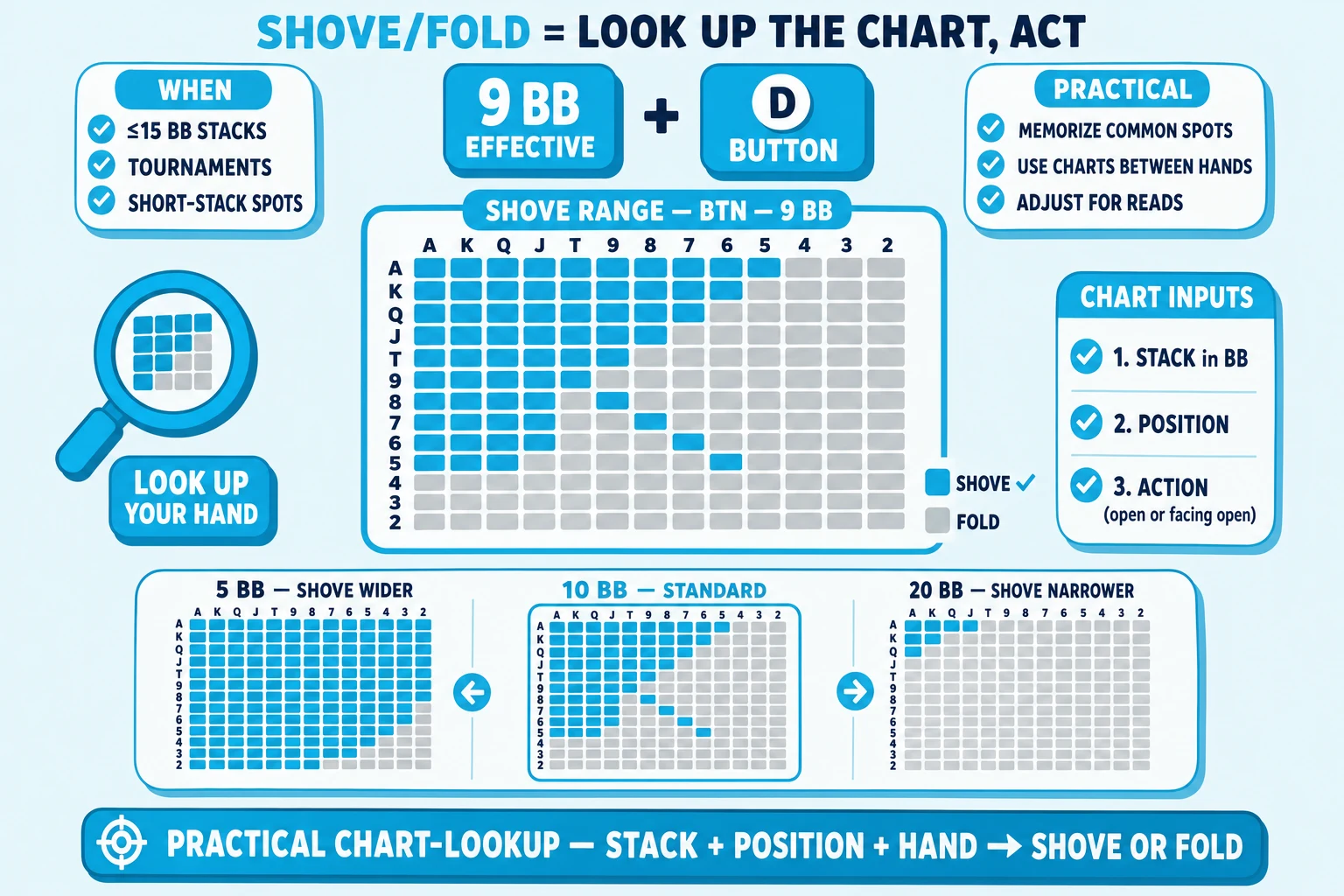
Reading and applying push/fold charts Push/fold charts list hands profitable to shove from each position at specific big-blind depths. Think of them as default guides for short-stack spots. Quick steps to use a chart:
- Note your exact big-blind depth (for example, 7bb or 10bb).
- Find your position (under-the-gun = first to act, button = dealer position, small blind, etc.).
- Read the chart’s recommended shove range for that position and bb depth.
- Adjust for table factors described below.
Example: a chart might show A8s (Ace-eight suited) is a shove from the button at 9bb but not from early position at the same depth. Tools like HRC (Holdem Resources Calculator) generate these ranges and give maximum push sizes; use them to translate theory into practical shove ranges.
Hand types to prioritize for shoving Some hands carry more intrinsic shove value. Blockers are cards that reduce opponents’ likelihood of holding specific strong combos (for example, an Ace in your hand blocks many opponents’ Ace-containing combinations).
- Blocker hands (Ax, Kx): Aces or Kings reduce opponents’ strong Ace/King combos, increasing fold equity. Example: A5s on the button is often shoveable at 9-10bb.
- Suited connectors (e.g., 76s): Cards that connect and share suit. They offer straight and flush potential plus fold equity, making them viable late-position shoves.
- Small pocket pairs (22-66): These have showdown value if called and often perform well against typical callers.
Avoid shoving very weak offsuit hands from early position where charts require stronger holdings.
Position and stack-depth adjustments Position matters: later seats (button, small blind) allow wider shoves because fewer players remain to act and you pick up more blind steals.
Poker Skill’s Button: Raise or Fold lesson gives this reason for a wider range at 100 big blinds, with only the blinds left to act, though the move there is a raise rather than a shove.
Stack-depth rules of thumb:
- ≤10bb: ranges widen significantly; many hands become profitable shoves. Example: with 9bb on the button, A9o, KTo, and many suited hands can be shoved.
- 15-20bb+: shift away from automatic shoves toward non-all-in raises and post-flop play; shove ranges tighten.
- <40bb: 4-bets (a re-raise after a raise and re-raise) are typically all-in shoves because smaller 4-bets either commit you or give opponents too good a price to call.
Strategic and exploitative considerations Use Game Theory Optimal (GTO) push/fold solutions as your baseline, then adjust exploitatively. If opponents over-fold to shoves, widen aggressively. If they call too loosely, tighten up. Shoving maximizes pressure, and it is especially valuable when a normal raise would commit a large fraction of your stack or when you need to simplify play. At a tight table, shove a wider button range; at a loose table where calls are cheap, restrict shoves to stronger holdings.
Quick checklist
- Check the push/fold chart for your exact big-blind depth and position before shoving.
- Prioritize blockers, suited hands, and pocket pairs when widening shove ranges.
- Widen aggressively in late position and tighten in early position.
- Shift to non-all-in raises as stacks approach 15-20bb; treat 4-bets as shoves under ~40bb.