


Early Position
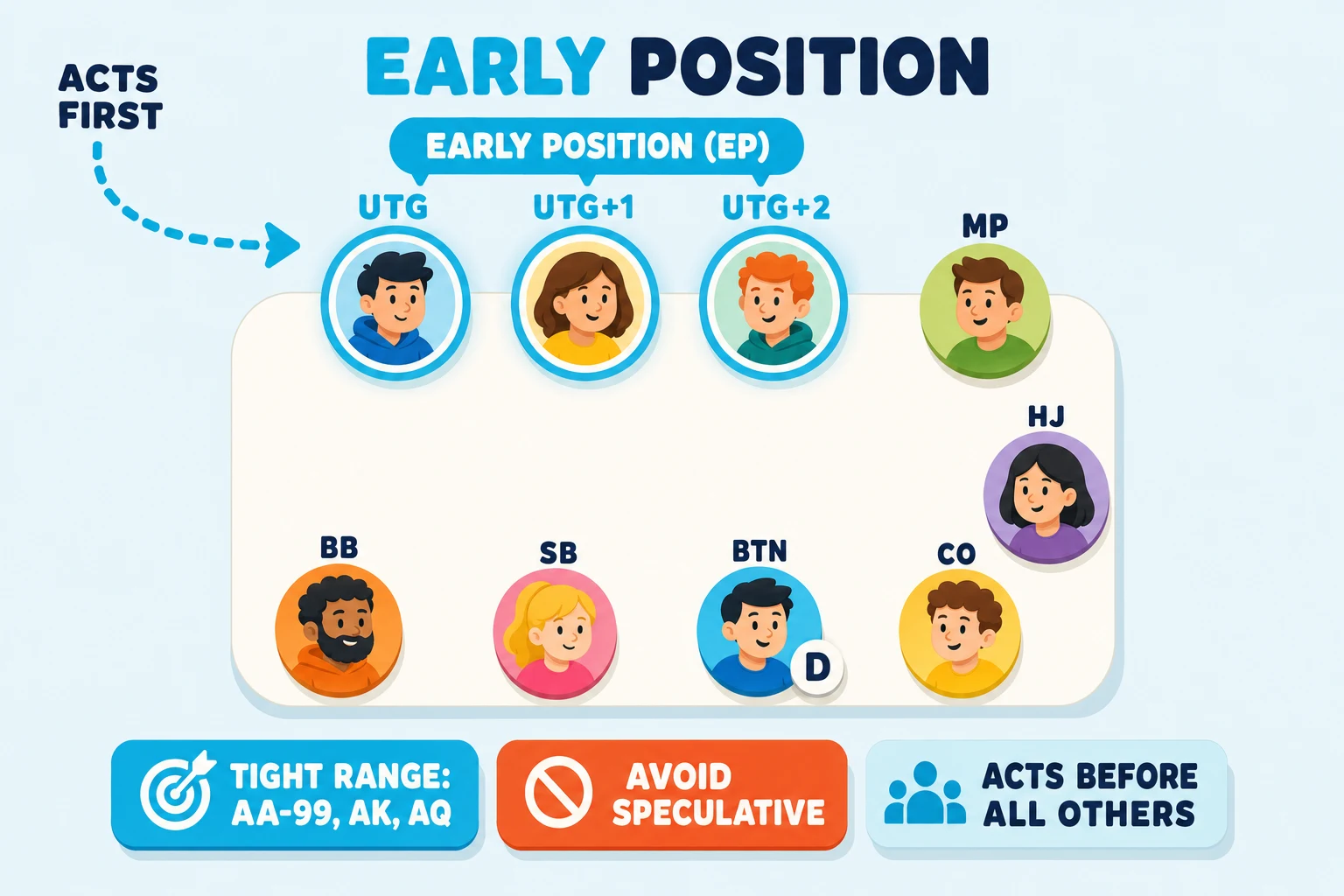
Early position (EP) means the seats immediately after the blinds at a full-ring table: UTG, UTG+1, and UTG+2. Players in EP act early on every post-flop street and therefore make decisions with less information than later actors. That reduced information and control changes which hands you should open and how you play them.
Practice this in Poker Skill. At its six-seat tables the under-the-gun seat acts first, and the lesson on that seat keeps the range tight: K♦ Q♦ is a raise, while J♣ 10♦ and Q♥ 10♦ are folds.
Get the free appEarly Position
Define Early Position (UTG, UTG+1, UTG+2)
Early position (EP) means the seats immediately after the blinds at a full-ring table: UTG, UTG+1, and UTG+2. Players in EP act early on every post-flop street and therefore make decisions with less information than later actors. That reduced information and control changes which hands you should open and how you play them.
Why Early Position Is Disadvantageous
Acting first gives you little information because opponents respond after seeing your action. You lose control of pot size and allow later players to apply pressure. More players left to act increases the chance someone holds a stronger hand or will raise. Speculative and marginal holdings become far less profitable when played from EP.
Pre-flop Hand Selection for Early Position
Tighten your opening range in EP. Favor premium hands that perform well when out of position.
- Primary openers: high pocket pairs and strong broadways - AA, KK, QQ, JJ, 99, AK, AQ.
- Avoid most speculative hands: small suited connectors (e.g., 6♠5♠), weak aces (e.g., A8o), and other holdings that need deep stacks or favorable flops.
- Rule of thumb: limit EP opens to roughly the top ten hands and fold most others.
Concrete examples: UTG with 9♦9♣ - open. UTG with 7♠6♠ - fold. UTG+1 with AKs - open. UTG+2 with A9o - usually fold.
Post-flop Decision-Making When Out of Position
Post-flop from EP, play your strong made hands aggressively and fold marginal hands to significant aggression.
- If you flop a strong hand (top set, top pair with top kicker), continue aggressively even out of position.
- With medium strength hands (middle pair or weak top pair), prefer pot control: check or check-call rather than build big pots.
- Reduce bluff frequency. Players acting after you can exploit bluffs with pressure or calls.
- Use selective aggression with position-independent equity, such as a strong draw that performs well regardless of turn action.
Example: You open UTG with AQ and the flop is K-8-2 rainbow. If a late player bets, folding is a reasonable option because your kicker is poor and you’re out of position.
Adjusting EP Strategy in No-Limit Cash Games and Tournaments
No-Limit magnifies EP mistakes because one large bet can cost a big portion of your stack. Maintain tight ranges and respect 3-bets (a 3-bet is a pre-flop re-raise) from later positions-often folding unless you hold a premium.
Stack depth matters. Deeper stacks allow a small, cautious expansion of your opening range because implied odds for speculative holdings improve. Still, post-flop complexity keeps EP play conservative.
In tournaments, tighten further when stacks are shallow or ICM pressure is high. Marginal spots can cost laddering value in payouts.
Checklist:
- Identify EP seats (UTG, UTG+1, UTG+2) at your table.
- Open mainly premium pairs and strong broadways from EP.
- Fold speculative hands and reduce bluffing out of position.
- React cautiously to 3-bets and late-position aggression.
- Factor stack depth before widening or narrowing your EP range.