


Effective Nuts
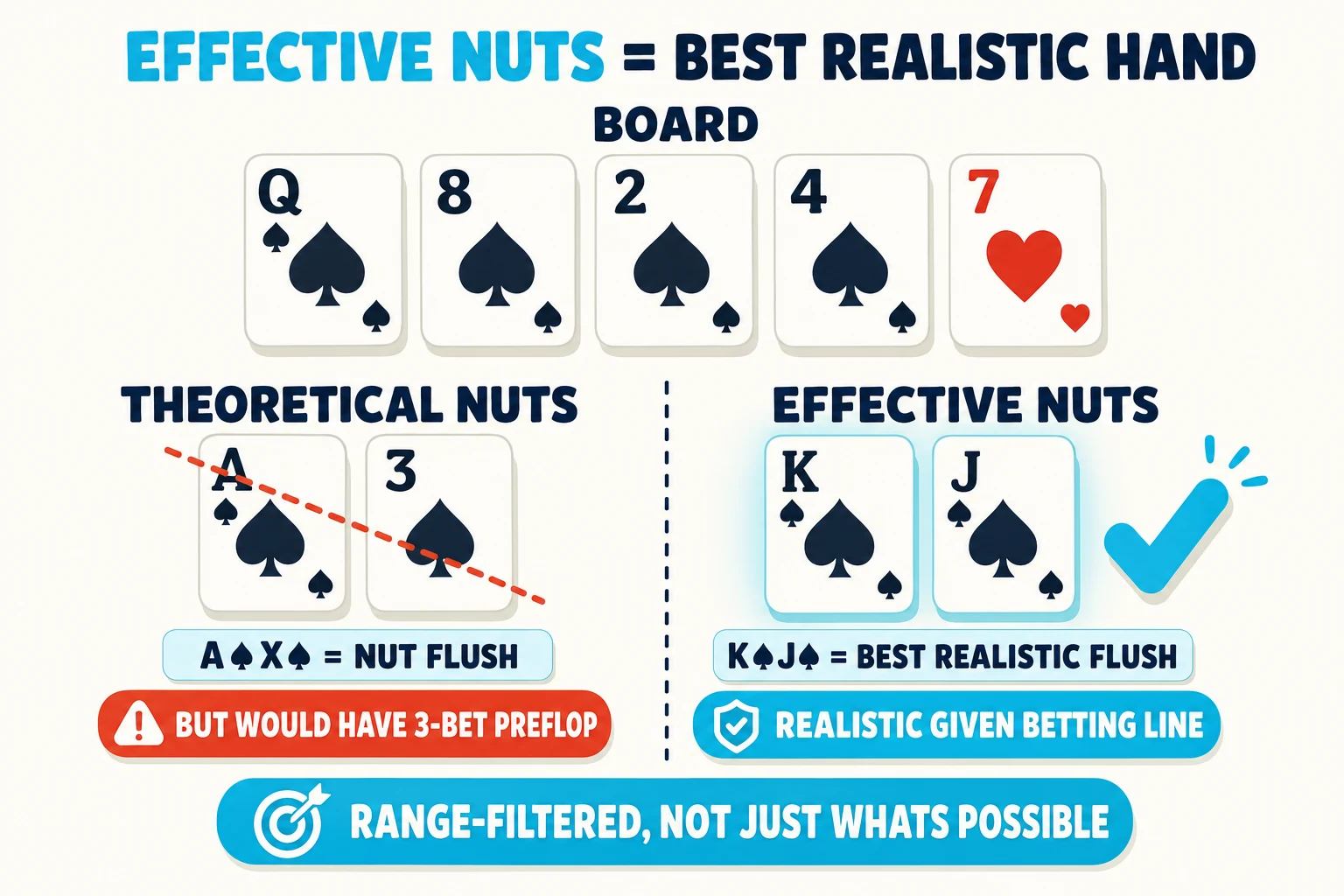
The best hand realistically possible in a spot, given the betting line. The theoretical nut may not be the effective nut once preflop and postflop action rules out the combos that would have played differently.
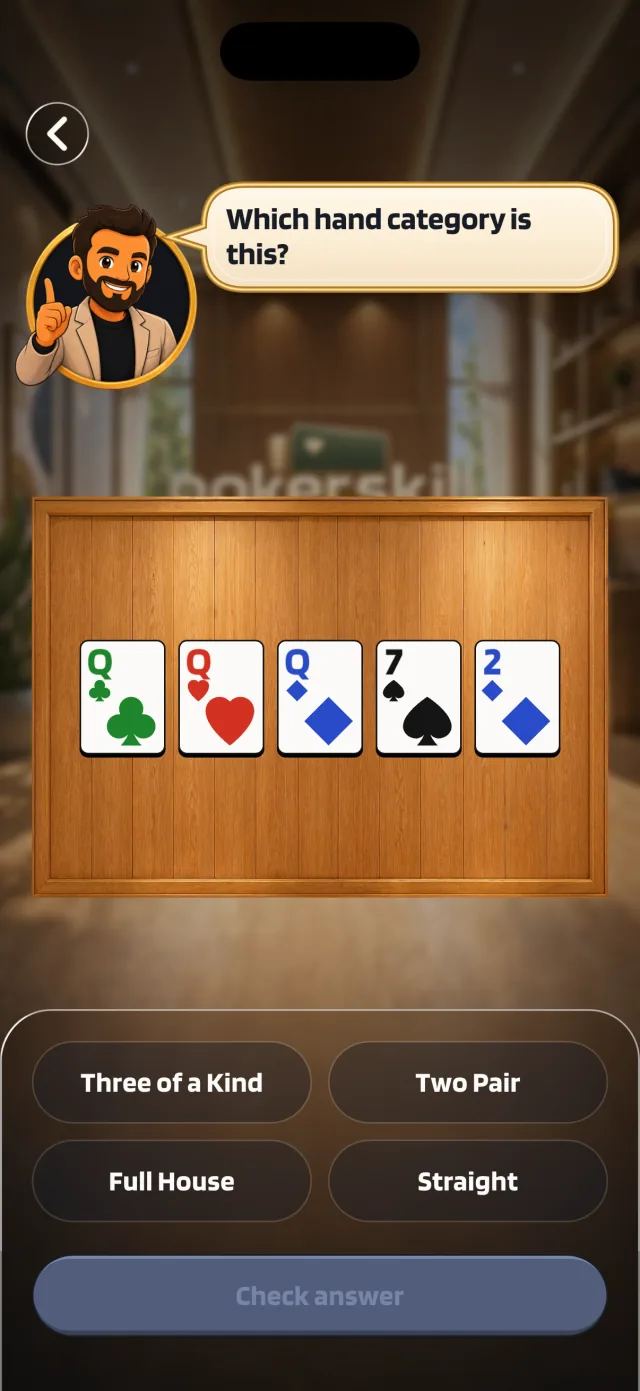
Practice this in Poker Skill. Reading the effective nuts starts with finding the nuts, and the Nut Flushes & Monotone Boards lesson trains that first step: with the A♦ out on A♦ 7♦ 2♦, K♦ 9♣ holds the nut flush draw.
Get the free appEffective nuts in No-Limit Texas Hold’em
What the effective nuts means
The nuts is the absolute best possible hand given the community cards. The effective nuts is the best hand realistically possible in a given spot, after factoring opponent ranges and prior betting. The two often differ.
The effective nuts shifts with each new card and as betting narrows ranges. If a four-flush board makes A♠X♠ the theoretical nut, but the betting line rules out an ace of spades in the opponent’s range, the next-best flush becomes the effective nut. The point of the term is to tell you whether your hand is practically unbeatable, not just theoretically.
Why the effective nuts matters for betting
If you hold the effective nuts, you can value-bet large, overbet, or shove. Few realistic hands call profitably, so polarized lines work well.
It also shapes protection and bluffing. On coordinated boards with many draws, you still need to protect very strong hands. When an opponent’s line is capped, meaning their betting shows a narrow range, you can induce bluffs instead of protecting.
Misreading the effective nuts is expensive. Calling big rivers with second-nut hands because you assumed you were unbeatable is a common leak.
How to identify the effective nuts at the table
Use this read on each street:
- Reassess ranges after every action. Combine board texture with prior bets, raises, and folds to narrow holdings. A preflop limp tells you something different than a 3-bet, and that changes which made hands stay live.
- Ask which hands remain plausible given the line. Cross out combos that would have 3-bet, folded, or led out earlier. An opponent who checked the flop and then checked a coordinated turn is unlikely to hold a hand that would have bet either street.
- Account for blockers. Cards in your hand reduce opponent combinations. The ace of the flush suit cuts nut-flush combos roughly in half.
- Repeat on the turn and river. The effective nuts can flip on a single card that completes straights, flushes, or full houses.
For example, when the river pairs the board, full houses become possible. Ask whether the earlier passive line makes those full houses realistic. If villain played quietly and missed the draws on the way, your two pair can be the effective nuts.
Betting and sizing when you have the effective nuts
If you are confident you are ahead of the realistic calling range, lean polarized. Big value bets and overbets pull more from stubborn second-best hands than smaller bets do.
If you want weaker hands to stay in, pick the size their hand can call. On dry boards, smaller bets coax calls from top pairs and two pairs. On coordinated, draw-heavy boards, bigger bets charge the rivered draw and protect equity at the same time.
When range certainty is low, balance value and protection. Avoid overcommitting with hands that might be second best; smaller bets let you fold to aggression while still pulling some value.
Common pitfalls and how to avoid them
- Overconfidence in absolute-nuts status: a later card can create combinations you did not see coming.
- Ignoring action history: heavy river betting almost always means you are behind. Be willing to fold second-nut hands.
- Skipping range review: without going back over hands, you will keep missing the impossible combos and misjudging the effective nuts.
Quick checklist
- Reassess the nuts on every street, using action and board texture.
- Think in ranges, not single hands, when judging whether you have the effective nuts.
- Pick a size that maximizes calls from worse hands while accounting for plausible stronger combos.
- Fold strong-but-second-best holdings to decisive aggression on coordinated boards.
- Review sessions to spot recurring misreads.