


Street
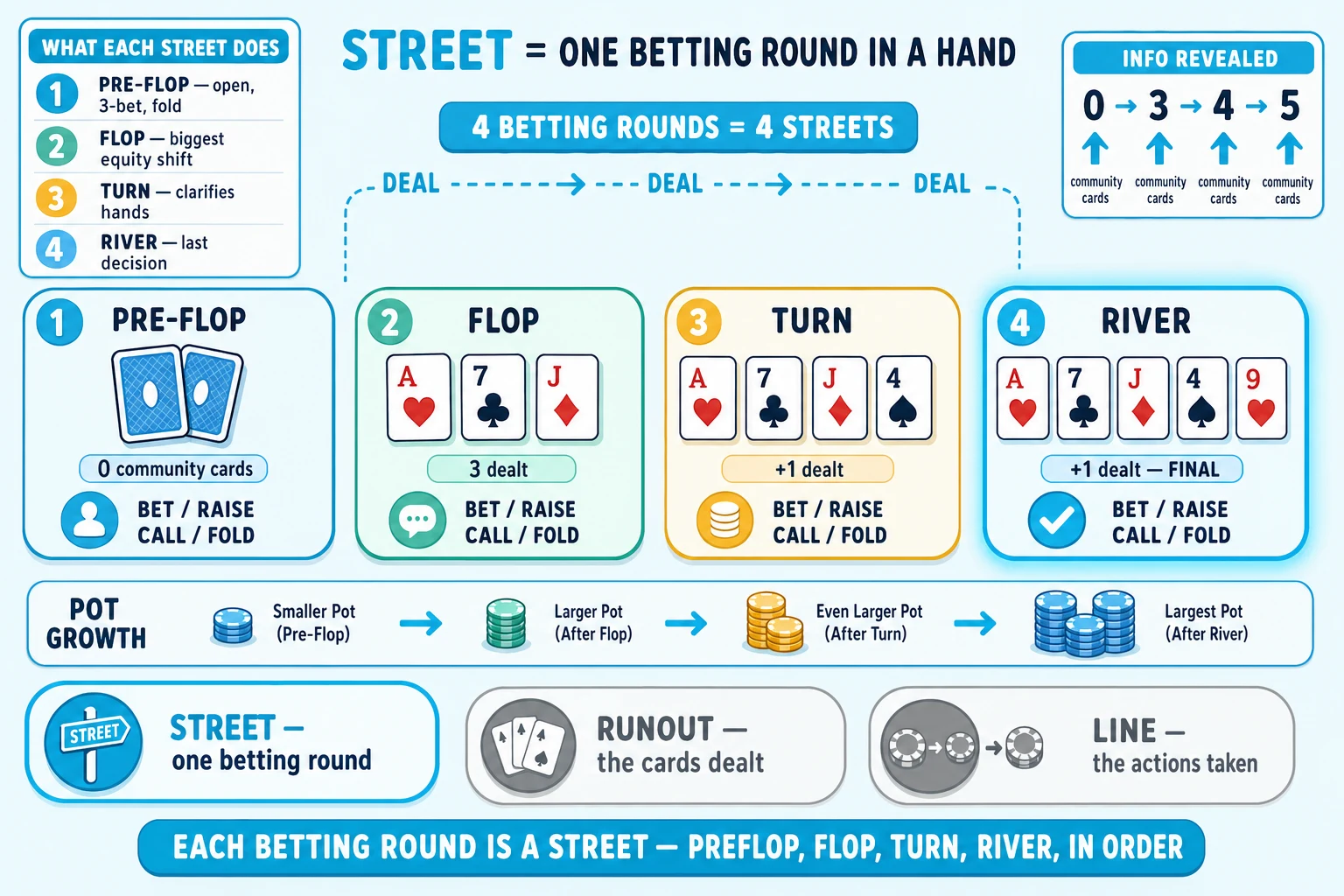
A "street" names each stage when community cards are dealt and another betting round occurs. In No-Limit Texas Hold'em you combine two private cards (hole cards) with community cards to form the best five-card hand. Streets follow a fixed sequence through the hand:
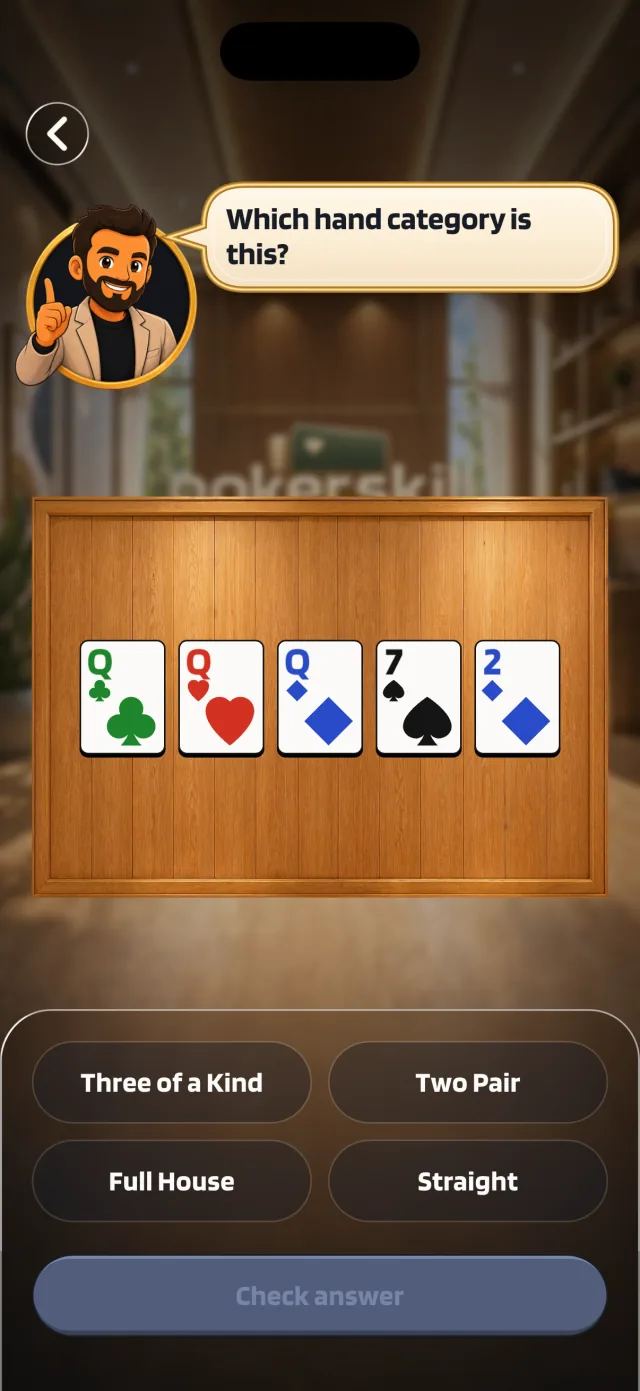
Practice this in Poker Skill. The strategy lessons run street by street: preflop raise-or-fold decisions first, then flop bets and checks, then whether the turn earns a second barrel.
Get the free appStreet in No-Limit Texas Hold’em
What a street is
A “street” names each stage when community cards are dealt and another betting round occurs. In No-Limit Texas Hold’em you combine two private cards (hole cards) with community cards to form the best five-card hand. Streets follow a fixed sequence through the hand:
- Pre-flop betting (after hole cards are dealt).
- The flop (three community cards are dealt).
- The turn (one more community card).
- The river (final community card).
- Showdown, if two or more players remain, when hole cards are revealed.
Knowing the current street tells you how much information is visible and how much pot and stack commitments can still change.
The flop (first postflop street)
The flop is the first post-preflop street: three community cards are dealt face up and a new betting round begins. This street often causes the biggest jump in hand strength because players can now make stronger combinations. Board texture - how coordinated or “wet” the flop is - matters for strategy and equity. A dry flop (disconnected cards with mixed suits) favors made pairs and single-pair holdings. A wet flop (connected cards or two of the same suit) produces many draws, like straight draws and flush draws that need one more card. For example, holding two cards of a suit while the flop shows two of that suit gives you a flush draw and a reason to continue or semi-bluff. Read the flop to update ranges: who could already have a made hand, who is drawing, and who might be bluffing. Use bet sizing and opponents’ earlier actions to narrow those possibilities.
The turn (fourth street)
The turn deals a fourth community card and opens the fourth betting round. This card often clarifies hands: some draws complete while others get blocked, and made hands usually strengthen. Pots are typically larger by the turn, so chasing draws becomes more expensive in absolute terms. That forces clearer strategic choices: apply pressure with a strong but vulnerable hand, fold marginal holdings, or convert earlier semi-bluffs into value bets when a draw completes. Players also use the turn to shape the narrative they will present on the river - continuing aggression or deliberately slowing down.
The river (fifth street)
The river is the final community card and the last betting round before showdown. It often decides hands by completing or busting draws and by confirming made holdings. River play typically polarizes: players bet with clearly strong made hands to extract value or bluff to represent that strength. Middle-strength hands face the toughest choices, because continuing depends on how believable your line is and how opponents acted on prior streets.
How streets affect betting and strategy
No-Limit betting freedom makes street-by-street adjustments essential. Early streets serve information gathering: size bets to protect equity, probe ranges, and shape future action. Later streets focus on extraction and pressure: the turn usually increases pot commitments; the river forces final decisions to get paid or fold to polarized aggression.
Quick checklist
- Recognize the current street and count visible community cards.
- Assess board texture each street to update ranges and draw odds.
- Increase bet sizing and pressure as pots grow, especially on the turn.
- Polarize river actions: commit with strong made hands and bluff selectively when your prior line supports the story.