


Suckout
A suckout is a poker hand where the player who was behind catches the card they needed to win, often after chips went in with the favorite ahead. It is the underdog catching the runout. The same pot looks like a bad beat from the favorite's side and a suckout from the winner's side. Calling every loss a suckout muddles review, so the term works best when the favorite was actually favored at the moment of all-in.

Practice this in Poker Skill. The Outs II lesson puts numbers on how often a draw catches up, about 35% by the river for a nine-out flush draw and about 17% for a gutshot.
Get the free appSuckout (also “sucked out” / “got sucked out on”)
What a suckout is
A suckout is a poker hand where the player who was behind catches the card they needed to win the pot, usually after chips went in with the other player favored. The mechanic has two halves: the favorite was the favorite at the moment of the all-in, and the underdog hit a card on a later street that flipped the result. From the underdog’s side it is “I caught my card.” From the favorite’s side it is a bad beat. Same pot, two perspectives.
A useful way to keep the term honest:
- Suckout = the underdog caught. Names the mechanic from the winner’s side.
- Bad beat = the favorite lost. Names the same mechanic from the loser’s side.
- Runner-runner = a specific two-card route to a suckout (turn and river both cooperate).
- Cooler = no clean underdog. Both hands were strong, the loser was either always behind or never folding.
The decision-review test that draws the line: was the favorite actually favored at the moment chips went in? If yes, the loss was a suckout / bad beat. If the loser was never ahead, the loss was a cooler or an overplay, and “suckout” is the wrong label.
Related terms
Suckout vs bad beat vs runner-runner vs cooler
Same losing pot, four labels, four mechanics. Sorting them is most of the review work.
| Frame | Whose side it names | Was the favorite actually favored at all-in? | Route the underdog took |
|---|---|---|---|
| Suckout | Winner’s side (“I caught”) | Yes | Any single card or runout that completes the underdog’s hand |
| Bad beat | Loser’s side (“I got beat”) | Yes | Same as suckout, same pot, opposite perspective |
| Runner-runner | Either side | Yes | A specific two-card route where the underdog needed the turn and the river |
| Cooler | Loser’s side (“no clean fold”) | No, both hands were already strong | Equity was already with the winner when chips went in |
A suckout and a bad beat are the same hand viewed from opposite chairs. A runner-runner is a sub-class of suckout where the underdog needed two cards. A cooler isn’t a suckout at all. It sits in a different bucket because no underdog ever caught up; the favorite was the favorite the whole time and there was nowhere to fold.
When the term applies
The label is honest when the favorite was favored when chips went in and the underdog hit a card on a later street. The canonical shapes:
- Two-outer set on the flop or later. The underdog has a small pocket pair, the favorite has an overpair or an over-pocket-pair. The flop or a later card pairs the underdog’s deuces. Roughly 11.8% to flop a set when holding a pocket pair, much smaller per street thereafter. Small enough to feel cruel, common enough to happen.
- Three-outer pair on the river. The underdog has bottom pair against top pair. The river pairs the kicker, making two pair, and wins. Three outs out of forty-four cards on the river is about 6.8% per single card.
- Runner-runner flush or straight. The underdog needs both the turn and the river to cooperate. The all-in equity numbers price this in, so the favorite is well ahead because the runner-runner route is rare. When it hits, the runout tells the story by itself.
- One-outer. The deepest suckout shape, where the underdog has exactly one card in the deck that wins. Roughly 4.3% with one card to come, 8.5% with two. Famous because the math is so unforgiving on the favorite.
- Drawing hand catches. The underdog has a draw (a flush draw, an open-ender, a combo draw) and the river brings the card. This is the most common suckout shape across all stakes because draws appear constantly.
A non-suckout example for contrast: the loser had pocket queens, the winner had pocket aces, all-in preflop. The board ran out clean with no help to QQ. QQ never had a card to “catch”; QQ was behind the whole way and lost the equity fight without a flip. That is just losing the equity. The suckout label needs the underdog to actually catch.
Example: pocket aces vs pocket deuces, 100bb preflop
The cleanest suckout walk at 6-max NLHE cash, 100bb effective stack.
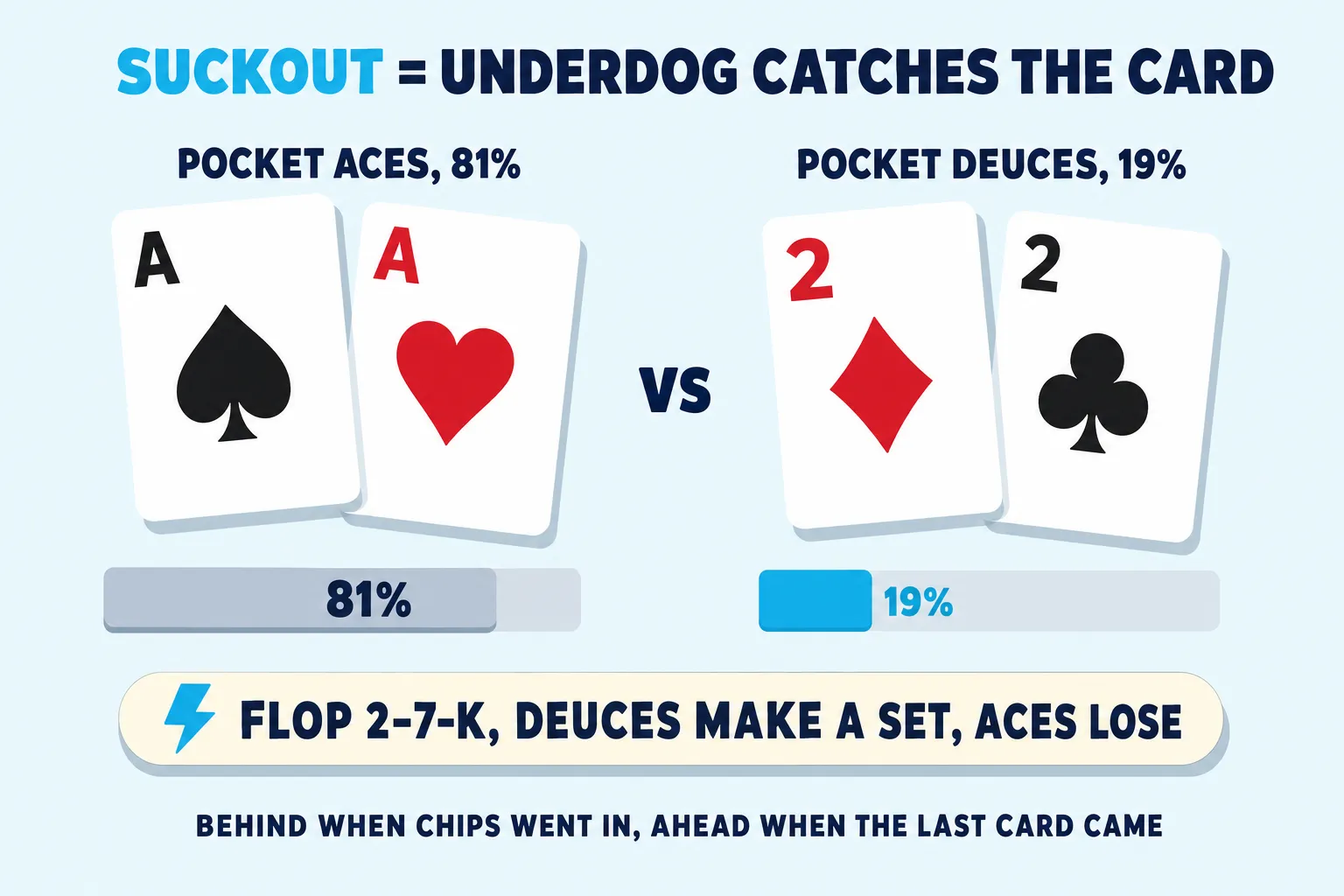
Setup: You open A♠A♥ to 2.5bb from the cutoff. The button calls. The small blind 3-bets to 12bb. You 4-bet to 32bb. The button folds. The small blind jams 100bb with 2♦2♣. You snap-call.
The math:
- AA vs 22 all-in preflop runs about 81% / 19%.
- The pot at the all-in is ~205bb. Your call is 68bb to win 137bb. Break-even equity = 68 / (68 + 137) ≈ 33%. Your 81% is well above the line. EV(call) ≈ (0.81 × 137bb) − (0.19 × 68bb) ≈ 111 − 13 ≈ +98bb vs folding. The call is the easy decision.
- The runout decides who realizes the equity. Two cards to come once the flop lands; the all-in equity is locked at 81 / 19 the moment chips are committed.
The runout:
Flop: 2♦ 7♣ K♥. The deuce hits. 22 makes a set; AA’s equity collapses from 81% to roughly 9%, with the only realistic path being one of the two remaining aces filling up to a bigger set or a runner-runner board pair. Turn 9♥. River J♥. 22 wins. AA goes broke for 100bb.
The label:
This is a textbook suckout from 22’s side and a textbook bad beat from AA’s side. The chips went in 81% / 19% in AA’s favor; 22 caught the two-outer on the flop. The decision was correct (you were getting it in 81% / 19% as the favorite), the result was a one-in-five outcome that landed.
What it isn’t: if AA had folded preflop because “I might run into a set,” that’s giving up an enormous edge to dodge a 19% loss. The suckout is the price of getting paid the 81% of the time the deuces miss. Folding aces in this spot is the actual leak.
Common mistakes when reviewing a suckout
1) Calling a cooler loss a suckout
A cooler is two strong hands colliding with no underdog. The loser was never favored, so the winner never had to “catch” anything. AA vs KK preflop where AA holds is not a suckout from anyone’s side; it is just AA winning the equity it already had. The fix: the suckout label needs an underdog catching the card. If neither hand was ever behind, the loss was a cooler or a fold-able overplay, not a suckout.
2) Ignoring when the chips went in
The suckout label only sticks when the favorite was actually favored at the moment of the all-in. If the chips went in after the underdog already caught their card (say, you call off a turn raise into a flush you missed) that is not the underdog catching; that is you paying off a hand that was already ahead. The all-in is what locks the equity story; before the all-in, equity is still moving and “suckout” doesn’t apply. The fix: time the equity to the all-in, not to the river.
3) Treating a suckout as a leak
A suckout that lands inside an honest equity range is not a mistake. AA losing to 22 about 19% of the time is the price of the 81% AA wins. The fix is acceptance, not a smaller AA range. The leak is when a player widens or tightens future spots to “make up for” the suckout. That’s tilt logic, not equity logic. The book frame is durable: the call was correct, the runout went the rare way, the next hand starts at zero.
4) Letting the suckout label become tilt cover
After a suckout, the next ten hands are where most of the damage happens. The instinct is to win the chips back; the suckout label is a story that justifies looser calls and bigger bluffs as “the cards owe me.” Real suckouts are almost free of moral content. Treat them like a rake bill: a cost of doing business that does not change how the next hand should be played. The fix: log the spot, name the mechanic honestly, deal the next hand.
FAQ
Is a suckout the same as a bad beat?
It is the same pot, viewed from opposite sides. Suckout names the mechanic from the winner’s side (“I caught my card”). Bad beat names the same mechanic from the loser’s side (“I had it and got drawn out on”). The favorite at the all-in is the same hand in both labels; only the chair you sit in changes which word you reach for.
Does the suckout have to come on the river?
No. The river is the most dramatic version because the equity flip is final, but a suckout can land on the flop or the turn. A two-outer set on the flop is a suckout from the overpair’s side; a backdoor flush completing on the turn is a suckout from the made hand’s side. The shape of the catch matters more than the street; the test is whether the underdog was an underdog when the chips went in.
Can suckouts be avoided?
Honest suckouts (the ones where the favorite was actually favored when chips went in) cannot be avoided across any meaningful sample. Trying to dodge them means giving up the much larger edge of being the favorite, which is where the money lives. What can be reduced is the second category, losses that wear suckout clothing but are actually overplays or coolers. Sorting losses into the right bucket is the work; the first bucket stays the same size forever, and that is fine.