


Runout
A runout is the sequence of community cards revealed in Hold'em: flop, turn, and river. These five cards form the board everyone uses with their two hole cards to make the best five-card hand.
Practice this in Poker Skill. The Plan the Turn lesson reads the runout from the flop: you name the turn cards that stop you, such as a third heart, and keep betting the ones that don’t.
Get the free appRunout in No-Limit Texas Hold’em
What a runout is and why it matters
A runout is the sequence of community cards revealed in Hold’em: flop, turn, and river. These five cards form the board everyone uses with their two hole cards to make the best five-card hand.
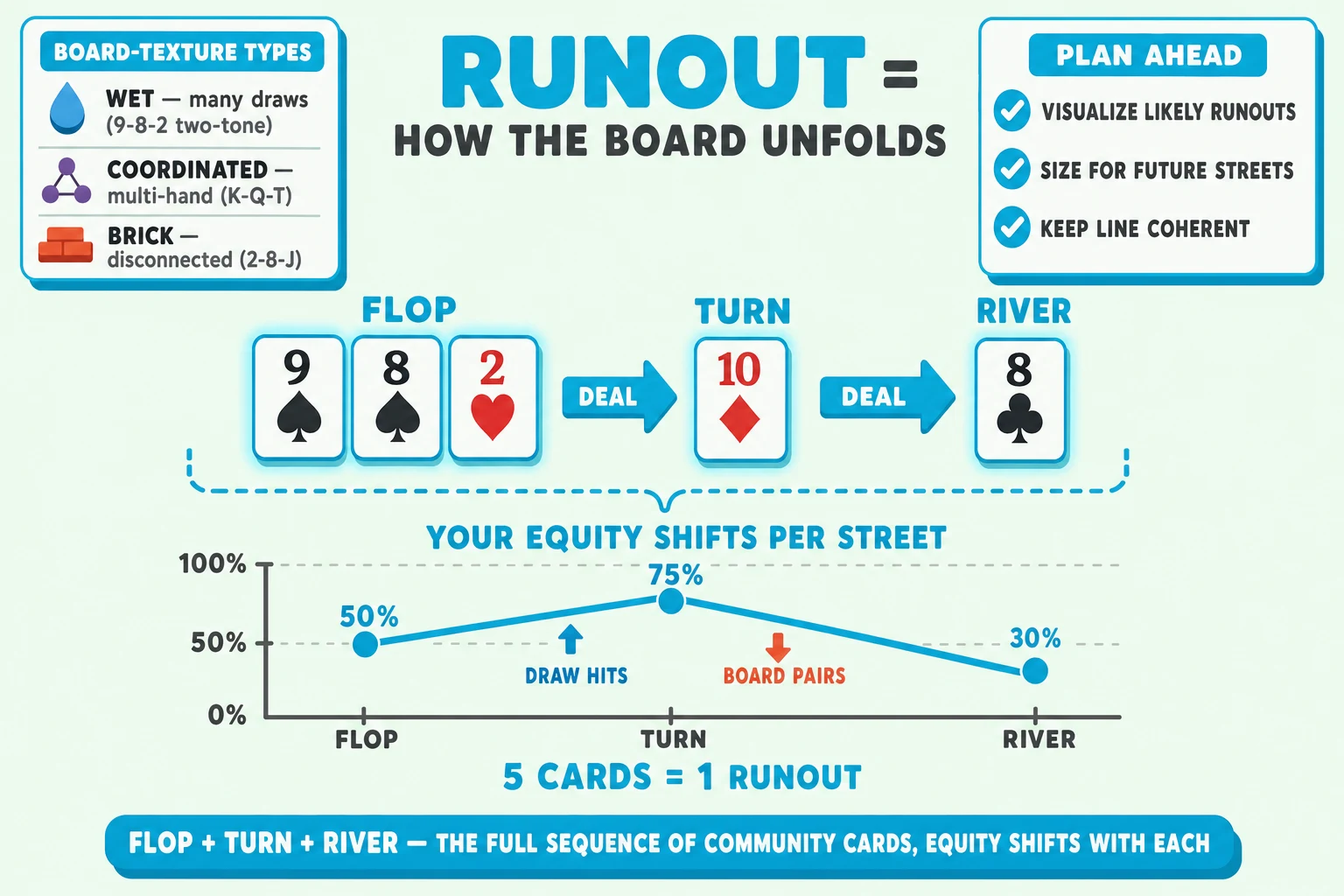
Each revealed card shifts which hands are possible and changes relative equity percentages. For example, a turn spade completing a flush draw can flip a likely loser into the favorite. The final river often decides the winner, so multi-street decisions must anticipate how the runout can finish.
How each street reshapes equity and decisions
Flop: The three-card flop creates the core board texture and shows initial possibilities. It tells you whether you’ve already made a strong hand or whether you’re on a draw. Players reassess ranges (the set of hands an opponent might hold) and choose whether to continue.
Turn: One card can swing the whole hand. A turn spade on a two-spade flop completes flushes; a low card after a connected flop can complete straights. Decisions often tighten on the turn because many draws either complete or miss, narrowing plausible hands.
River: The river resolves remaining equity conflicts and forces final choices: value bet, call, fold, or bluff. With no more cards to come, players judge whether their hand beats opponents’ likely holdings.
Concrete example: You hold K♠Q♠. Flop: J♠9♠2♥ - you have a nut (best) flush draw plus overcards. Turn: 10♦ - you now also have an open-ended straight draw. River: 8♣ completes your straight and changes how you extract value versus bluffing earlier.
Board texture: wet, coordinated, and brick runouts
Board texture describes how the runout behaves.
- Wet (many draws): Wet boards have connected ranks and suited cards that create many straight and flush possibilities, for example 9♠8♠7♦. They increase the chance of strong hands by the river and usually produce more betting and check-raising.
- Coordinated: Coordinated boards make multiple hands plausible without being extremely draw-heavy. For example K♦Q♦10♣ allows two-pair, straights, and broadway draws. Opponents’ ranges widen, so give them credit for more holdings.
- Brick: A brick runout is largely static - disconnected, rainbow (many suits), and unlikely to complete draws, for example 2♣8♦J♠ -> 3♥ -> 9♦. Bricks reduce action; players often favor value bets or cautious lines rather than big bluffs.
How runouts affect betting strategy across streets
As runouts produce draw cards, aggression and bluffing frequency typically rise. On a wet turn that completes many draws, you should mix value bets with bluffs that represent the nuts. On static or brick runouts, value betting becomes more profitable because fewer surprise hands appear. Bluffing frequency falls; a missed draw on the river is a weak story unless your line convincingly represented strength.
Always reassess opponent ranges after each street to decide whether to bet for value, bluff, or fold. Size bets with future streets in mind - sizing too large on the flop can commit you to bad rivers.
Planning ahead: reading runouts and river-focused thinking
- Visualize which runouts improve your range and which complete opponents’ draws before betting heavily.
- Identify key turn and river cards (for example, a fourth heart or a low card completing straights) that change optimal lines.
- Choose bet sizes and lines that remain sensible across those likely runouts - avoid lines forcing you to fold the river when you should be leading.
Checklist:
- Remember the runout sequence: flop -> turn -> river.
- Reassess equity and ranges after every community card.
- Classify the board as wet, coordinated, or brick to guide aggression.
- Anticipate which turn and river cards will change the hand story.
- Plan bet sizing and lines that remain reasonable across likely runouts.