


Brick
A brick is a turn or river card that does not materially improve most hands or complete likely draws. The turn is the fourth community card; the river is the fifth and final community card. A brick usually leaves who is ahead unchanged from the previous street.
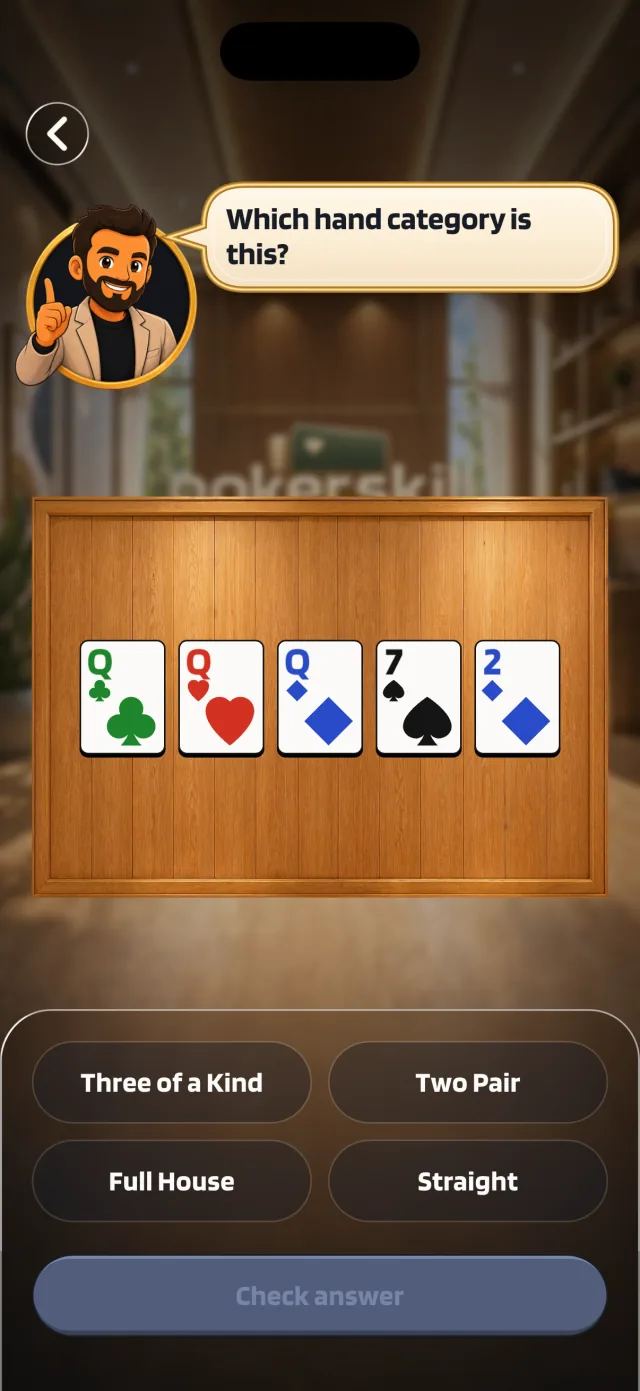
Practice this in Poker Skill. In the turn lessons the 5♠ on 9♦ Q♦ 3♠ is a brick, nobody’s card, so A♣ Q♥ still has the best hand and bets again for value.
Get the free appBrick
What a “brick” is in No-Limit Hold’em
A brick is a turn or river card that does not materially improve most hands or complete likely draws. The turn is the fourth community card; the river is the fifth and final community card. A brick usually leaves who is ahead unchanged from the previous street.
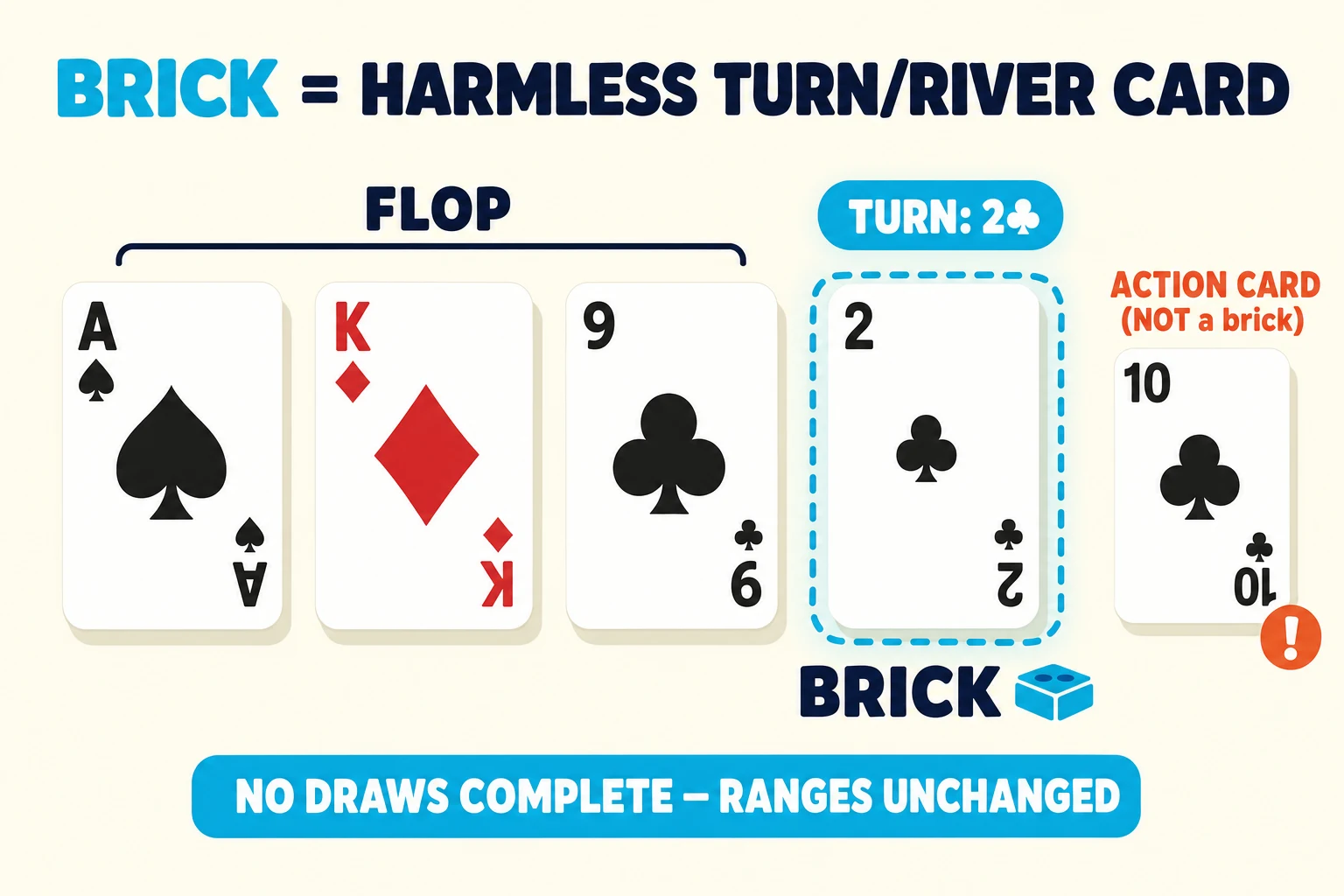
Example: the board is A♠ K♦ 9♣ and the turn is 2♣. The 2♣ doesn’t add straights or flushes, so most players’ equities stay similar - that turn is a brick. Another common brick is a low, uncoordinated card of a different suit than the existing draws (for example, 2♣ when spade or broadway - high-card straight - draws dominate).
Recognizing bricks on the turn and river
Quick checks to decide whether a new community card is a brick:
- Does the card complete obvious straight or flush draws? If not, it’s likely a brick.
- Consider board texture: disconnected, single-suited cards that don’t add straight lines usually have low impact.
- On the river, treat the card as most decisive - if it doesn’t change made hands or draws, prioritize showdown value and plausibility.
Example: flop Q♥ J♦ 7♠ - opponent checks, you bet. The turn is 3♣. No coordinated draw completes, so the turn is a brick. On the river, a similar small off-suit card that still doesn’t pair the board is also a brick and should be treated the same way.
How bricks change value-betting decisions
When a brick arrives, players who were ahead before usually remain ahead. That makes value betting with strong hands more attractive.
- Thin value bets (smaller bets for marginally strong hands) become more viable because opponents are less likely to have completed draws.
- You can modestly increase bet sizing on a brick to extract more from second-best hands; the chance an opponent just made a draw is lower.
Example: you hold K♣ K♦ on A♠ K♠ 9♦ and the turn is 2♣ (brick). Your trips probability hasn’t changed, so a value bet of 50-70% pot can extract from Kx and two-pair hands.
How bricks affect bluffing and defensive play
Bricks reduce many bluffs’ effectiveness and lower continuation-bet fold equity. Because the card is unlikely to complete a draw, opponents more often call with marginal hands.
- Bluffs lose fold equity: fewer made hands are scared off by harmless cards.
- Continuation bets on a brick are more likely to be called by medium-strength hands.
- Defensively, shift toward check/call or protecting value rather than wide-range bluffing.
Example: you c-bet the flop and face a call. On a brick turn, a second barrel is often less likely to force folds, so prefer check/call with medium strength rather than bluffing again.
Action cards vs bricks - what to watch for
Action cards complete draws or dramatically change equity (for example, an 8♠ on a four-spade board completing a flush) and demand immediate range reassessment. Compare the new card to the board’s draw possibilities: if it doesn’t alter likely best hands, treat it as a brick.
When an action card arrives, re-evaluate ranges and adjust sizing and bluff frequency. When a brick arrives, lean toward preserving existing range advantages: more value bets, fewer bluffs.
Quick checklist
- Check whether the card completed straights or flushes before labeling it a brick.
- If you were ahead, prefer value bets on a confirmed brick; reduce bluff frequency.
- On the river, prioritize showdown value and plausibility over ambitious river bluffs.
- Always reassess ranges when an obviously action-changing card appears.