


Turn
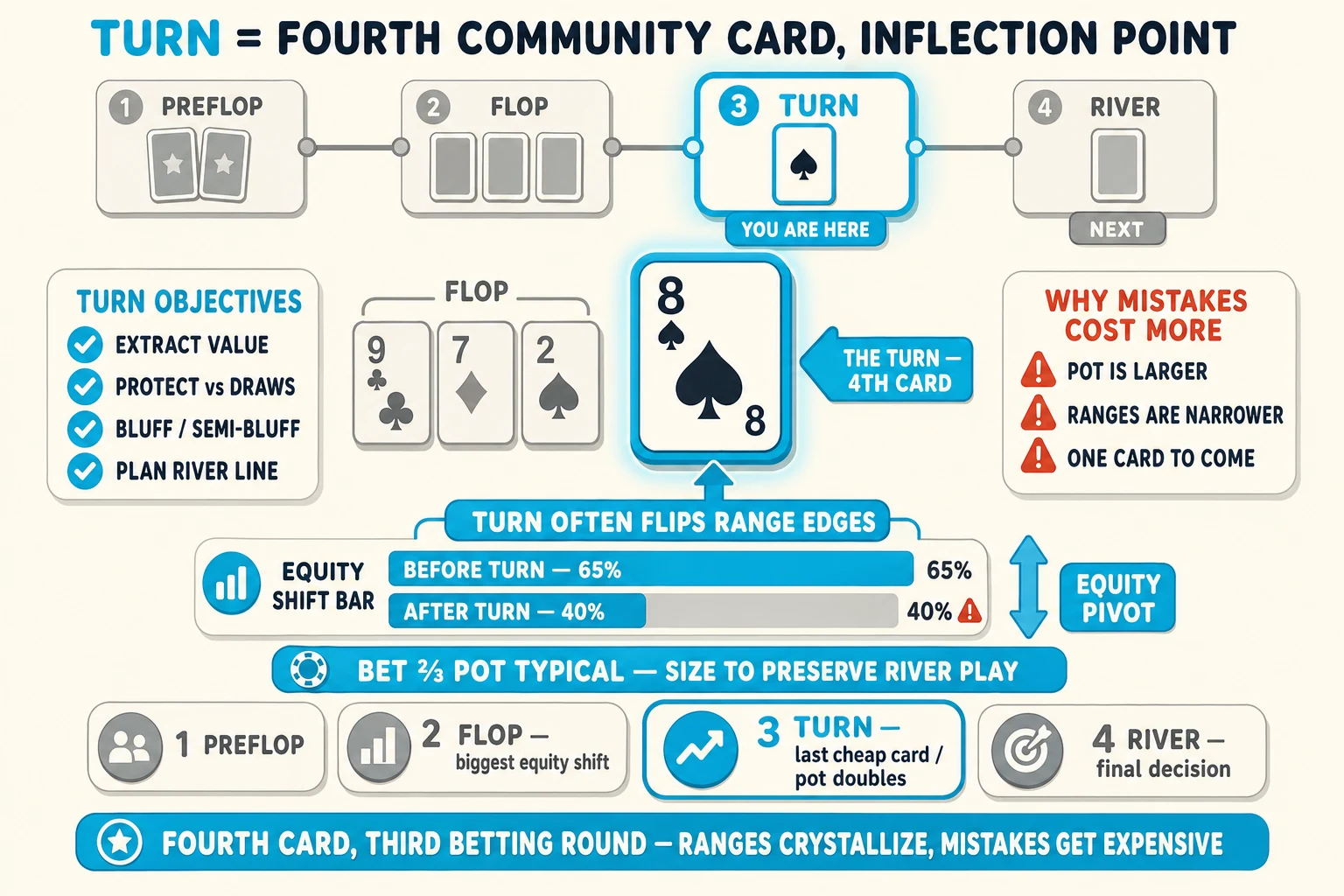
The turn is the fourth community card and the street where ranges narrow and the pot grows, so mistakes cost more. Decisions that looked correct on the flop can become costly once another card appears. With more money committed and one card left, a wrong call or bluff often seals the outcome. Your turn choice also largely determines viable river lines: bet, check for a free card, or face a committed pot. For example, calling a flop bet with middle pair can be wrong if the turn pairs the board or completes common draws.
Practice this in Poker Skill. The Read the Turn Card lesson includes an action turn that keeps a value bet going: the deuce gives 4-3 a wheel straight, but weaker aces and unfinished draws can still call.
Get the free appThe Turn in No-Limit Texas Hold’em
Why the Turn Matters
The turn is the fourth community card. Ranges narrow noticeably and the pot is significantly larger, so mistakes cost more. Decisions that looked correct on the flop can become costly once another card appears. With more money committed and one card left, a wrong call or bluff often seals the outcome. Your turn choice also largely determines viable river lines: bet, check for a free card, or face a committed pot. For example, calling a flop bet with middle pair can be wrong if the turn pairs the board or completes common draws.
Primary Turn Betting Objectives
Turn bets pursue a few clear goals-identify which applies and act accordingly.
- Extract value: Bet to get called by worse hands while building the pot. Example: top pair on a dry board earns straightforward value bets that worse pairs and draws often pay.
- Protect: Bet to deny correct-priced draws free cards and reduce their equity. Protection bets often size larger than thin value bets.
- Bluff / Semi-bluff: Bluff to force better hands to fold. Semi-bluff has some equity-like a flush or straight draw-and can still improve if called. Semi-bluffs combine fold equity now with the chance to make the best hand later.
Choose your objective by assessing how the turn changed equities and narrowed ranges.
Reassessing Ranges and Using Position
“Range” means the set of hands an opponent could reasonably hold. Re-evaluate both ranges after the turn card.
Steps to update ranges:
- Ask how the turn helps or hurts your range and your opponent’s range.
- Consider prior action: did passive flop lines narrow the opponent to made hands or missed draws?
- Decide whether continuing sets up good river choices.
Position gives you flexibility. Acting after your opponent lets you check to control pot size, bet to apply pressure, or induce mistakes with timed checks. Acting first requires precision-don’t default to passivity. Leading the turn or using a check-raise (checking, then raising an opponent’s bet) can protect your range and stop opponents from shoving you off the pot.
Turn Bet Sizing & Pot Management
Size bets to balance protection, value, and river planning.
- Too small invites free cards from draws; too large can overcommit marginal hands.
- Use sizing that leaves options: a medium-sized turn bet can preserve a pot-sized river shove if necessary.
- Always factor SPR-the ratio between effective stacks and the current pot-when choosing aggression or pot control.
Practical rule: when many draws remain, size closer to large-to-pot; when mostly worse pairs will call, smaller bets extract value without bloating the pot.
Handling Action Turns and Marginal Hands
Action turns complete obvious straights, flushes, or pair the board; they demand extra caution and range thinking.
Bet strong made hands for value and protection; keep the line simple on otherwise dry boards. With marginal hands, determine whether the turn helped or hurt both ranges before acting. Mix lines: sometimes bet to protect, sometimes check to induce bluffs. Mixing keeps your range uncapped and harder to exploit.
Example: weak top pair on a turn that completes a flush should see both checks and small bets in similar spots, preventing opponents from folding automatically when you bet.
Quick checklist
- Pause on the turn and explicitly re-evaluate both ranges.
- Choose a bet size that balances protection, extraction, and river planning.
- Use position to control lines; play out of position with precision.
- Adjust aggression on action turns and when board texture changes.
- Mix value bets and bluffs on the turn to keep your range uncapped and unpredictable.