


Turn Class
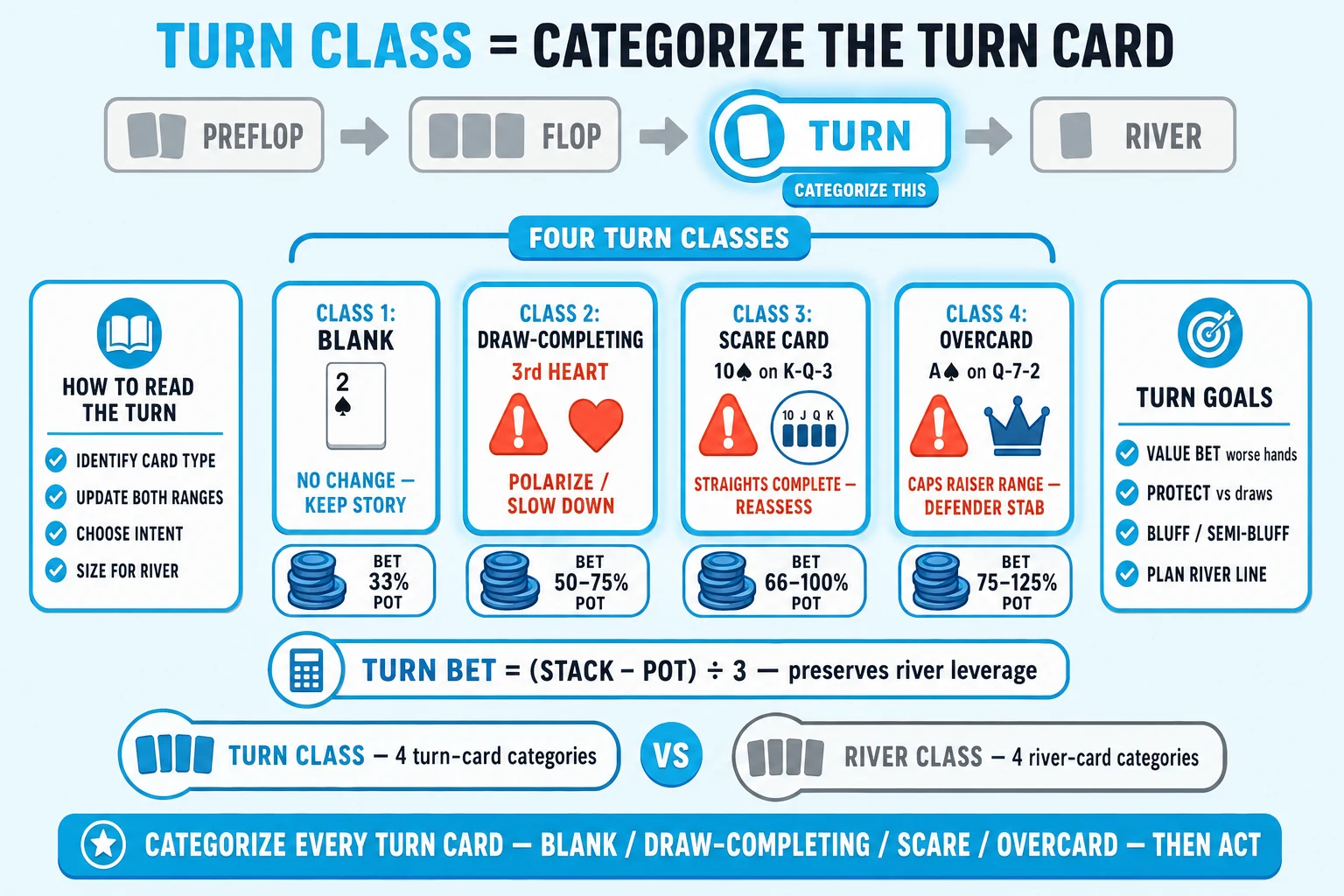
Categorizing the turn card by what it does to ranges: blank, draw-completing, scare, or overcard. Each class has a default sizing and intent, and reading the card right is what makes the turn the most important street to study.
Practice this in Poker Skill. A blank cuts both ways in the turn lessons, keeping top pair betting in Read the Turn Card but stopping queen-jack high in Bad Barrel Cards.
Get the free appTurn class
Why the turn matters
The turn, the fourth community card, is often the most important street in Hold’em. Pots are larger by then and ranges have narrowed, so each decision costs more. A range is the set of hands a player could reasonably hold. A single turn card can shift equity sharply by completing draws, pairing the board, or adding overcards. For example, you raised preflop with A♦K♠ and the flop comes 9♣7♦2♠, a dry board. The turn brings 8♠, which adds straight possibilities for QJ or T6. That one card can flip whether a continuation bet still works. Mistakes on the turn are expensive, so reread the spot before you bet, call, or fold.
Re-evaluating ranges on the turn
Use a quick, structured checklist to update both ranges after the turn.
- Identify the card type quickly: did it complete obvious draws, pair the board, or bring an overcard? Example: Flop Q♥10♥3♣; turn J♥ completes many heart flushes and adds straight combos like KQ and 98.
- Determine which parts of each player’s pre-turn range improve or weaken. If an opponent cold-called from the big blind, a heart on the turn likely helps their suited holdings.
- Recalculate how betting or checking widens or tightens your continuing range. Tighten when the turn completes many draws; widen when it’s a blank that leaves many hands behind.
- Consider fold equity and opponent tendencies to see whether the turn favors big pairs, draws, or bluffs.
Run these quick checks every time the turn appears in a hand.
Betting goals and bet sizing on the turn
There are four primary turn betting intents:
- Extract value from worse hands (value).
- Protect a made hand against live draws (protection).
- Bluff to make stronger hands fold (bluff).
- Semi-bluff with hands that can improve on the river (semi-bluff).
Size bets to account for board texture and effective stacks, leaving room for meaningful river decisions. A practical sizing guide: Turn Bet Size = (Effective Stack Size - Current Pot Size) ÷ 3
Example: Effective stacks $150, pot $60 -> (150 - 60) ÷ 3 = $30. This sizing preserves room for a pot-sized river bet while applying pressure now.
Typical turn scenarios and practical lines
Card categories: paired boards, cards that complete flushes or straights, overcards, blanks (bricks), and aces.
Out of position (OOP - acting before your opponent): bet when you were slowplayed on the flop, just made your hand, picked up a strong draw, or plan to bluff. Otherwise check to keep weaker hands in and control pot size. Example: Flop K♣9♣2♦, turn Q♣ gives you the nut flush draw. An OOP bet buys fold equity and builds the pot for river value.
In position (IP - acting after your opponent): use their action to pick clear lines: thin value-bet, check-call medium-strength hands, or check-raise with a strong made hand or semi-bluff. Remember that turn raises generally show strength or a semi-bluff.
Common mistakes and quick adjustments
- Don’t overplay marginal hands on action turns that complete obvious draws; tighten calling and continuation ranges.
- Avoid automatic turn bets; specify what the bet accomplishes: value, protection, or fold equity.
- Adjust aggression by position and opponent type. Versus calling stations, favor value lines. Versus fold-prone opponents, increase bluff frequency.
Quick checklist
- Re-evaluate both ranges immediately after the turn card appears.
- Define your primary intent on the turn (value, protection, bluff, semi-bluff).
- Use the sizing formula as a starting point and adapt to stack sizes and board texture.
- Vary lines by position and opponent tendencies to stay balanced.