


Two Pair
Two cards of one rank, two of another, plus a kicker. Beats one pair, loses to trips. Higher pair ranks win first, the kicker breaks the tie when ranks match.
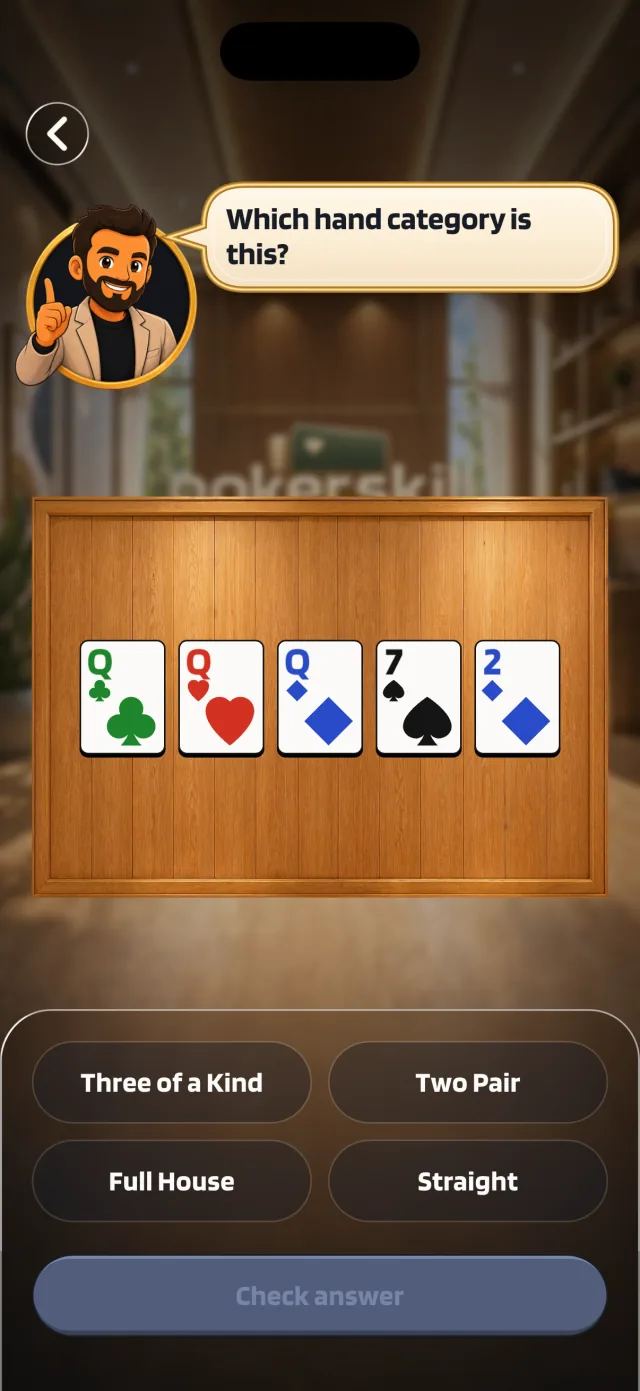
Practice this in Poker Skill. On K♥ 7♦ 5♣ K♣ Q♠, the Counterfeits on the Board lesson asks who wins between 7♥ 5♦ and Q♥ A♠, and the board’s kings turn the two pair of 7♥ 5♦ into kings and sevens, which lose to the kings and queens of Q♥ A♠.
Get the free appTwo Pair (No-Limit Texas Hold’em)
Definition and basic hand strength
Two Pair is two cards of one rank, two cards of another rank, plus a fifth unmatched card called the kicker. You can make it from any combination of your two hole cards and the five community cards. Two pair beats a single pair, but it loses to three of a kind (a set or trips), a straight (five consecutive ranks), a flush (five cards of the same suit), a full house (three of a kind plus a pair), four of a kind and a straight flush, royal flush included. The pair ranks decide which two pair wins, with the kicker breaking ties when the pairs match. Aces and Kings beat Kings and Queens; if both players hold Kings and Queens, the higher kicker takes it.
For the full order of hands, odds and tie-break examples, see the poker hand rankings chart.
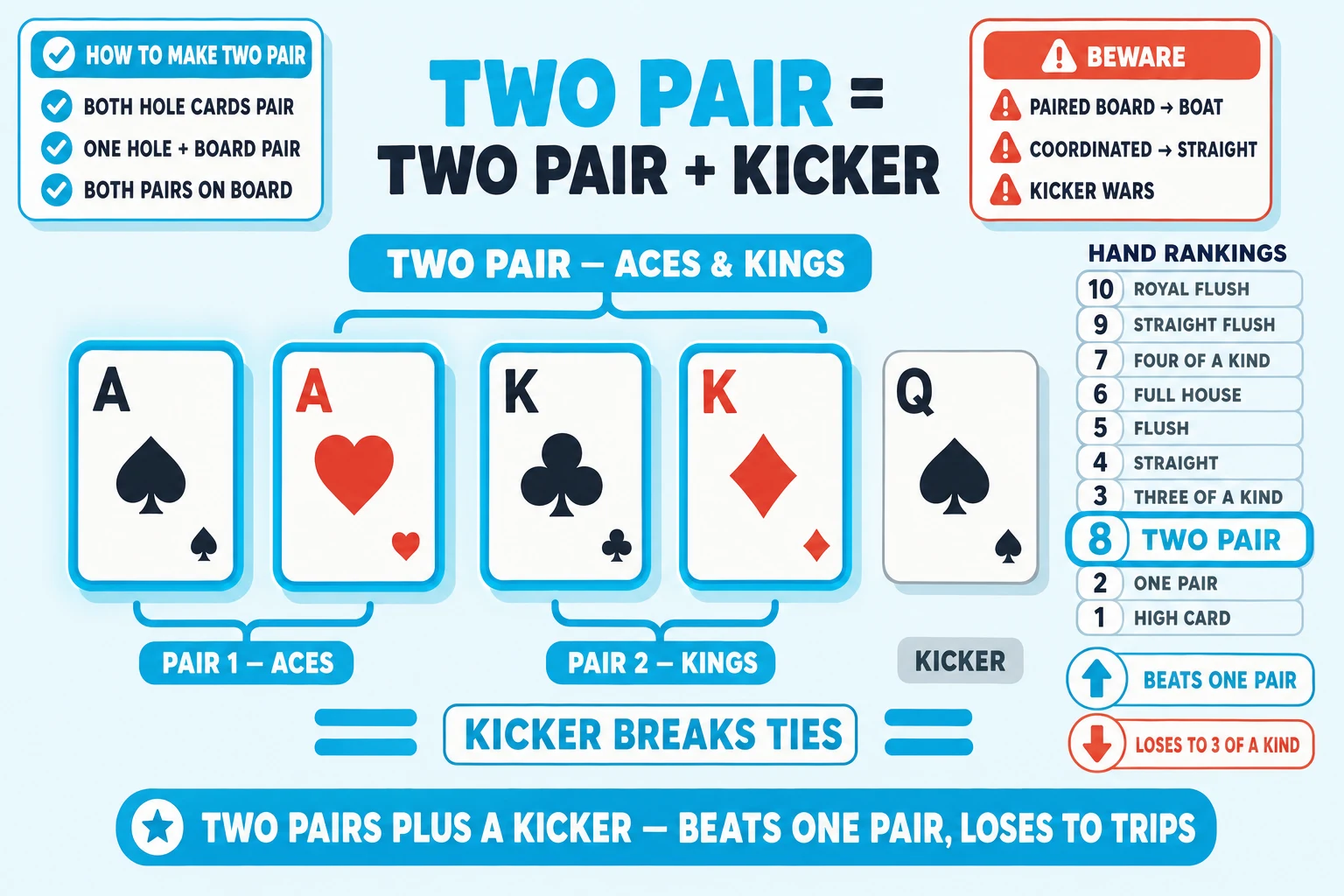
How Two Pair can be formed at the table
Common ways Two Pair appears:
- Both hole cards each pair with different community cards. Example: you hold Q-10 and the board has both a Q and a 10. You have Queens and Tens.
- One hole card pairs while the board shows a separate pair. Example: you hold K-9 and the flop is K-7-7. You have Kings and Sevens.
- Both pairs come from the board and your hole card is the kicker. Example: board J-7-7-J-2 gives everyone Jacks and Sevens; the highest hole-card kicker wins.
Both pairs come from the board on about one river board in 21, and then everyone shares that Two Pair. Whether your Two Pair uses one or two hole cards affects how likely opponents can beat you.
Kickers and tie-breaks
The kicker is the unmatched fifth card that breaks ties. When multiple players share the same pair ranks, the highest kicker wins. Example: board J-7-7-J-2, both players have Jacks and Sevens from the board; a King kicker beats a Ten. If the pairs and kickers are identical, the pot is split, as when two players on J-J-7-7-A both play the board’s Jacks and Sevens with its Ace.
Board texture and common threats
A paired board can quickly create full-house possibilities if it pairs again on later streets. Coordinated boards (connected ranks or three cards of one suit) give opponents straight and flush chances. Two pair on a draw-heavy board is vulnerable. Dry, uncoordinated boards are less likely to improve opponents, so two pair holds up more often there.
Betting strategy: extracting value vs protecting the hand
- On dry boards: favor value bets to extract from worse pairs and weaker hands.
- On coordinated or paired turn and river boards: tighten up. Check to control the pot, or, if draws are clear and you are still ahead, bet big enough that they pay a bad price to continue.
- Always weigh opponent count and visible draw odds before committing big bets; multiway pots increase the chance of being outdrawn.
Practical mistakes to avoid and quick-read patterns
- Don’t overvalue a low Two Pair on a board that contains a higher pair or many draws.
- Avoid bloating the pot when several opponents remain and board threats exist.
- If both your hole cards contributed to Two Pair, your hand usually fares better than when the board makes both pairs.
- Remember kicker comparisons in multiway pots: a strong kicker can win tied pair ranks.
Compare all ten poker hand rankings, best to worst to see where two pair sits.
For two pair against every other category, see what beats what in poker.
Quick checklist
- Confirm both pair ranks and the kicker before committing chips.
- Assess board texture: dry = value, coordinated/paired = caution.
- Count opponents and apparent draw possibilities before choosing bet sizes.