


Pair
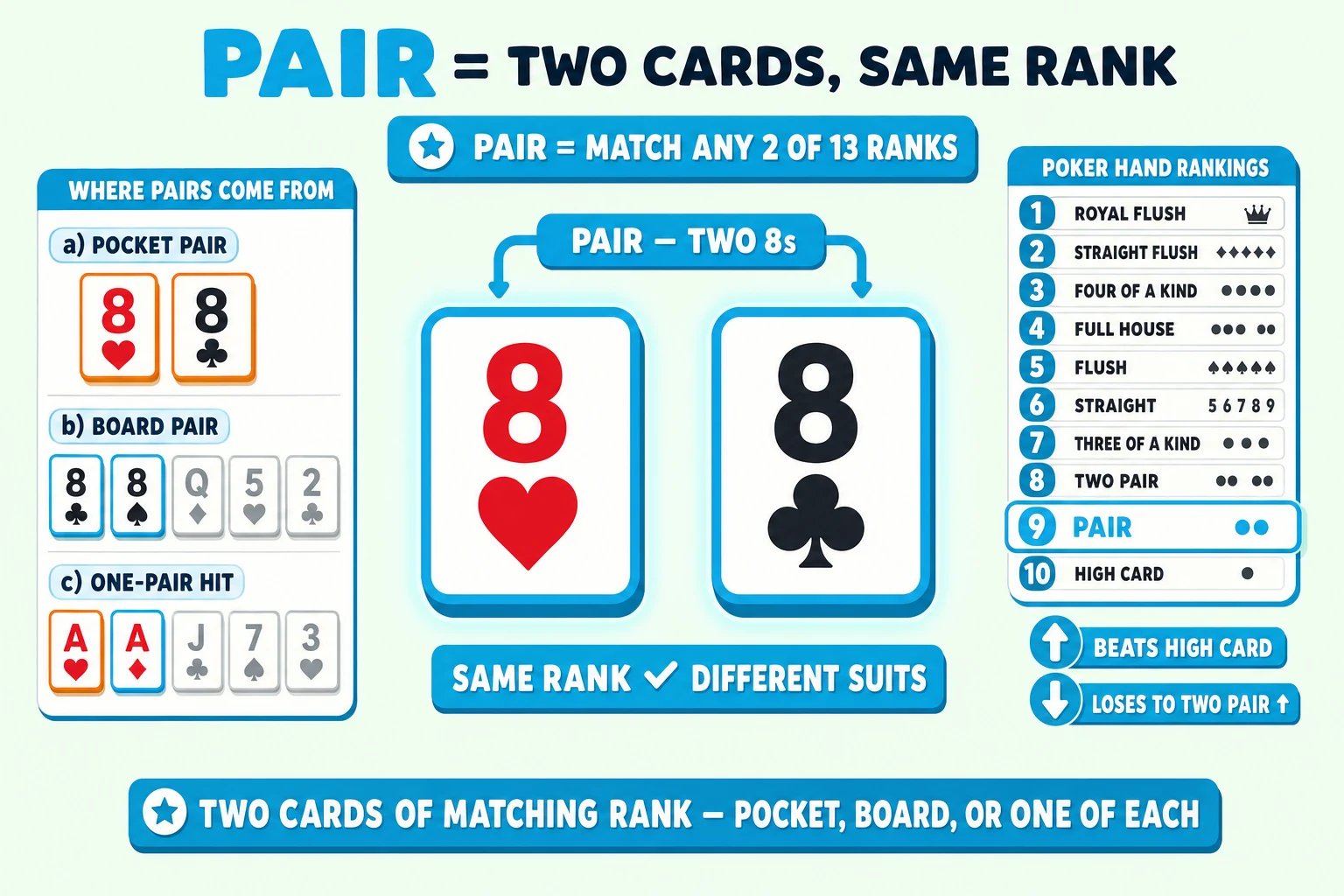
A pair is two cards of the same rank, either in your hole cards or using a community card. Pocket pairs come from both hole cards matching; board pairs use one hole card with the board. Pairs form a foundational hand rank and often steer post-flop plans. A single pair beats unpaired hands but loses to higher pairs, trips, two pair, straights, and flushes. Treat pairs as common holdings that require careful evaluation, not automatic aggression.
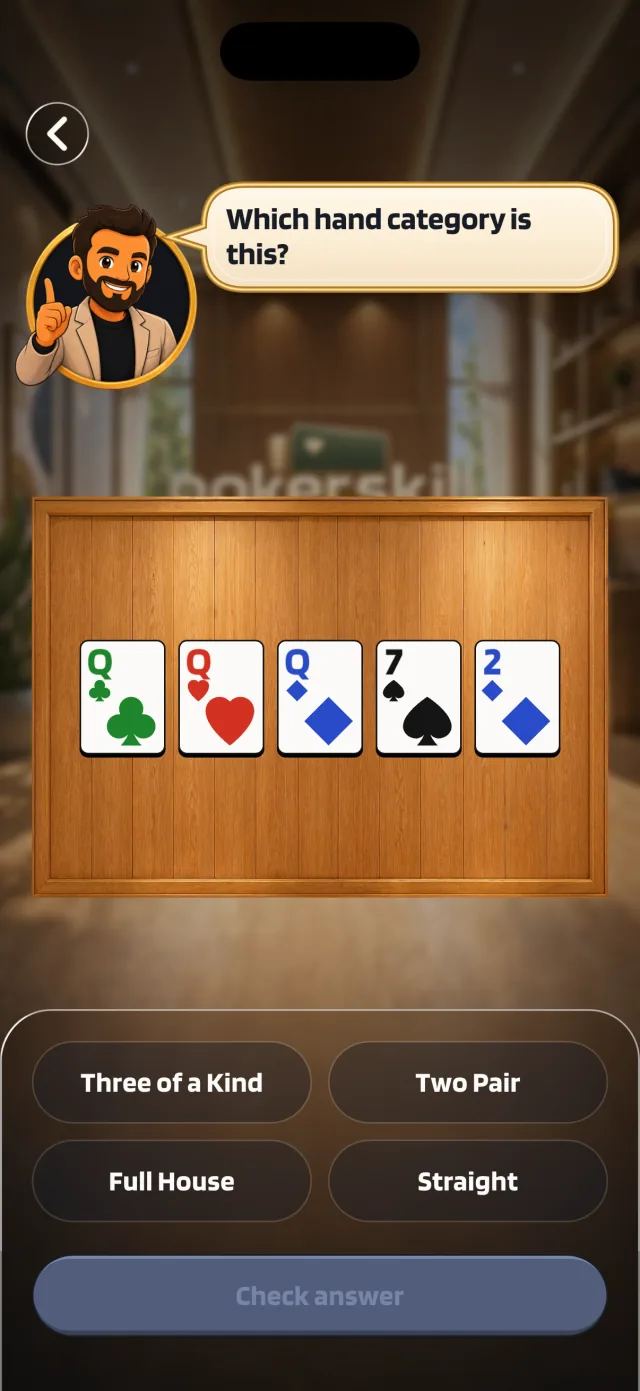
Practice this in Poker Skill. The Intro to Pot Control lesson practices that care with weaker pairs, calling with second pair under a king to keep the pot small instead of raising.
Get the free appPair in No-Limit Texas Hold’em
Define a pair
A pair is two cards of the same rank, either in your hole cards or using a community card. Pocket pairs come from both hole cards matching; board pairs use one hole card with the board. Pairs form a foundational hand rank and often steer post-flop plans. A single pair beats unpaired hands but loses to higher pairs, trips, two pair, straights, and flushes. Treat pairs as common holdings that require careful evaluation, not automatic aggression.
Pocket pair vs board pair
Pocket pair: both hole cards form the pair (example: you are dealt K♦ K♠). Pocket pairs play strong pre-flop and justify aggressive action, especially aces and kings. They can also improve to trips on the flop, which changes hand strength dramatically.
Board pair: one hole card pairs a community card (example: you hold A♣ 8♠ and the flop is A♦ 7♣ 2♠ - you have top pair). Board pairs depend heavily on your kicker (the other hole card) and on board texture. They are more situational and demand careful reading of opponents and the board.
Adjust ranges accordingly: pocket pairs tend to control pre-flop action; board pairs often require caution and read-based decisions.
How to judge pair strength
Use these quick rules:
- Rank matters: top pairs like aces or kings play aggressively; low and medium pairs face domination and draws.
- Check board texture: connected or monotone boards increase straight and flush possibilities; paired boards raise trip likelihood.
- Read opponent action: heavy aggression often signals a stronger made hand; treat lone pairs with suspicion.
Example: you hold 9♣ 9♦ and face a K♥ 7♣ 2♠ board while an opponent bets big. Your medium pair is likely behind; consider pot control or folding.
Betting, pot control, and implied odds with pairs
No-Limit allows large bets, so sizing and intention determine outcomes.
- With strong pairs, value-bet and apply pressure to deny drawing odds.
- With weaker pairs, control the pot: check or call smaller bets to reach showdown without inflating the pot.
- Weigh implied odds - the future winnings if you improve - before chasing draws. Calling a small preflop raise with a low pocket pair to try for trips can be reasonable if you expect big pots when you hit.
Use position to protect vulnerable pairs: in late position you can control pot size and act after opponents. In early position, play more cautiously.
Psychology and tactical uses of a pair
Pairs are common, which makes them useful in mixed tactics.
- Slow-play strong pairs selectively to induce bluffs or larger bets on later streets.
- Use pairs as credible calls or bluffs depending on table tendencies; showing a weak pair can mislead opponents later.
- Watch bet patterns: repeated multi-street aggression usually signals a stronger pair, trips, or better - adjust accordingly.
Compare all ten poker hand rankings, best to worst to see where a pair sits.
For the full list of hands that beat a pair, see what beats what in poker.
Quick checklist
- Identify whether your pair is pocket-made or board-made.
- Evaluate pair rank relative to board texture and opponent actions.
- Choose aggression, pot control, or fold based on strength and betting dynamics.
- Consider potential improvements (two pair/trips) and implied odds before committing chips.
- Use slow-play or aggressive lines selectively, guided by opponent tendencies.