


Implied Odds
Pot odds plus the chips you realistically expect to win on later streets if your draw hits. Justifies calls that current pot odds alone would not.
Practice this in Poker Skill. Pocket twos fold on the button behind a raise and a call in the squeeze lesson: a pair that small needs a cheap flop and a payoff, and the raise already took the cheap flop away.
Get the free appImplied Odds in No-Limit Texas Hold’em
What implied odds mean
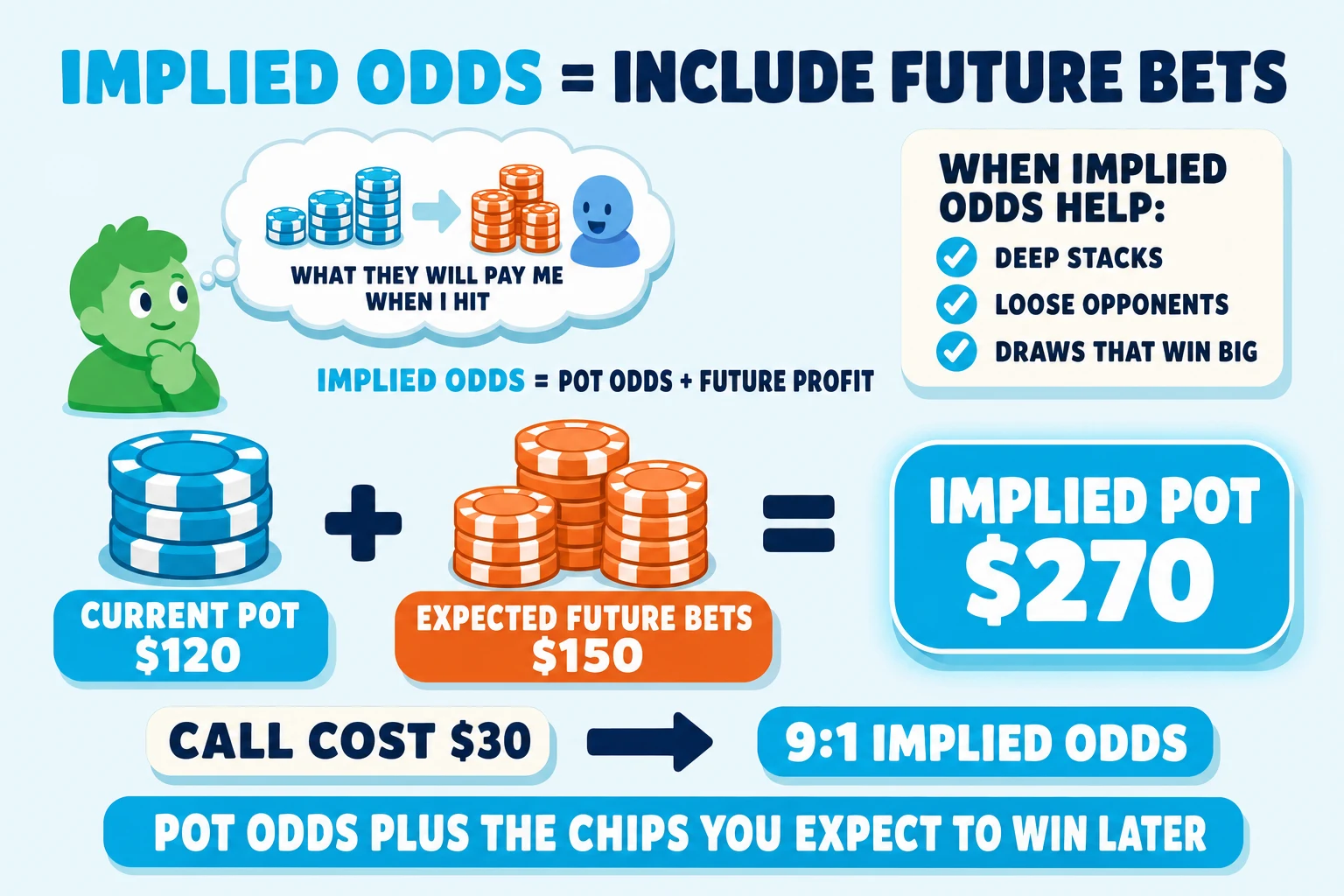
Implied odds extend pot odds by adding the money you expect to win later. Pot odds compare the current pot to the cost of a call. Implied odds forecast future betting rounds and the extra payoff if your hand improves. A draw needs more cards to become strong, for example a flush or straight draw. In No-Limit Hold’em, large possible later bets can make an otherwise unprofitable call correct. Think of implied odds as the future value of a call - what you win after you hit.
When implied odds change your decision
When your draw’s immediate pot odds don’t justify a call, implied odds can flip the decision. If you expect opponents to call or raise after you hit, those future bets increase your effective pot. Example: on the turn you have a draw and calling now gives only marginal pot odds. If an opponent often bets big on the river with one-pair hands, you’ll get more chips when you hit. That extra expected money may justify the call. Use implied-odds thinking to choose between calling, folding, or raising. If implied odds are high, calling to see another card can be correct. If implied odds are low because opponents fold to pressure or stacks are shallow, folding is usually better.
Estimating implied odds - a practical method
- Note the current pot and the cost to call now to get immediate pot odds.
- Estimate how much extra an opponent is likely to put in the pot on later streets if you hit. Be realistic and consider position and stack sizes.
- Add that expected extra to the current pot to get an implied pot size, then compare that to your call.
Example: the pot is $120 and you must call $30. You estimate one opponent will call another $150 if you hit on the river. Treat the pot as $270 for your calculation and decide whether the call is profitable. Keep estimates rough - you’re judging plausibility, not doing exact math. Deeper stacks increase the realistic extra money you can win; short stacks or single opponents who fold reduce it.
Reading opponents to refine implied odds
Opponent tendencies and table dynamics change how much future profit you can expect. Players who call down light or chase with weak hands often pay you off when you hit, raising implied odds. Tight or cautious players who fold to aggression reduce implied odds because they won’t contribute extra chips. Also consider position: when you act after an opponent, you can often extract more value on later streets. When out of position, extracting that value is harder. Adjust your estimate based on recent showdown behavior, bet sizing, and players’ willingness to call big rivers.
Common mistakes and when implied odds fail
Frequent errors:
- Overestimating future action: expecting opponents to pay larger bets than they will.
- Ignoring shallow stacks: small stacks can’t add meaningful chips even when you hit.
- Relying on implied odds without realistic reads: speculative calls lose when opponents fold often.
Fold when payoffs are unlikely or based on optimistic assumptions.
Quick checklist
- Compare current pot odds to potential implied odds before calling a draw.
- Consider stack sizes and likely future bets when estimating implied value.
- Adjust estimates based on opponent tendencies (loose vs. cautious).
- Fold when future payoffs are unlikely or based on optimistic assumptions.