


Straight Draw
A straight draw happens when your seven-card possibilities include four of the five ranks a straight needs: four sequential ranks, or four with one gap inside. You need one more card to make a five-card straight. This usually appears after the flop or the turn and changes how you should bet. Knowing you have a draw - and its strength - affects whether to call, raise, fold, or semi-bluff. A semi-bluff is a bet with a hand that can still improve to the best hand.
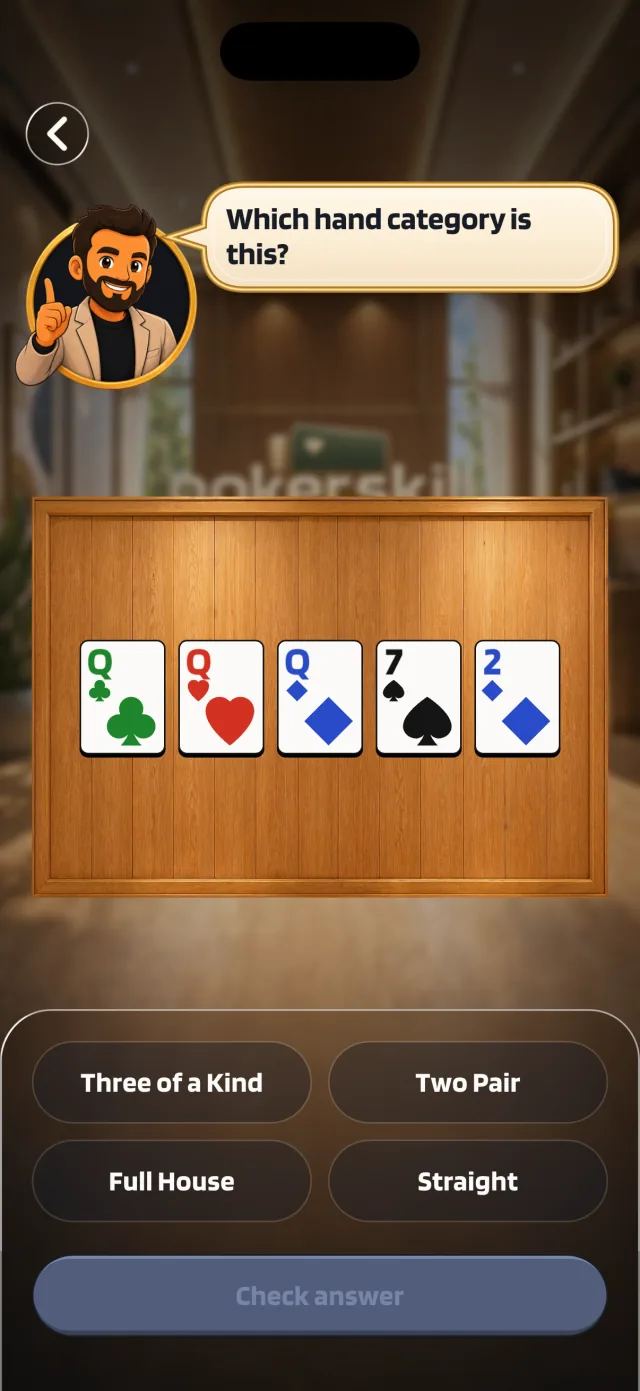
Practice this in Poker Skill. In one of its straight-draw questions, 3♠ 6♠ on 4♣ 5♦ K♣ is an open-ender: any 2 or 7 completes 3-4-5-6, eight outs that hit about 31.5% of the time by the river.
Get the free appStraight Draw
What a straight draw is
A straight draw happens when your seven-card possibilities include four of the five ranks a straight needs: four sequential ranks, or four with one gap inside. You need one more card to make a five-card straight. This usually appears after the flop or the turn and changes how you should bet. Knowing you have a draw - and its strength - affects whether to call, raise, fold, or semi-bluff. A semi-bluff is a bet with a hand that can still improve to the best hand.
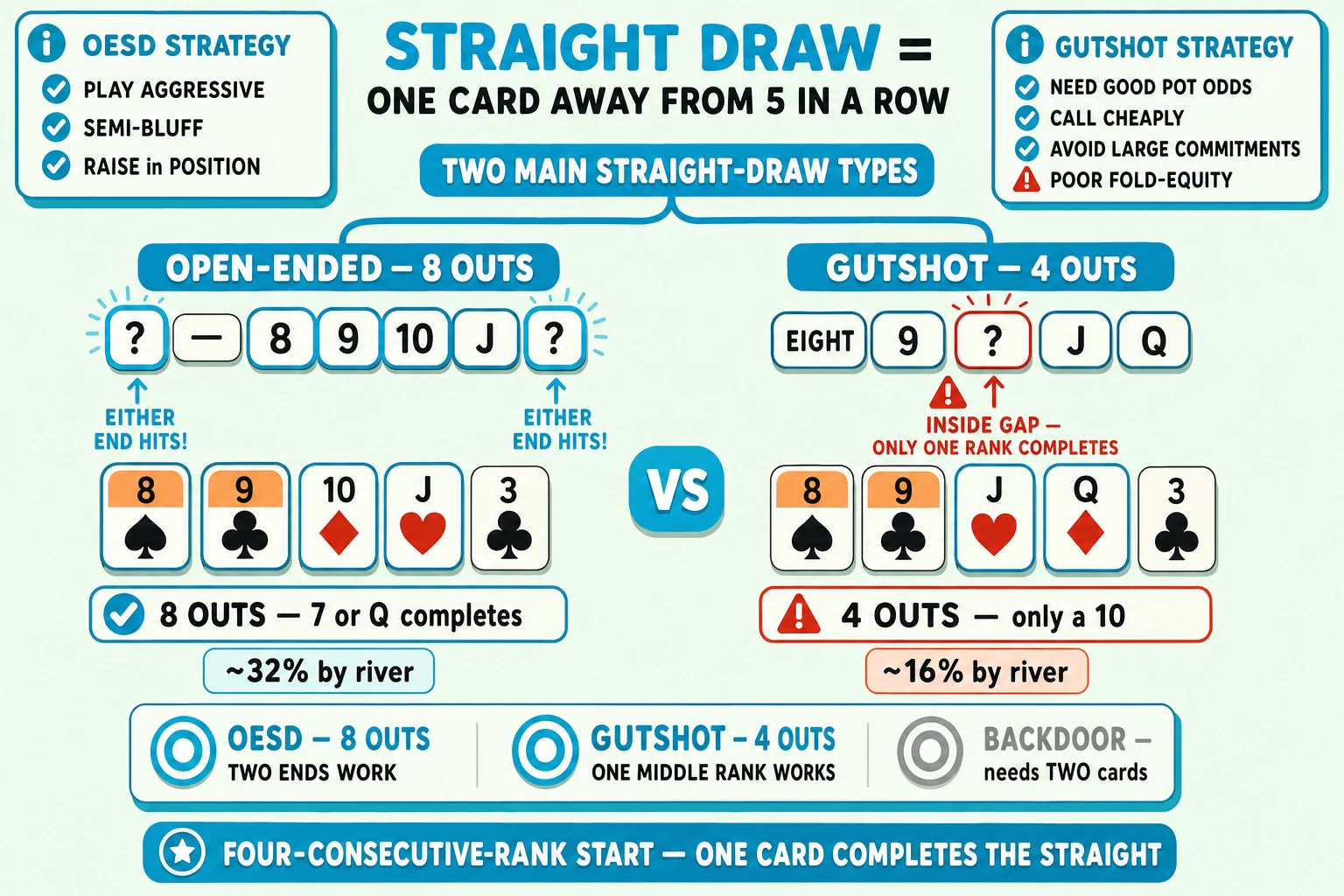
Example: You hold 8♠9♣ and the flop is 10♦J♥3♣. You now have four sequential ranks (8-9-10-J) and need one card to complete a straight.
Types of straight draws: open-ended vs gut-shot
There are two main straight draws with different strengths.
- Open-Ended Straight Draw (OESD): You have four consecutive cards where either end completes the straight. OESDs provide eight outs - cards that complete your hand. Example: Holding 8-9-10-J, either a 7 or a Q completes your straight, giving eight outs.
- Gut-Shot (Inside) Straight Draw: You need one specific rank inside the sequence to complete the straight. Gut-shots provide only four outs. Example: Holding 8-9-J-Q, you need a 10 - only four tens complete your straight.
OESDs are stronger and usually played more aggressively; gut-shots are riskier and require better pot odds or implied odds to pursue. The two draws are compared side by side, with three worked hands, in OESD vs gutshot.
Calculating outs and basic odds
Count your outs first: OESD = 8 outs; gut-shot = 4 outs. With two cards to come (on the flop to the river), an OESD hits about 31.5% of the time, while a gut-shot hits about 16%. The rule of 2 and 4 runs close for small draws, and on Poker Skill’s odds chart a gutshot’s four outs come in 8.5% of the time on the next card and 16.5% by the river, where the rule says 8% and 16%. Price a flop call with the two-card figure only when it puts one of you all-in; with more betting to come, compare pot odds (the ratio of the current pot size to the cost of a contemplated call) with the next card alone. If your chance to hit exceeds the break-even probability implied by pot odds, calling can be correct. The street-by-street numbers behind these percentages are walked through in open-ended straight draw odds.
Betting strategy: when to fold, call, raise, or semi-bluff
Translate draw type into action:
- OESD: In position against one opponent, a semi-bluff bet or raise can win the pot at once or build it for when you hit. Out of position or in a multiway pot, calling with good pot odds is the more common way to continue.
- Gut-shot: Usually call only if pot odds or implied odds justify it. Semi-bluff selectively when opponents are likely to fold to pressure.
- Folding: Fold a gut-shot facing a big bet with poor pot odds and little implied value. Fold an OESD too when the price asks for more than its chance to hit and implied odds can’t close the gap, as against a half-pot or bigger turn bet with little left to win on the river.
- Raising with draws: Raise to build value, force folds, or define opponent ranges. Raise more often with OESDs; with gut-shots, raise only on strong reads.
Concrete example: You have an OESD on the flop in position and the pot is small, so a raise can build the pot or win it. If out of position and facing a large bet, calling is often safer.
Position, pot odds, and implied odds
Position helps you realize equity and control pot size, letting you apply semi-bluffs more effectively. Always count your outs, compare your hit chance to offered pot odds, and factor in implied odds. Deep stacks and multi-way pots increase a drawing hand’s value because you can win more on later streets.
Quick checklist
- Count outs precisely before acting (8 for OESD, 4 for gut-shot).
- Compare draw odds to current pot odds and expected implied odds.
- Prefer aggressive play with OESDs in position; be cautious with gut-shots unless odds or reads justify it.