


Pot Odds
The ratio of the current pot to the cost of a call, converted into the equity your hand needs to break even. Drives every calling decision against a bet.
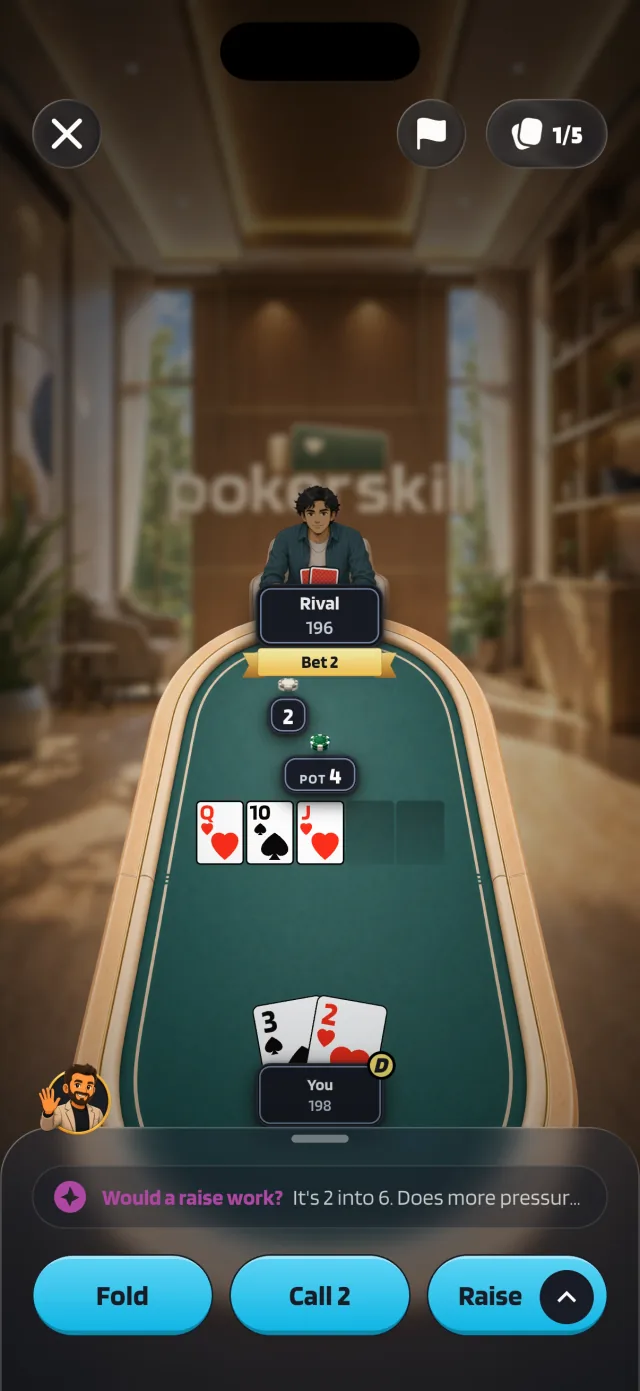
Practice this in Poker Skill. Facing a half-pot bet on the turn in Practice vs AI, where you play full hands against AI opponents, Coach Max can do the arithmetic for you: the pot lays 3-to-1, so you need to be good about 1 in 4.
Get the free appWhat pot odds are and why they matter
Pot odds are the ratio of the current pot size to the amount you must call to continue. In No-Limit Texas Hold’em they tell you whether the reward (the pot) justifies the price of a call. Instead of guessing, pot odds turn calls on draws or against large bets into repeatable math. A draw is a hand needing one more card to improve; an out is an unseen card that completes it. Pot odds let you compare the price you’re being offered to the likelihood your outs will hit.
Pot odds break-even % = call / (pot + bet + call)If the pot number you are using already includes the opponent’s bet, use:
Pot odds break-even % = call / (pot + call)For the full outs, equity, pot-odds, and EV workflow, read Poker odds explained.
How to calculate pot odds
Formula: Pot odds = Total pot ÷ Amount to call, stated as “x to 1.”
Step-by-step:
- Count the total pot before your decision, including the opponent’s latest bet.
- Note the exact amount you must call on this street to continue the hand.
- Divide the total pot by the call amount to get the odds ratio.
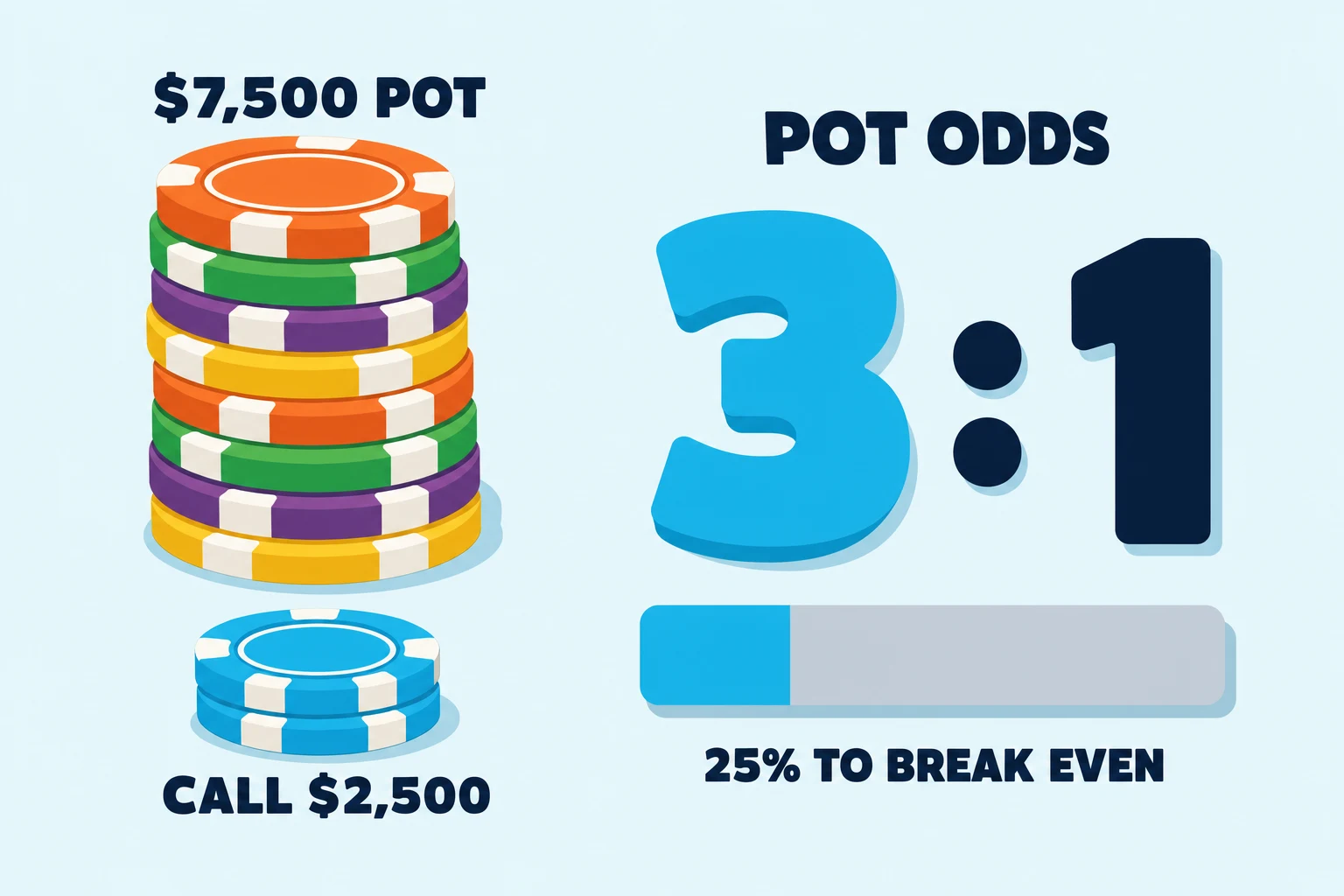
Example: $5,000 sits in the pot after prior action and your opponent bets $2,500. Your call would be $2,500, so pot odds equal $7,500 ÷ $2,500 = 3-to-1. You are getting 3-to-1 on a call.
For the at-the-table version, with a price chart by bet size and worked hands from flop to river, read how to calculate pot odds.
Converting pot odds into break-even percentage
Convert a pot-odds ratio into the minimum win percentage needed to break even: Break-even % = 1 ÷ (Pot odds + 1).
With 3-to-1 odds, break-even percentage equals 1/(3+1) = 25%. A 25% win chance by the river makes repeated calls at those odds break even.
Applying pot odds to drawing hands
- Count your outs - the cards left in the deck that complete your hand.
- Estimate the chance your outs hit by showdown, using memorized percentages or a quick calculator.
- Compare that hit probability to the break-even percentage from the pot-odds calculation.
Example: a typical nine-out flush draw hits on the next card roughly 20% of the time, and by the river roughly 35% of the time when you get to see both cards. If your break-even is 20% and you are guaranteed one card, calling is correct. If the price asks for more equity than your draw has, fold. Memorize common draw percentages or use quick conversions to speed live decisions.
Bet sizing: how to control opponents’ pot odds
Bet size is how you shape the math for opponents:
- Bigger bets shrink the pot odds offered to callers, making chase calls less profitable.
- Smaller bets increase the pot odds and can encourage correct calls from drawing hands. In No-Limit, use bet sizing to force or deny mathematically correct calls. Bet sizing protects made hands and extracts value when callers lack proper odds.
Quick pot-odds reference
- 1/4 pot bet -> ≈ 5-to-1 -> ≈ 17% break-even.
- 1/2 pot bet -> ≈ 3-to-1 -> ≈ 25% break-even.
- Full pot bet -> ≈ 2-to-1 -> ≈ 33% break-even.
- Double pot bet -> ≈ 1.5-to-1 -> ≈ 40% break-even.
Quick checklist
- Calculate pot odds (Total pot ÷ Amount to call).
- Convert to break-even % with 1 ÷ (odds + 1).
- Compare break-even % to your hand’s win probability (outs).
- Use bet sizing to change the odds opponents face.
- Memorize common bet-size-to-odds scenarios for quick in-game decisions.