


Pot-Limit
Pot-limit is a poker betting structure where the largest legal bet or raise is capped at the size of the current pot, including the call you'd have to make first if you're raising over an opponent's bet. It sits between fixed-limit (every bet a fixed amount) and no-limit (you can wager up to your full stack on any street). Stacks still reach all-in in a pot-limit game; they just get there through compounding pot-sized bets across multiple streets, not through a single shove. Pot-Limit Omaha (PLO) and Big O are the two pot-limit games most players meet today.
Pot-Limit: the betting structure that caps every raise at the size of the pot
What pot-limit is
Pot-limit is a poker betting structure where the largest legal bet or raise is capped at the size of the current pot. When you’re betting first, the maximum is the pot total in front of you. When you’re raising over someone else’s bet, the rule includes one extra step: the pot is calculated as if you had already called the bet you face, and your raise is capped at that new total.
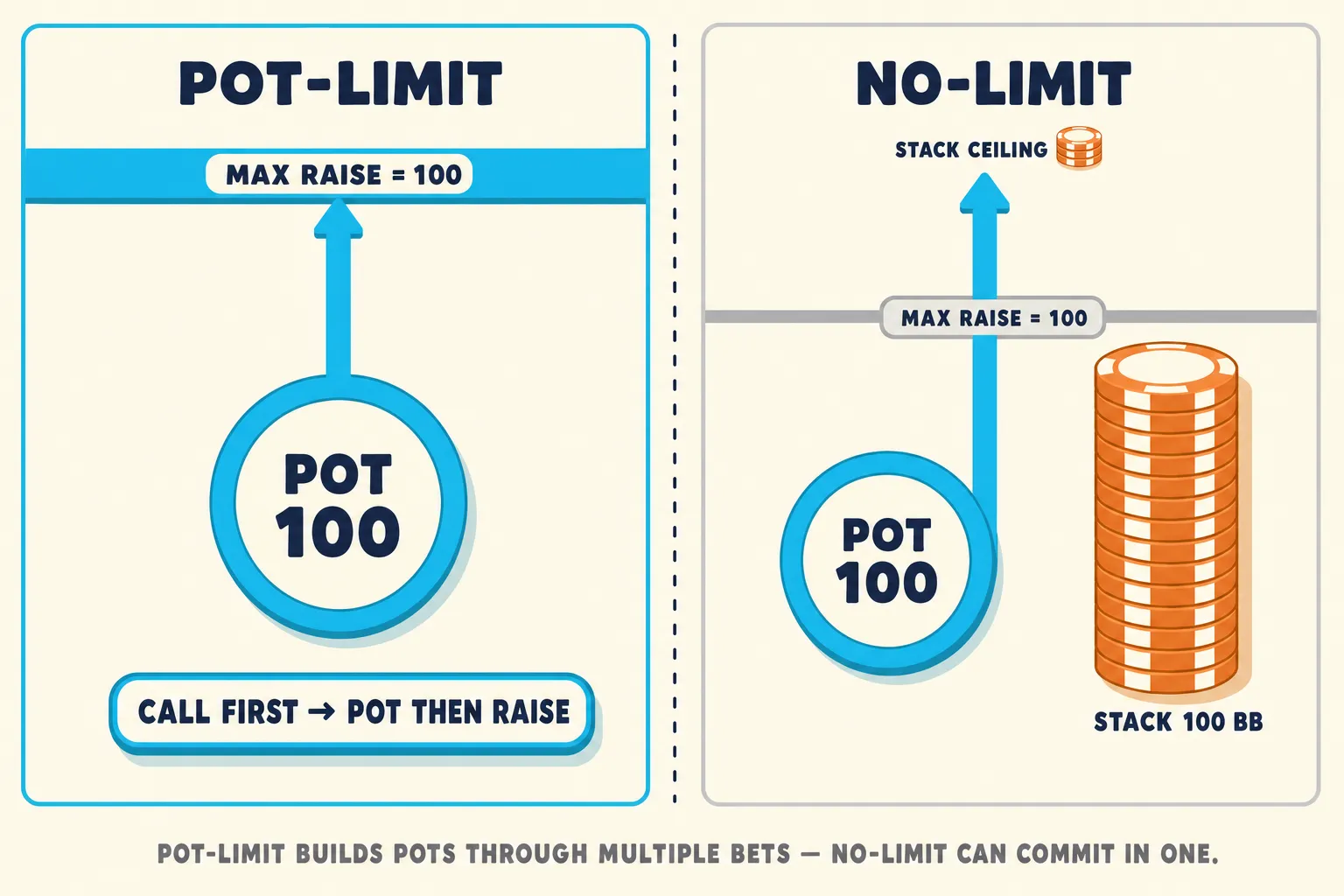
The structure sits between two cousins. Fixed-limit games force every bet and raise to a preset amount on each street. No-limit lets you wager up to your entire stack at any time. Pot-limit is the middle option: bet sizing is flexible, but the upper end is bounded by the pot rather than by your stack.
The shorthand most players use:
- A pot-sized bet equals the current pot, full stop.
- A pot-sized raise equals the pot after you call the bet in front of you. Skipping the call step is the most common pot-limit math mistake at the table.
How a pot-sized raise is calculated
Three steps. They run in this order every time, no exceptions:
- Match the bet in front of you. Mentally call the outstanding bet first.
- Total the new pot. Add what was already in the pot before your call, plus the bet you faced, plus your call.
- Add that total on top. The sum from step two is your maximum raise size. Your final action is the call from step one plus the raise from step three.
A worked number, no abstractions. Pot is $100. Opponent bets $50. You want to make the maximum legal pot-limit raise.
- Step one: call $50.
- Step two: $100 (existing pot) + $50 (their bet) + $50 (your call) = $200.
- Step three: raise $200 on top.
- Final action: $50 call + $200 raise = $250 total.
A second example with smaller numbers, because the arithmetic gets quicker once you’ve done it twice. Pot is $80. Opponent bets $20.
- Call $20.
- New pot: $80 + $20 + $20 = $120.
- Raise $120.
- Total action: $140.
Cardrooms have the dealer announce the maximum raise on request, and online sites have a “pot” button that does the calculation for you. Knowing the math by hand still matters, because pot-sized bets compound, and you should know what your stack covers before you start betting.
Pot-limit vs no-limit at a glance
| Trait | Pot-limit | No-limit |
|---|---|---|
| Maximum single bet | Size of the pot | Effective stack |
| Maximum single raise | Size of the pot after call | Effective stack |
| Stacks all-in in one bet? | No (preflop), rarely on flop | Yes, on any street |
| Bluff frequency at the table | Lower (capped pressure) | Higher (full-stack threat) |
| Common variants | PLO, Big O, PLO8 | NLHE and most live tournaments |
| Pot growth | Compounding across streets | Single-decision possible |
The line that matters in practice is the third one. In no-limit, an opponent can put your whole stack at risk on the flop with a single overbet. In pot-limit, that same threat takes two or three bets across two or three streets to build. You get more decision points and more information before chips fully commit. Poker Skill deals no-limit Hold’em only, and its raise-mechanics lesson sets a floor where pot-limit sets a ceiling: match the bet, then add at least that much again, so a raise over a 300 bet goes to 600 or more.
When pot-limit shapes the hand most
The structure asserts itself in three places:
- Multi-street commitment math. A pot-sized bet roughly triples the pot. Two pot-sized bets compound. At 100bb effective stacks, three pot-sized bets across the flop, turn, and river usually put both players all-in by the river. That gives you a budget of three big decisions before stacks are gone, not one.
- Multi-way drawing pressure. PLO and Big O ranges contain many drawing hands per opponent. Pot-limit caps how aggressively you can charge multiple drawers at once: you can bet the pot, but not more, even when four opponents each have 30% equity against your made hand. The structure trades a single overbet’s deny-equity force for repeated streets of pressure.
- Pot-controlled bluff frequency. Books on PLO converge on the same observation: pot-sized bets on the river are nut-leaning by default, because the bluffer can’t make the bet bigger to manufacture more fold equity. The cap on bet size also caps how much pressure a bluff can apply, and that bleeds back into how often bluffing is profitable. Calling a pot-sized river bet with a non-nut hand bleeds chips faster in PLO than the equivalent call in no-limit Hold’em.
The interaction with stack depth and SPR is where the structure either feels constraining or feels generous. At 50bb effective, a single pot-sized bet on the flop usually commits stacks; the game plays close to no-limit. At 200bb effective, three pot-sized bets are still not enough to reach all-in by the river; the game plays much deeper than typical NLHE. Most pot-limit cash games deal in the 100-150bb range and find a comfortable middle.
Example: from preflop to all-in across three streets
Two PLO players, 100bb effective. Blinds 0.5bb / 1bb.
Preflop. Pot is 1.5bb (the blinds). Hero in the cutoff opens for the pot. Hero “calls” 1bb mentally, which makes the pot 2.5bb, then raises 2.5bb on top, for a total of 3.5bb. The big blind calls 2.5bb more. Pot after preflop = 7.5bb. Each player has put in 3.5bb and has 96.5bb behind.
Flop. Pot is 7.5bb. The big blind checks. Hero bets the pot, 7.5bb. The big blind calls. Pot after the flop = 22.5bb. Each player has now committed 11bb and has 89bb behind.
Turn. Pot is 22.5bb. The big blind checks. Hero bets the pot, 22.5bb. The big blind calls. Pot after the turn = 67.5bb. Each player has now committed 33.5bb and has 66.5bb behind.
River. Pot is 67.5bb. The big blind checks. Hero would like to bet the pot, but only has 66.5bb left. Pot-limit caps the bet at the pot, but a bet smaller than the cap is fine, so Hero shoves the remaining 66.5bb. The big blind calls. Final pot = 200.5bb. Both stacks are in.
Three pot-sized bets in a row got 100bb stacks all-in by the river without any single bet being legally an overbet. The pot-limit ceiling was the binding constraint on every street before the river, and the players still committed every chip. That is the structural shape pot-limit games take: the pot grows roughly threefold per street of called pot-sized action, and at 100bb depth the ceiling lands in the river-or-near-it range.
If you want to short-circuit this in your head: at 100bb effective, plan for three streets of pot-limit action to take both stacks. Treat that as the budget you’re spending each pot you decide to commit to.
Common mistakes
- Forgetting to call before sizing the raise. A player who bets $50 into a $100 pot expects a raise calculated as $250 total, not $200. The dealer will announce the legal raise; the mistake is in your own planning. Always run the call-first step before deciding whether to raise the pot.
- Trying to overbet the pot in a pot-limit game. PLO and Big O are pot-limit, not no-limit, and the dealer will cap your raise down to the legal size if you announce too much. Treating PLO like NLHE and reaching for a stack-sized bet is the single most common cross-game error.
- Mistiming the all-in budget. New pot-limit players keep firing pot-sized bets without checking what’s left behind, then find themselves committed to a river call they would have folded if they’d planned the streets in advance. Count the three-streets-to-all-in math before the flop, not after the turn.
- Reading pot-sized river bets as bluffs. Pot-sized bets in pot-limit games are usually made by hands that want a call. The cap on bet size means a bluffer can’t make the bet bigger to apply more pressure, so the bluff frequency on a pot-sized river bet runs lower than on a 70%-pot bet in no-limit Hold’em. Calling pot-sized rivers with second-best hands is one of the slowest-leaking habits in PLO.
FAQ
Is pot-limit the same as fixed-limit?
No. Fixed-limit forces every bet and raise to a preset amount that the cardroom posts on the table (a $2/$4 limit game has $2 bets and raises preflop and on the flop, $4 bets and raises on the turn and river). Pot-limit lets you choose any bet up to the pot. The two are sometimes confused because both are called “limit” games in casual conversation, but the structures are unrelated.
What games are played pot-limit today?
Pot-Limit Omaha and Big O are the two pot-limit games most players meet at modern cash tables and online. The four-card hi-lo cousin (PLO8) is also pot-limit. Pot-limit Hold’em exists but is rare; most live and online Hold’em games are no-limit. Some legacy fixed-limit and pot-limit Stud variants run in mixed-game rotations.
Does the pot-limit cap apply to opening bets too?
Yes. Preflop, the maximum opening raise is the pot calculated with your call of the big blind included. From the cutoff in a $1/$2 pot-limit game, that math is $1 (small blind) + $2 (big blind) + $2 (your call) = $5 pot, plus a $5 raise, for a maximum opening raise to $7. Most pot-limit players call this “opening for the pot” or “raising the pot,” and it’s the standard preflop sizing in PLO.