


Omaha (Omaha Hold'em)
Omaha is the four-hole-card poker variant family that uses Hold'em's community-card framework with one strict twist: every showdown hand must use exactly two of your four hole cards plus exactly three of the five board cards. The most-played form is Pot-Limit Omaha (PLO), the high-only variant. The most-played split-pot form is Omaha High-Low Eight-or-Better, where the pot is split between the best high hand and the best qualifying low. The five-card cousin Big O sits in the same family. The blinds, betting rounds, and table flow match Hold'em; the hand-construction rule does not.
Omaha (Omaha Hold’em): the four-hole-card poker family with the must-use-two-from-your-hand rule
What Omaha is and how the rules work
Omaha is the four-hole-card poker variant family that uses Hold’em’s community-card framework with one strict twist on hand construction. Each player receives four hole cards before the flop, and the betting rounds match Hold’em: a preflop round, a three-card flop, a turn, and a river. At showdown you build your best five-card hand using exactly two of your four hole cards plus exactly three of the five community cards. Not one, not three; exactly two from your hand and exactly three from the board, every time. The blinds, the action order, and the betting rounds are identical to Hold’em; only the hand-construction rule and the typical betting structure (pot-limit, where the maximum raise is the size of the pot) are different.
Two of the family members have full guides: pot-limit Omaha rules for the high-only game, and Omaha hi-lo rules and strategy for the split-pot eight-or-better version.
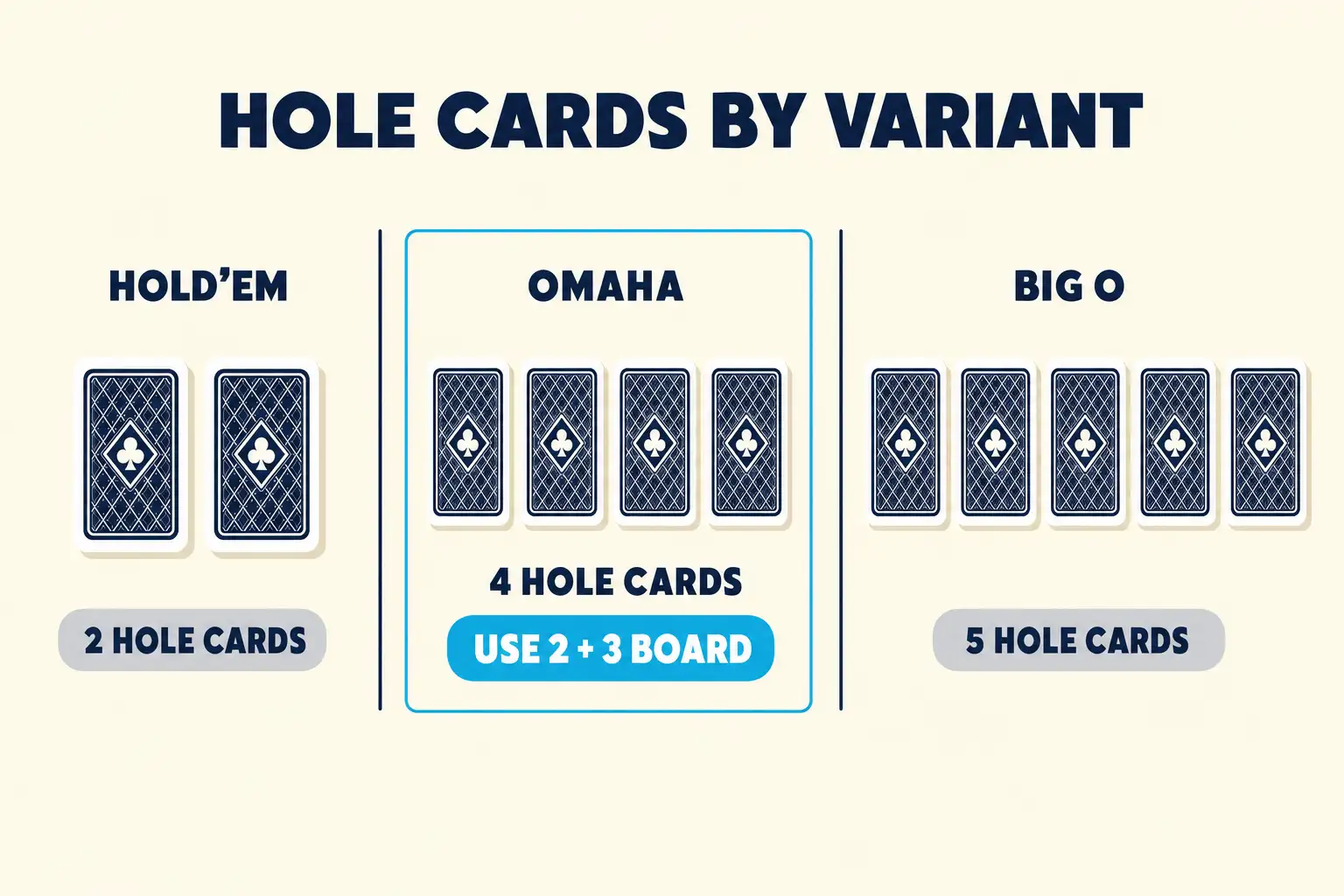
The Omaha family at a glance
Most players who say “Omaha” mean Pot-Limit Omaha. The Omaha family is a little wider than that, and the differences are worth keeping straight before you sit at a new table.
| Variant | Hole cards | Pot | Low qualifier | Typical betting |
|---|---|---|---|---|
| Omaha High (PLO) | 4 | High only | n/a | Pot-limit |
| Omaha 8-or-better (O8 / PLO8) | 4 | High + qualifying low | 5 unmatched cards 8 or below | Pot-limit |
| Big O | 5 | High + qualifying low | 5 unmatched cards 8 or below | Pot-limit |
| Texas Hold’em (for contrast) | 2 | High only | n/a | No-limit |
The shared backbone across the Omaha row is the must-use-exactly-two rule. The variants split on whether the pot is high-only or split, and on how many hole cards each player gets. Everything else — preflop action, flop, turn, river, the mechanics of the showdown — is the same as in Hold’em.
When the must-use-two rule changes your decisions
The “exactly two hole cards plus exactly three board cards” rule sounds like a footnote and is the single biggest source of beginner mistakes for players moving over from Hold’em. Three places it bites:
- Flushes need two suited cards in your hand. A board with four hearts does not give a player who holds a single heart a flush. In Hold’em, one heart in your two-card hand plus four hearts on the board gives you a flush; in Omaha that hand has nothing. You need at least two hearts in your four hole cards, plus at least three hearts on the board.
- Straights need two connecting cards in your hand. A board of 9-T-J does not give a player who holds a single Q a straight; they need a second connecting card in their hand to bridge the run.
- Paired boards still have to pass the two-and-three test. If the board is K-K-7-2-2 and you hold A-K-Q-J, Hold’em lets you use your K with both board kings and both deuces for kings full. Omaha will not. You must use exactly two cards from your hand, so the best you can build is K-A plus K-K-7 from the board: three kings. To make kings full on that board in Omaha, you would need a legal two-card hand component, such as K-2 from your hand with K-K-2 from the board.
Hold’em players read their two cards instinctively and add the board. In Omaha you have to do the opposite: pick two from your four, then pick three from the board, and confirm those choices give you a legal five-card hand. The arithmetic feels awkward at first; it becomes automatic by the second or third session.
Example: building a hand in Omaha
You hold A♥ K♣ Q♣ 7♦. The board comes K♠ 9♥ 4♥ 2♥ 5♥.
A Hold’em player looking at this hand would see two things at once: top pair top kicker (kings with an ace) and an ace-high heart flush. The Omaha rule applies before you name any of them.
The flush is not actually there. You hold one heart: the A♥. The board shows four hearts: 9♥, 4♥, 2♥ and 5♥. Hold’em would let you combine your one heart with the four on the board and call it a flush. Omaha will not. You need two hearts from your hand; you have one. The flush read is a phantom. In Poker Skill, which teaches Hold’em only, a hand-rankings question puts four hearts on the board so that any single heart in your hand makes the flush, the right Hold’em read and the wrong Omaha one.
Top pair top kicker is what the hand actually plays. You take K♣ from your hand to pair the K on the board, and the A♥ from your hand as the kicker. That is two cards from your hand plus K-9-5 from the board, which is exactly three from the board. Result: K-K with an ace kicker. In Hold’em that is sometimes ahead heads-up; in Omaha, with six two-card combinations per opponent, it is rarely ahead in a contested pot.
The lesson the example carries: in Omaha you list the candidate hands, apply the two-from-hand-and-three-from-board test to each, then keep the strongest one that survives the test. The ranking that matters is the hand you can legally build, not the hand that looks strongest at first glance.
Common Omaha mistakes
- Reading a flush off a single suited hole card. The most common Hold’em-to-Omaha leak. If you hold one heart and the board shows four hearts, you do not have a flush. Period. Pause and count.
- Reading a full house off a single pair in your hand. A pair on the board contributes two of your three board cards; a single pair in your hand contributes both of your hole cards. You need a pair on the board to make any full house at all, exactly as in Hold’em. “Set + something” off a non-paired board is wishful thinking.
- Overvaluing aces alone. A-A-x-x where the x’s are uncoordinated low cards is one of the most overplayed Omaha holdings. With six combinations per opponent, A-A-7-2 has only one real combination working hard for it; it is a one-pair hand on most flops it sees.
- Drawing to non-nut flushes and bottom-end straights. Pot-sized bets in Omaha are usually made by the best five-card hand on the board or a draw to it. A king-high flush draw when the ace of that suit is live is a slow leak; the bottom end of a straight where a higher one is possible is a fast one.
- Calling pot-sized bets with second-best anything. Pot-limit means a pot-sized bet is the biggest raise allowed. Players who size up to the pot in Omaha have the nuts or strong nut draws far more often than they are bluffing. Calling those bets with hands that beat only bluffs is the slowest way to lose chips in this family of games.
Where Omaha sits in the variant family
Omaha is the umbrella. Pot-Limit Omaha — PLO — is the high-only, four-hole-card variant most cardrooms and online sites mean when they say “Omaha” without further qualification. Omaha High-Low Eight-or-Better adds the split-pot half: half goes to the best high hand, half to the best five-unmatched-cards-eight-or-below low; if no qualifying low is made, the high hand wins everything. The best possible low is 5-4-3-2-A, the wheel. Big O is the five-hole-card hi-lo cousin: same must-use-exactly-two rule, one extra hole card per hand, ten two-card combinations per hand instead of six, and the same hi-lo split. Players who already know Hold’em pick up Omaha faster than they pick up the hi-lo variants because the high-only showdown is familiar; the only thing they have to retrain is the hand-construction rule. Players who already know Omaha pick up Big O and PLO8 faster than Hold’em-only players for the same reason.
The decision the Omaha family forces every hand is the count: two from my hand, three from the board, what is the best five-card combination that survives the rule? Run that count once before you announce a hand and the rest of Omaha makes sense. Skip it and the rule will find you on the river the painful way.