


Offsuit
Offsuit means your two hole cards are different suits, written like AKo. The hand can't make a flush together, so most offsuit holdings play a step weaker than their suited cousins.
Practice this in Poker Skill. The Small Blind vs CO Open lesson pairs K♥ J♥ with K♣ J♦ to show the gap: the suited one is a 3-bet for value and the offsuit one a fold.
Get the free appOffsuit in Poker: Meaning, Notation, and Offsuit vs Suited
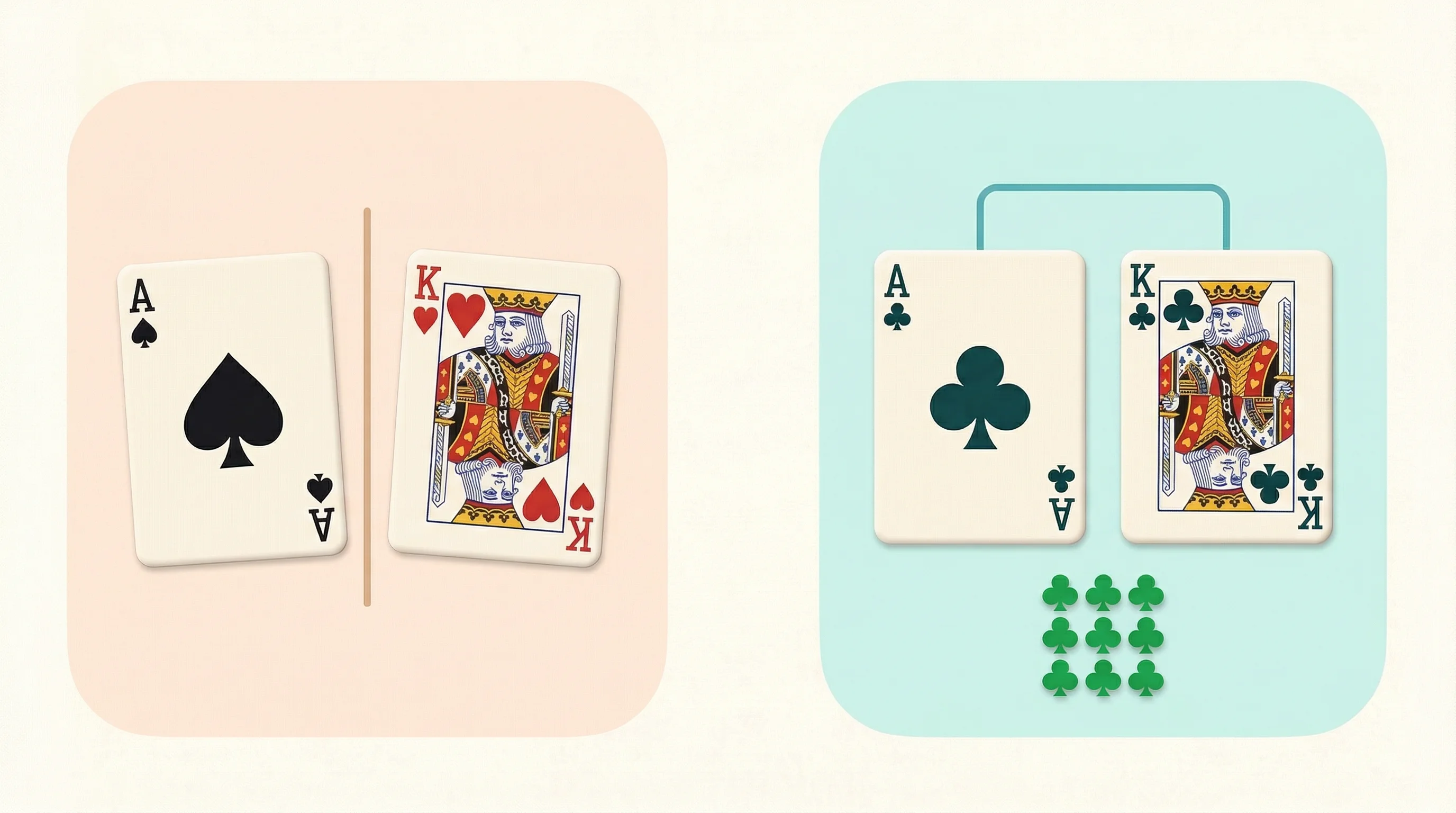
Offsuit in poker means your two hole cards are different suits. For example, A♠ K♥ is ace-king offsuit, written as AKo. The suited version, AKs, is usually stronger because both cards share a suit and can make a flush together.
That is the fast answer most players want. The practical question is what offsuit means for strategy, which offsuit hands stay strong, and why suited versions of the same ranks usually play better.
What does offsuit mean?
An offsuit hand is a starting hand where your two private cards are different suits.
Examples:
- A♠ K♥ = offsuit
- Q♣ J♦ = offsuit
- T♠ 8♥ = offsuit
That is the whole definition. If the two cards are not the same suit, they are offsuit.
This matters because in Hold’em your two hole cards can help you make more than just pairs. When both cards share a suit, they also bring flush potential. When they are offsuit, that shared flush potential disappears.
Offsuit hands can still make:
- top pair
- two pair
- trips
- straights
- full houses
But they cannot make a two-card flush draw together the way a suited hand can.
Offsuit vs suited
The easiest way to understand offsuit is to compare it directly with suited hands.
| Hand type | Example | What it means | Why it matters |
|---|---|---|---|
| Offsuit | AKo | Ace-king of different suits | Strong high cards, but no shared flush potential |
| Suited | AKs | Ace-king of the same suit | Same high cards plus flush potential |
| Offsuit | QJo | Queen-jack of different suits | Can flop pairs and straights, but less playability |
| Suited | QJs | Queen-jack of the same suit | More equity, more semi-bluff potential, easier to continue with |
| Offsuit | T8o | Ten-eight of different suits | Usually a fold in many preflop spots |
| Suited | T8s | Ten-eight of the same suit | Still not premium, but much more playable in the right spot |
The big idea is simple: the ranks stay the same, but the suited version usually has a little more value.
That does not mean every offsuit hand is weak. AKo is still a strong hand. It just means AKs is usually a bit stronger than AKo, and QJs is usually a bit stronger than QJo.
Poker notation: what the “o” means
Poker shorthand uses letters to describe the ranks of the hand and a final letter to show whether it is suited.
- s = suited
- o = offsuit
So:
- AKo = ace-king offsuit
- AKs = ace-king suited
- QJo = queen-jack offsuit
- JTs = jack-ten suited
This notation is common in strategy charts, solver outputs, preflop ranges, and coaching content.
If you see a chart telling you to open AJo but fold A9o, that final o matters. It tells you the hand is being judged without suitedness.
So AKo simply means:
- A = ace
- K = king
- o = offsuit
Why offsuit hands are usually weaker
Offsuit hands are not bad by definition. They are just usually weaker than their suited versions for a few clear reasons.
1. No shared flush potential
This is the biggest reason.
With AKs, both hole cards can contribute to a flush. With AKo, they cannot. That extra flush potential adds equity and creates more profitable turn and river runouts.
2. Less postflop flexibility
Suited hands can pick up:
- flush draws
- backdoor flush draws
- stronger semi-bluff opportunities
Offsuit hands miss all of that shared suit value. When they miss the flop, they often have fewer clean ways to improve.
3. Weak offsuit broadways get dominated more often
This is where many beginners lose money.
Hands like KJo, QTo, or A9o can look attractive because they contain high cards. But when they make one pair, they often run into a dominated hand problem.
Example:
- You open KJo
- An opponent continues with KQ
- The flop comes K-7-3
You made top pair, but your kicker is in bad shape.
4. Fewer profitable continues in marginal spots
Because offsuit hands have less playability, they usually defend worse against pressure. They also become harder to continue with in multiway pots.
That does not mean you should fold every offsuit hand. It means you should be more selective with:
- loose offsuit opens
- loose calls versus raises
- weak offsuit hands from early position
That is where ideas like Raise First In (RFI) and position start to matter.
Are offsuit hands ever strong?
Absolutely.
Some offsuit hands are still very strong because the card ranks matter a lot.
Examples:
- AKo is a premium unpaired hand and often has two strong overcards
- AQo is often worth opening and continuing with in many standard spots
- KQo can be a solid hand in the right position and action
The key is not to think in extremes.
Do not think:
- suited = always good
- offsuit = always bad
Think this instead:
- the suited version is usually better
- strong ranks can still make an offsuit hand playable
- weaker offsuit hands become much easier folds
That is also why even a premium hand does not stop mattering just because it is offsuit. AKo is still a serious hand. It is just not quite as strong as AKs.
Simple preflop examples
Here is a beginner-friendly way to think about common offsuit hands.
AKo
- Strong hand
- Often opened, 3-bet, or continued aggressively
- Still slightly behind AKs because it cannot make a flush the same way
QJo
- Looks pretty
- Can make top pair or a straight
- Often gets dominated and can create awkward one-pair spots
T8o
- Usually too weak to play from many spots
- Offsuit gapper with limited playability
- Much less attractive than T8s
As a simple preflop rule, open hands like AQo from any seat when the pot is unopened, and defend them more selectively when you are facing a raise.
You do not need exact solver frequencies to get the basic lesson: as hands get weaker, the gap between suited and offsuit matters more.
Common beginner mistakes
1. Thinking offsuit just means “bad”
That is too simple.
AKo is offsuit and still strong. The correct takeaway is not “offsuit is trash.” The correct takeaway is “offsuit usually loses some value compared with suited.”
2. Ignoring the notation
If you read a chart quickly, it is easy to confuse AJs with AJo or KQs with KQo.
That one letter can change the decision.
3. Overplaying weak offsuit broadways
This is a classic leak.
Hands like KTo, QJo, and JTo can make second-best top pair far too often. Beginners see picture cards and assume strength that is not really there.
4. Forgetting position
An offsuit hand that is reasonable on the button may be a fold from early position.
Later position gives you:
- more information
- more steal opportunities
- easier postflop decisions
That matters a lot when your hand has limited flexibility.
5. Treating suited vs offsuit as a tiny detail
It is not a tiny detail. In preflop study, the difference between suited and offsuit is built into ranges for a reason.
Quick checklist
Usually, yes: you should respect an offsuit hand a little less than a suited version of the same ranks.
Ask:
- Are the card ranks strong enough on their own?
- Am I in position?
- Am I likely to get dominated when I make one pair?
- Would this hand be much better if it were suited?
If the last answer is yes, that is a clue the offsuit version may be a fold more often than you think.
FAQ
What does offsuit mean in poker?
Offsuit means your two hole cards are different suits. For example, A♠ K♥ is an offsuit hand.
What does the “o” in AKo mean?
The o means offsuit. So AKo means ace-king with two different suits. AKs means ace-king suited.
Why are offsuit hands weaker than suited hands?
They are usually weaker because they do not share flush potential. That removes some equity and makes many offsuit hands less flexible after the flop.
Is AKo a strong hand in poker?
Yes. AKo is a strong starting hand even though it is offsuit. It is just usually a bit weaker than AKs. When Poker Skill deals you A♥ K♦ behind a raiser and a caller, the answer is a 3-bet, since ace-king beats most of what they hold.
What is the difference between offsuit and suited poker hands?
Suited hands use two cards of the same suit, which gives them flush potential. Offsuit hands use two different suits, so they lose that extra draw value.
Final takeaway
If you were searching for offsuit poker meaning, here is the simple answer:
Offsuit means your two hole cards are different suits, and the “o” in notation like AKo tells you that immediately.
The strategic point is just as important:
- suited hands usually have a little more value
- strong offsuit hands still exist
- weaker offsuit hands get into trouble much more often
Once you start reading ranges and hand charts, this becomes second nature.