


Dominated Hand
A dominated hand occurs when two players share a high card, but one has a worse kicker. The kicker is the unpaired card used to break ties when both pair the same rank.

Practice this in Poker Skill. In the lessons on playing against limpers, A♦ 10♣ in the hijack folds behind an under-the-gun limp, because an early limp is full of the better aces that beat its top pair.
Get the free appDominated Hand
Definition: what a dominated hand is
A dominated hand occurs when two players share a high card, but one has a worse kicker. The kicker is the unpaired card used to break ties when both pair the same rank.
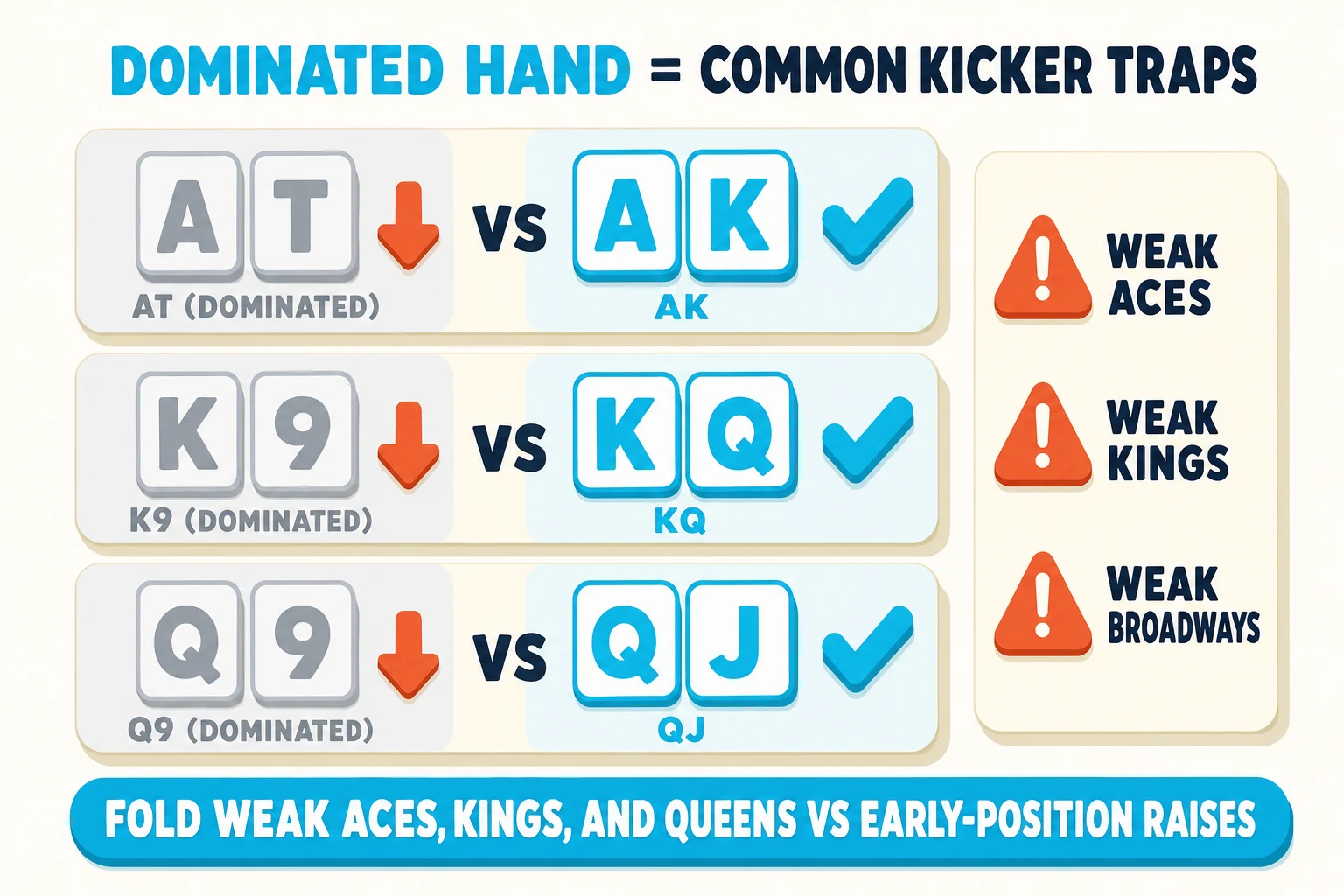
Example: You hold A-T and an opponent holds A-K. If an Ace appears on the board, both pair the Ace, but A-K’s King kicker beats your Ten. In heads-up confrontations the dominant hand wins roughly 75% of the time, so dominated holdings must hit unlikely turn or river cards to win.
How domination affects preflop and postflop decisions
Domination matters most in one-on-one pots because direct kicker clashes occur frequently. Preflop, calling raises with marginal high-card hands invites domination. An early-position raiser often holds A-K against your A-T, or K-Q against your K-9.
Postflop, dominated hands are hard to play profitably. After the flop, you frequently need a runner-runner or a backdoor straight/flush to overtake the stronger kicker. That forces tough decisions about continuing in the pot versus folding to aggression.
Example: You called a button raise with A-T; the flop is A-7-2. You have top pair with a weak kicker. If the raiser c-bets, decide whether to continue against a range that includes A-K and A-Q-hands that currently crush yours.
Starting hands that commonly get dominated
Hands that commonly fall into domination traps:
- A-T, A-9: Ace with a small kicker, often dominated by A-K, A-Q, A-J.
- K-9, K-8: King with a weak kicker, vulnerable to K-Q and K-J.
- Q-9: easily dominated by Q-J or Q-T in similar spots.
These marginal high-card hands frequently face stronger versions of the same top card when facing raises.
Situations where domination matters less
Domination is a smaller concern in multiway pots and many low-limit games. Multiway action dilutes direct kicker matchups because several players lower the chance a single opponent holds the exact dominant version. Speculative hands like suited connectors gain value there because they can make straights or flushes that beat top-pair kickers.
In loose, passive tables where players limp or call widely, don’t over-apply heads-up domination rules-pot dynamics and chase equity change the math.
Practical adjustments: what to play instead and when to fold
- Prefer suited connectors (connected same-suit cards, e.g., 7-6s) and small pocket pairs (e.g., 5-5). These hands avoid obvious kicker problems and win in different ways in single-raised pots.
- Tighten calling ranges versus early-position or aggressive raisers. Fold A-T and K-9 more often when you suspect stronger broadway holdings.
- Postflop, if you pair the top card but hold a weak kicker and face heavy aggression, lean toward folding rather than making a small-odds hero call.
Quick checklist
- Check whether your hand shares a top card but has a worse kicker before calling a raise.
- Avoid calling raises with marginal high-card hands (e.g., A-T, K-9) in heads-up or tough games.
- Prefer suited connectors or small pairs in spots where domination risk is high.
- Remember multiway and low-limit games reduce domination’s impact; adjust ranges accordingly.