


Kickers
A kicker is the extra card that breaks ties between hands with the same rank. It matters when both players have the same pair, two pair, or three of a kind. A showdown is when players reveal their hole cards to decide the winner. Kickers only matter at showdown when the ranked portions of the hands are equal.
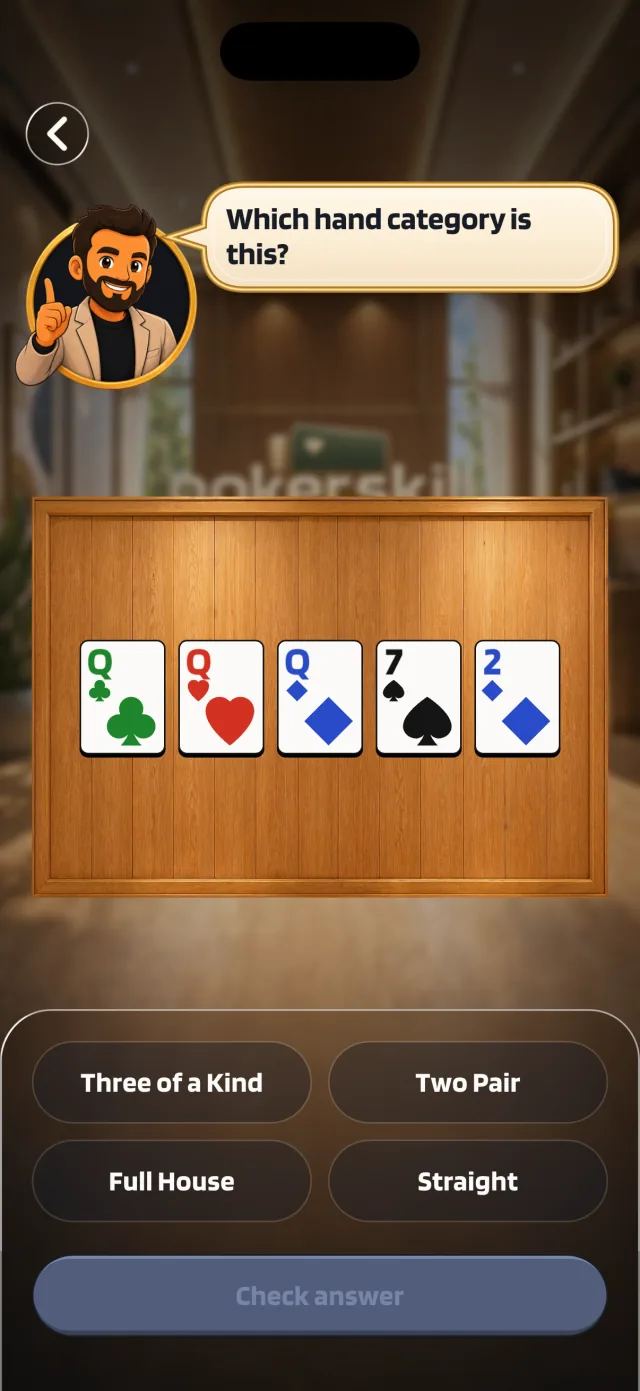
Practice this in Poker Skill. On Q-Q-Q-9-2, the first board in the Kickers Decide Winners lesson, your A-K plays both cards as kickers because the trips belong to everyone.
Get the free appKickers (No-Limit Texas Hold’em)
What a kicker is
A kicker is the extra card that breaks ties between hands with the same rank. It matters when both players have the same pair, two pair, or three of a kind. A showdown is when players reveal their hole cards to decide the winner. Kickers only matter at showdown when the ranked portions of the hands are equal.
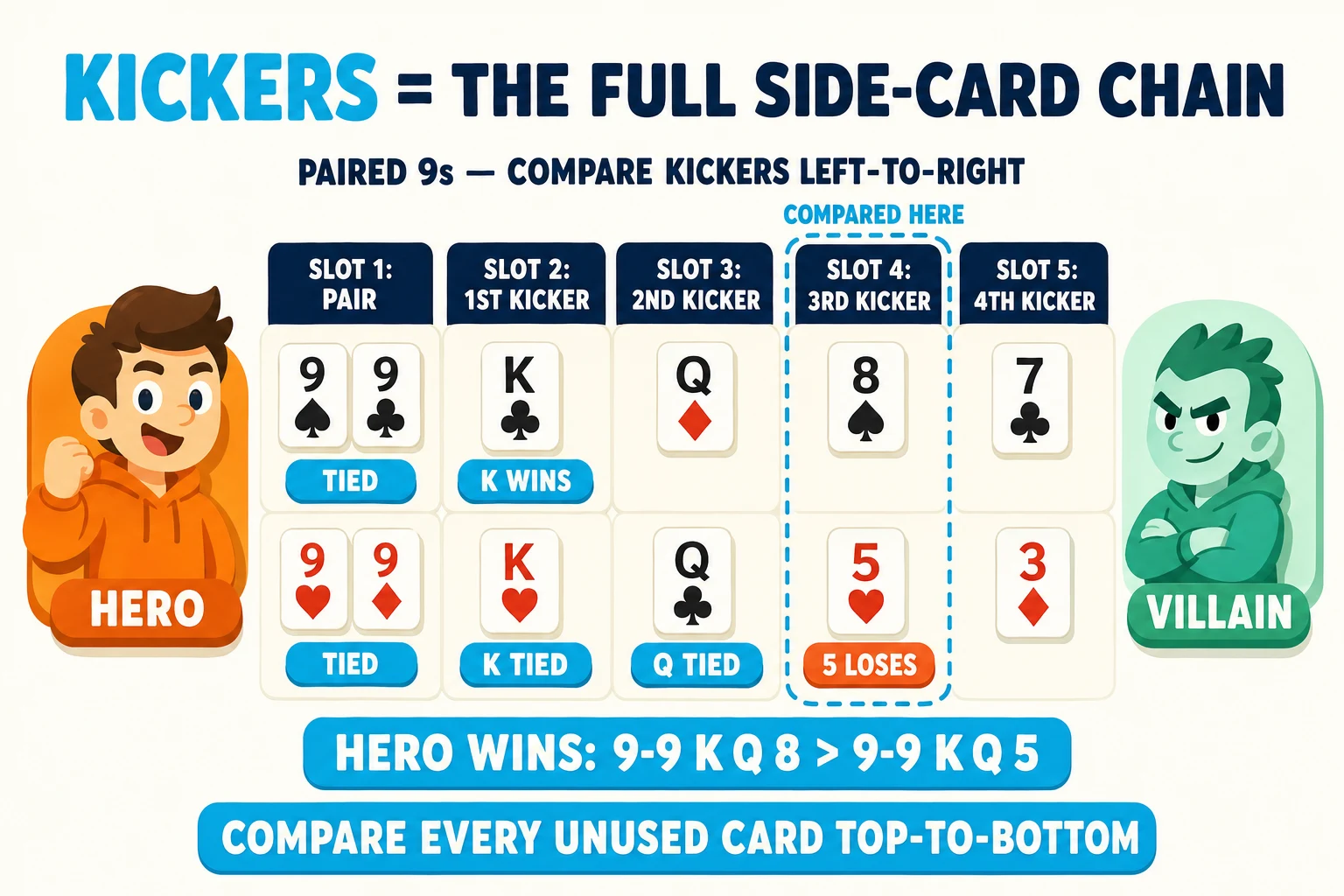
Think of the kicker as the side card - the tie-breaker from your two hole cards. If two players both pair nines, the highest remaining card among each five-card hand decides the winner.
How kickers determine winners at showdown
When two hands tie in rank, follow these steps to compare kickers:
- Identify the shared rank (pair, two pair, trips) that both players use.
- Compare the highest remaining card not involved in that rank - the highest kicker wins.
- If those kickers are equal, compare the next highest unused card. If all five cards are identical between players, the pot is split.
Example: Player A has A♠-9♣ and Player B has K♦-9♦. The board shows 9♠-7♥-2♣-5♦-J♣, so both players make a pair of nines. Compare kickers: A♠ (Ace) beats K♦ (King), so Player A wins the pot.
Sometimes the community cards make the best five-card hand for everyone. In that case, players’ hole cards are irrelevant and the pot is split.
Typical kicker-deciding situations (top pair, two pair, trips)
Top-pair situations are the most common spots where kickers decide showdowns. If both players use one hole card and a community card to make top pair, the other hole card becomes the kicker.
Two pair and three-of-a-kind situations also force kicker comparisons at showdown. Example situations include:
- Both players share board two pair and each use one hole card; the next highest side card decides.
- If trips use a shared board pair, the highest side card outside the trips wins the hand.
These spots occur often and a single side card can swing a big pot.
Kicker trouble: risks of weak kickers
Kicker trouble means losing with a seemingly strong made hand because your kicker is weak. A weak kicker can make top pair or trips lose big pots when an opponent holds a superior side card. This problem costs you because players often commit chips believing they hold the best hand. Always consider whether your pair is vulnerable to being out-kicked before committing large bets.
Using kicker awareness in hand selection and play
Consider kicker strength when choosing hands preflop and when planning postflop aggression.
- Preflop: Favor hole cards that give strong kickers for top pair, like a broadway card plus a high unpaired card.
- Postflop: With top pair and a weak kicker, play cautiously; a strong kicker justifies aggression.
- Board reading: Adjust betting when the streets are likely to create kicker-deciding showdowns.
Quick checklist
- A kicker breaks ties when hands share a pair, two pair, or trips.
- Favor hole cards with good kicker potential whenever you can.
- Watch for boards that give everyone the same best five-card hand, creating split-pot risk.
- Factor kicker strength into both aggression and hand-selection decisions.