


LAG
A LAG (loose-aggressive) player enters more pots than the table average and bets, raises, and re-raises at a higher frequency than a balanced regular. The style trades hand-strength margin for pressure, so a controlled LAG picks spots while a reckless LAG plays one speed.
Practice this in Poker Skill. After each Practice vs AI game against AI opponents, the review sets how often you entered pots and raised preflop beside an optimal range, so you can see how loose and aggressive your own play runs.
Get the free appLAG (Loose-Aggressive): the high-volume pressure style in plain English
What a loose-aggressive player is
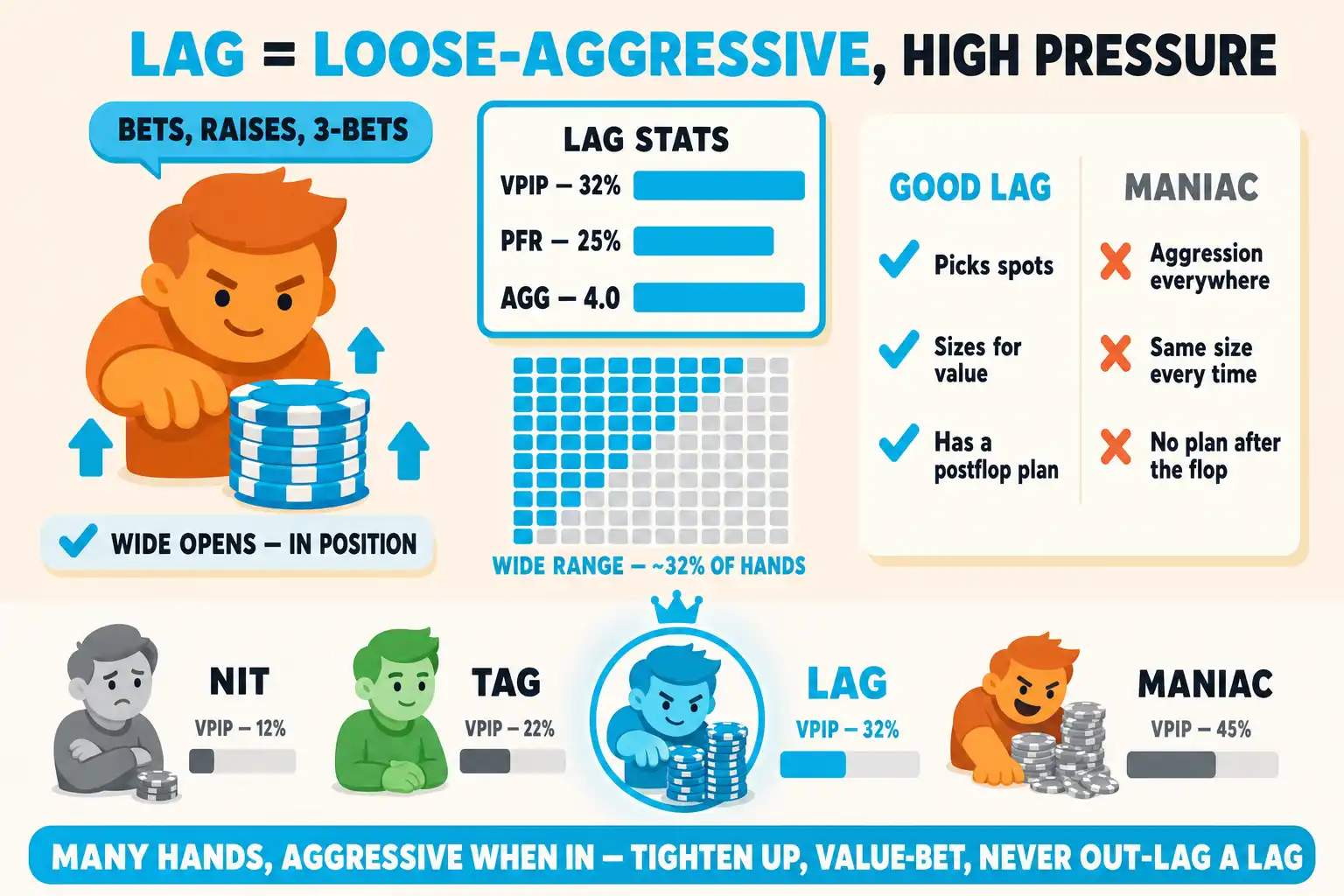
A loose-aggressive (LAG) player enters more pots than the table average and applies pressure on more streets than a balanced regular. “Loose” describes the hand-selection axis: a LAG opens, calls, and 3-bets a wider preflop range than the room. “Aggressive” describes the action axis: when the LAG is in a pot, the default is to bet or raise rather than check or call. The two axes combine into a style that creates more pots, bigger pots, and more spots where opponents have to make hard decisions for stacks.
How LAG differs from neighboring archetypes
A clean read separates the four common archetypes by which two axes are active:
- Tight + aggressive (TAG): few hands, but aggressive when in. Predictable preflop, hard to fold to postflop.
- Loose + aggressive (LAG): many hands, aggressive when in. The pressure style.
- Loose + passive (calling station): many hands, but mostly checks and calls. The opposite of a LAG on the action axis.
- Tight + passive (nit): few hands, mostly checks and calls. The opposite of a LAG on both axes.
A “maniac” is a LAG with the discipline removed. Same aggression rate, no hand selection, no plan after the flop. A controlled LAG and a maniac look identical for the first orbit and very different by the third.
Related terms
LAG vs. TAG vs. nit vs. calling station
Stat bands below are HUD-community shorthand for 6-max NLHE cash, not formal definitions. Real players smear across the boundaries; the table is a reading tool, not a label gun.
| Player type | Typical VPIP | Typical PFR | Typical AGG | How to play back |
|---|---|---|---|---|
| Nit | 12–17% | 9–14% | 1.5–2.5 | Steal blinds, c-bet often, fold to rare aggression |
| TAG | 20–24% | 17–21% | 2.0–3.0 | Respect raises, defend selectively, isolate |
| LAG (controlled) | 28–35% | 22–28% | 3.0–5.0 | Tighten your range, value-bet thinner, 3-bet for value |
| Maniac (reckless LAG) | 40%+ | 30%+ | 5+ | Tighten further, never bluff, snap value calls down lighter |
| Calling station | 35%+ | 5–12% | 0.5–1.5 | Cut bluffs, size up value, bet thin |
Read across one row and the style maps to a single counter-plan; jump rows and the counter-plan inverts. The most common reading mistake at the table is treating any aggressive opponent as a LAG and any loose opponent as a calling station. Many opponents sit in between, and those in-between profiles are where the hard decisions live.
When LAG style works (and when it backfires)
LAG-style play earns its keep under specific conditions. It is not a default style for every table.
Where loose-aggressive wins:
- 6-max and short-handed tables where every player must defend wider, so the LAG’s extra hands are not just being thrown away preflop.
- Tables where most opponents fold rivers too often or fold to a third bet too often. Pressure has buyers.
- When you have built a tight image earlier in the session and opponents still treat your raises as “must be a hand.”
- In position, deep-stacked, against opponents whose postflop game is weaker than yours.
Where loose-aggressive backfires:
- Tables that are already loose. If three opponents are calling everything down, the LAG’s bluffs find no folders. The book advice is the opposite of intuition: play tight when the table is loose.
- Against multiple calling stations in the same hand. Stations buy bluffs at a steep discount and turn marginal value into pot-sized losers.
- Short stacks where a single 3-bet commits the chips and bluff equity vanishes.
- After your bluff frequency has been decoded. Once an observant opponent has watched two or three LAG bluffs go to showdown, the style needs to gear down or the next bluff gets called.
The same player can look controlled at one table and overextended one seat over in a different lineup. Style is conditional.
Example: a controlled LAG line
100bb effective, 6-max, $1/$2 NLHE cash. UTG folds. Hijack folds. Cutoff (a TAG opener) raises to $6. You’re on the button with 8♠7♠. The big blind is a nit; the small blind is a regular.
A controlled LAG 3-bets here. The hand has clean playability in position against a single opener: straight cards, suited, easy to fold to a 4-bet, easy to barrel on a connected runout. Make it $20.
Both blinds fold. The cutoff calls $14 more. Pot is $43.
Flop: 9♣ 6♦ 2♠. You flopped an open-ended straight draw plus a backdoor flush draw. The cutoff checks. C-bet $20. A third of pot is enough to fold out his under-pairs and ace-high that didn’t connect, and you keep equity if he calls with a hand like A♠9♥. He calls. Pot is $83.
Turn: 5♥. You filled the straight. He checks. Bet $55, about two-thirds of pot. He calls.
River: K♣. He checks. The natural value bet sizing is $120 into $193, around 60% pot. Sized for hands like 9-x and 7-7 / 8-8 to call; sized to look like the ace-high overpair line he’s afraid of. He calls with K-9 suited and pays the straight off.
The same hand played reckless-LAG style, say 4-bet bluffing the cutoff preflop because “any two cards in position,” turns into a leak. The 4-bet folds out the same opens that would have folded to a 3-bet, works only when the cutoff calls and the LAG hits the flop, and runs into the cutoff’s value 5-bet range. The discipline lives in picking the spot, not in the aggression itself.
Common mistakes when playing or facing a LAG
1) Tagging every aggressive opponent as a LAG
Aggressive does not mean loose. A TAG who 3-bets you twice in two orbits is still a TAG. The countermove for a TAG (defend tighter, don’t 4-bet bluff) is the wrong move for a LAG (defend wider, 4-bet bluff selectively). Watch the showdowns and the preflop range, not just the aggression count.
2) Trying to out-LAG a LAG
The instinct after losing two pots to a LAG is to widen your own range and fight fire with fire. The book advice is the opposite. Tighten your base range against a LAG, value-3-bet more, and let their reckless aggression run into your stronger holdings. Out-LAG-ing a LAG turns into a coin flip with weaker cards.
3) Treating “good LAG” and “maniac” as the same opponent
A controlled LAG folds to your check-raise on a wet board because they have a plan; a maniac shoves over the top because they don’t. Reading them the same way costs full stacks. The clearest tell is the river: a controlled LAG slows down on bad runouts; a maniac fires anyway.
4) Playing LAG style with TAG hand-selection muscle memory
Newer LAGs widen the preflop range without rewiring the postflop game. They still C-bet only top-pair-or-better, still fold turn cards as if every overcard hit the opponent, and never barrel rivers. The result is a player who accepts extra marginal flops but never earns enough folds. If the postflop barrels aren’t there, the LAG opens turn into leaks.
FAQ
When does LAG style work in 6-max NLHE cash?
A controlled LAG style works best at the right tables: short-handed, tight-image, weak-postflop opponents. It is not a default style for every lineup. Many solid regulars sit closer to TAG and lean into LAG selectively when the table invites it. The trap is decoupling “controlled” from “LAG”; aggression without selection creates leaks quickly.
What’s the difference between a LAG and a maniac?
Both put the same number of bets and raises in. The LAG has hand selection, sizing logic, and a postflop plan; the maniac doesn’t. After one orbit they look identical; after a session, their showdown hands, bet sizes, and give-up spots separate them.
How do I exploit a LAG opponent?
Tighten your starting range, especially out of position. 3-bet for value with the top of your range, not for show. Don’t bluff into them on the river without a clear blocker story. Let their aggression do the work: when they bet into you with a strong hand, raise; when they bet into you with air, call down lighter than you would against a tight player. The LAG’s pressure comes from forcing folds, so the counter is to fold less and call lighter, not to bluff back.