


Late Position
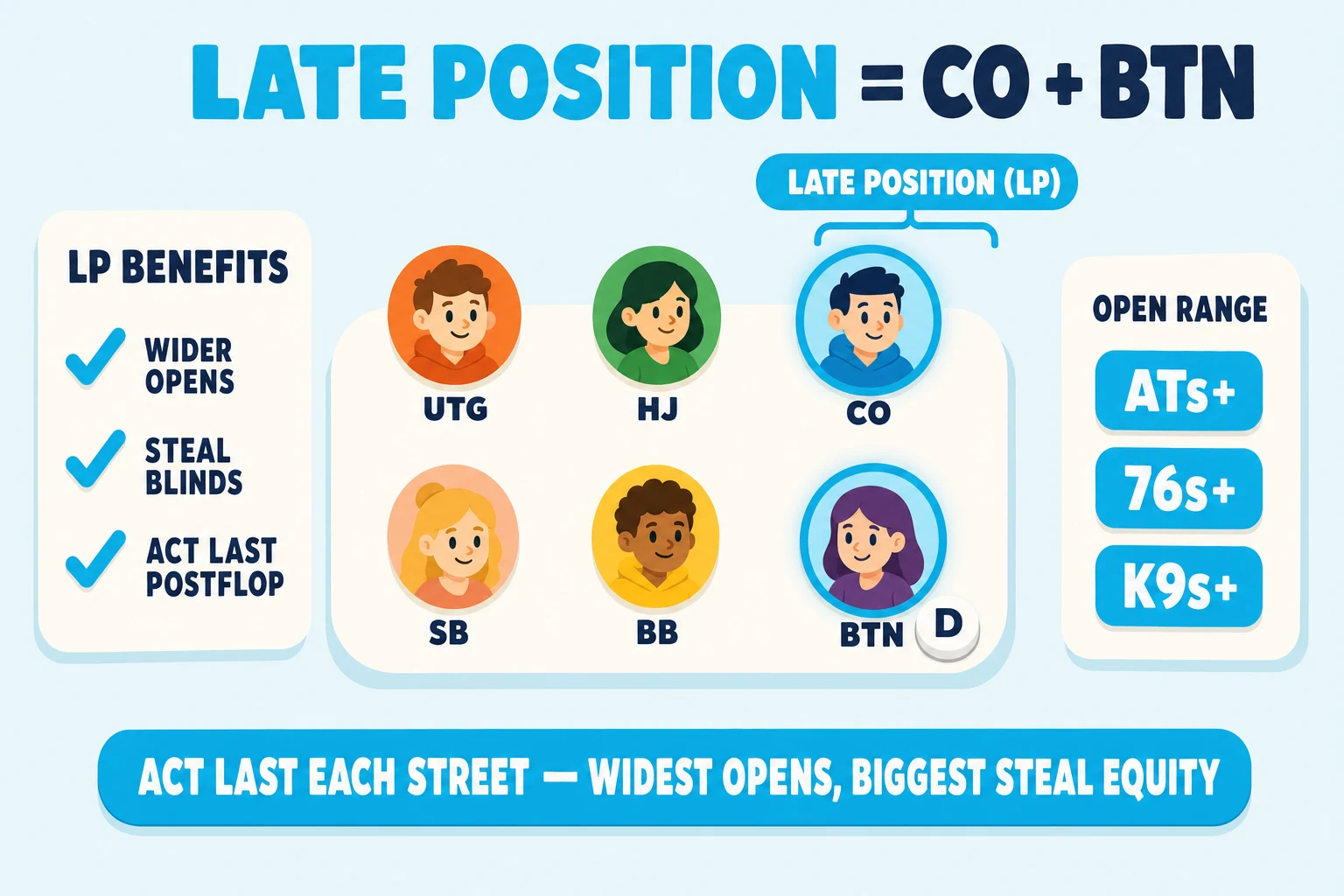
Late position means the seats that act near the end of each betting round: the Cutoff (seat before the dealer Button) and the Button. Acting after most opponents matters because you see their choices before you decide. That extra information - who entered the pot, who raised, who folded - is the core reason late position is powerful. It lets you widen options and make more precise decisions.
Practice this in Poker Skill. Suited hands like K♣ 9♣ and A♦ 5♦ raise on the button in the raise-or-fold lesson for that seat, while a weak offsuit 9♣ 6♦ folds even there.
Get the free appLate Position in No-Limit Texas Hold’em
Defining Late Position (Button & Cutoff)
Late position means the seats that act near the end of each betting round: the Cutoff (seat before the dealer Button) and the Button. Acting after most opponents matters because you see their choices before you decide. That extra information - who entered the pot, who raised, who folded - is the core reason late position is powerful. It lets you widen options and make more precise decisions.
Why Late Position Gives an Edge
Acting last gives several concrete advantages. You can play a broader set of hands profitably because you observe opponents’ actions before committing chips. Late position enables targeted pressure: steals (opening to take the blinds), re-steals (re-raising an attempted steal), and aggressive lines against the blinds become practical. You also control pot size better - keep it small with marginal hands or build it with strong holdings - and exploit opponent tendencies more easily.
Example: if two players call preflop and the Button raises, you can often assume a wide range and use positional edges post-flop to outplay them.
Adjusting Your Starting Hands in Late Position
Late position lets you widen preflop ranges, but do it thoughtfully.
- Widen opens: include more suited connectors (hands that can make straights and flushes) and suited broadways (high-card suited hands with post-flop playability). These hands gain value when you act last because they realize equity more often and are easier to navigate post-flop.
- 3-bet strategy: a 3-bet (a re-raise after an initial raise) from the Button is often polarized - it mixes very strong hands and lighter bluffs - to maximize fold equity. From the Cutoff, you can call wider against weak opens, using position post-flop to extract value.
- Be cautious: tailor expansions to opponent types and stack sizes. Versus tight players you can widen more; versus blinds with short stacks, tighten to avoid marginal all-in confrontations.
Stepwise preflop adjustment:
- Identify the opener and their tendencies.
- If the table folds to you in late position, open with a broader set of playable hands.
- Versus an earlier raise, choose whether to 3-bet (polarized) or call, based on opponent strength and stacks.
Post-flop Play When You’re Last to Act
Acting last gives clearer information on board texture and opponents’ reactions. That lets you make more accurate value bets by sizing after you see checks or calls. You can time bluffs when opponents show weakness, increasing fold equity. You also control pot size: check-back to keep pots small with marginal hands, or lead/raise to build pots when you sense weakness.
Example: on a coordinated flop with one caller and blinds in, a Button player can use a small probe bet and fold to aggression, or escalate into a larger bluff if the earlier caller shows weakness.
Late Position: Tournaments vs Cash Games
Late position value shifts by format. In tournaments, stealing and 3-bet aggression often pay off more because fold equity and chip accumulation matter. Still, tighten openings when the blinds contain short stacks to avoid marginal all-in confrontations. In cash games, deeper stacks increase the value of speculative hands from late position; suited connectors and small pairs become more profitable when you can exploit positional edges post-flop.
Quick checklist
- Identify Button and Cutoff seats and prioritize acting with information.
- Widen opening and calling ranges in late position, favoring suited connectors and playable suited broadways.
- Use late position to apply pressure with steals and well-timed 3-bets.
- Control pot size and exploit opponent tendencies when acting last.
- Tighten ranges versus short-stacked blinds to avoid marginal all-in confrontations.