


Position
Position describes a player's seating order relative to the dealer button and determines who acts when. The dealer button marks action: players to its left act earlier, players on and near it act later. Acting later gives you more information about opponents before you decide on each street. That informational edge affects every betting round: pre-flop, the flop, the turn, and the river. Because you see others' bets and checks first, you make more accurate calls, bluffs, and sizing decisions. Post-flop means the three betting rounds after the initial deal: the flop, turn, and river.
Practice this in Poker Skill. The Postflop Action Order + IP/OOP lesson drills who holds this edge on each street, including the hand where the button folds and the cutoff becomes the player who acts last.
Get the free appPosition (No-Limit Texas Hold’em)
What “position” means at the table
Position describes a player’s seating order relative to the dealer button and determines who acts when. The dealer button marks action: players to its left act earlier, players on and near it act later. Acting later gives you more information about opponents before you decide on each street. That informational edge affects every betting round: pre-flop, the flop, the turn, and the river. Because you see others’ bets and checks first, you make more accurate calls, bluffs, and sizing decisions. Post-flop means the three betting rounds after the initial deal: the flop, turn, and river. For every seat counted back from the button, which ones exist at which table size, and what each is worth, read poker positions.
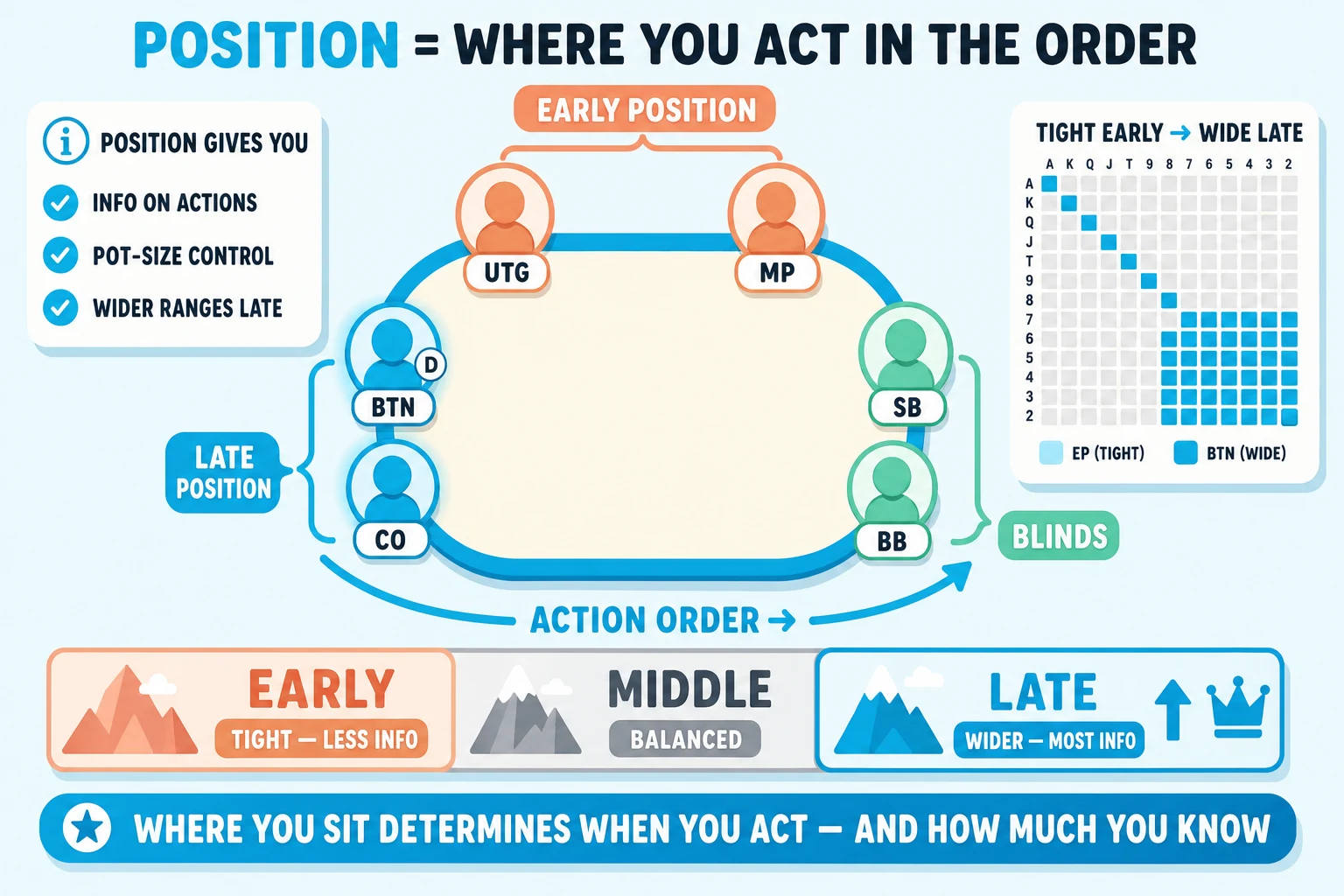
Table seats: Early, Middle, and Late position
Players fall into three common zones:
- Early Position (EP): the first seats to act. This usually includes the blinds - the forced small and big bets - and players immediately left of the blinds. You have the least information acting here.
- Middle Position (MP): seats between EP and LP. MP is a transition zone where you widen your range slightly but still act cautiously.
- Late Position (LP): the cutoff (one seat right of the button) and the button. These seats act last and hold the most post-flop advantage.
Example: At a nine-handed table, UTG (under the gun - first to act pre-flop) is EP, seats four through six are MP, and the cutoff plus button are LP.
Why the button is the power seat
The button acts last on every post-flop street, so you observe all opponent actions before deciding. That last-to-act information makes the button the single strongest seat at the table. Acting last lets you play a wider range - both strong holdings and speculative hands - because you’ll have more context about opponents’ actions. You can also bluff more credibly: a river check-raise from the button carries weight because you saw earlier actors show weakness. Example: With 8♠7♠ on the button facing a single raise, calling or three-betting becomes more attractive than from EP since you’ll play post-flop with positional advantage.
How position changes hand selection
Seat affects which hands you open, call, or fold. Think in terms of ranges - the sets of hands you might hold.
- Early position: Play tight and value-heavy. Open premium hands like A-K and high pairs. Fold marginal speculative hands because you’ll act with less information. Example: 3♦3♣ is a weak open in EP and often folded or only opened very cautiously depending on table dynamics.
- Middle position: Widen slightly. Add suited connectors and more broadway hands, but avoid overly marginal holdings in multiway pots.
- Late position: Widen considerably. Open small pairs, suited connectors, and speculative hands because you’ll see opponents act first and can steal blinds or exploit weak defenses. Example: 5♠6♠ from the cutoff or button is playable as a call or steal attempt; in EP it’s usually folded.
Always adjust pre-flop ranges by seat - plays that profit on the button can lose in early seats.
Using position to control pots, aggression, and bluffs
Acting last gives you initiative: apply pressure when opponents must act first. You control pot size more easily - bet to build when favored or check to keep the pot small with marginal hands. Bluffs and value bets work better from late position because you size knowing how others responded. A well-timed river bet from the button can fold better hands after you saw opponents show weakness. Example: On K♣8♦2♥ flop, bluffing is riskier when first to act and facing a bet. If you’re on the button and everyone checks to you, a bet can take down the pot or set up a clear river decision with maximum information.
Quick checklist
- Note your seat relative to the dealer before each action.
- Tighten ranges in early position; widen them in late position.
- Prefer aggressive lines when acting last; be more cautious when first to act.
- Use the button to exploit tendencies and apply post-flop pressure.
- Factor position into both pre-flop and post-flop planning.