


Middle Position
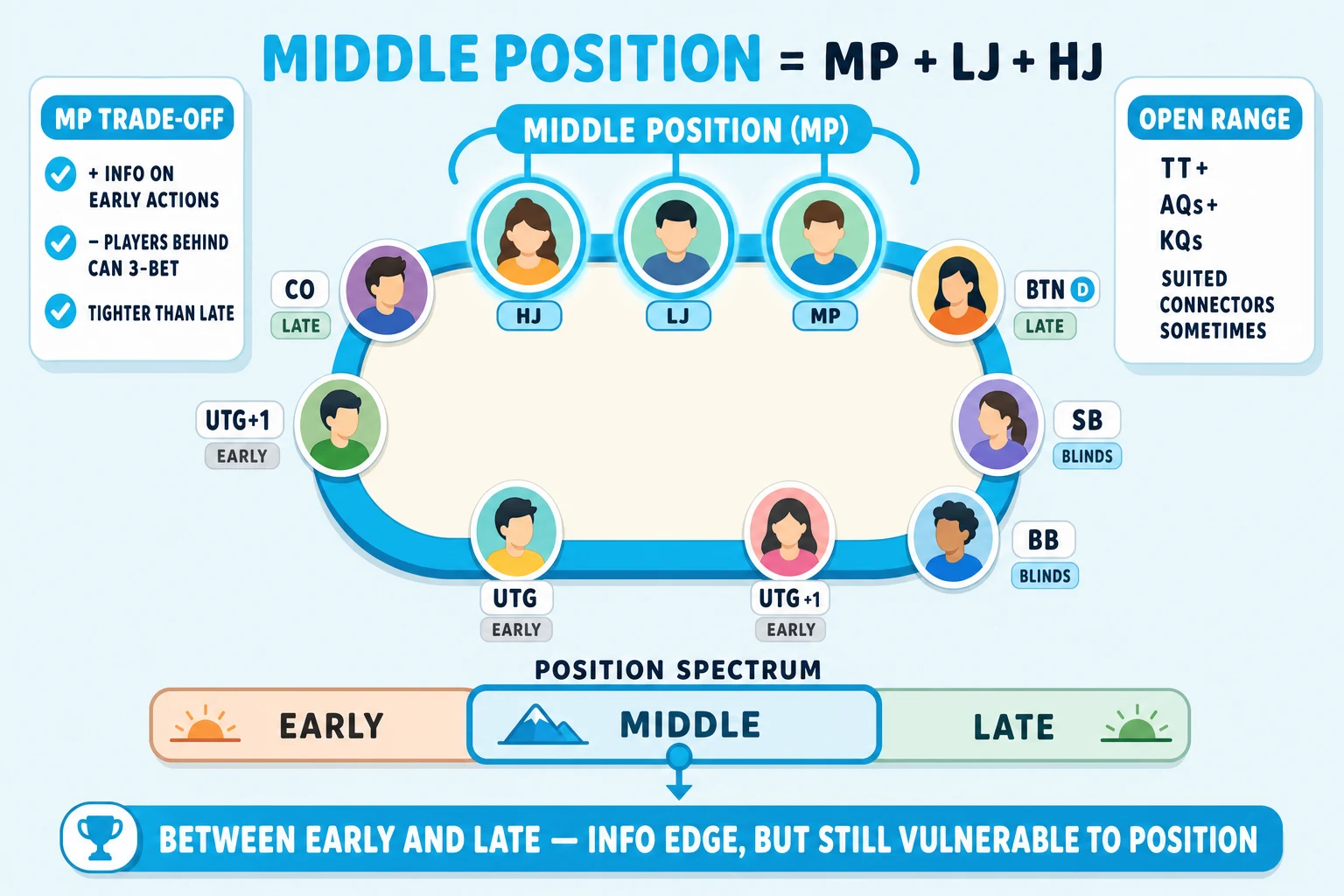
Middle position (MP) sits between early and late seats at the table. You act after early-position players, so you see their actions before deciding. That extra information improves decisions compared with early position, but more players still act after you than on the button. You typically know which early players folded, limped (called the blind), or opened the pot, and you use that information to open, call, or fold.
Practice this in Poker Skill. In the First In: Don’t Limp lesson, every hand is dealt to the hijack, the middle-position seat at a six-handed table, and each one is a raise or a fold, never a limp.
Get the free appMiddle Position in No-Limit Texas Hold’em
What middle position is and where you act
Middle position (MP) sits between early and late seats at the table. You act after early-position players, so you see their actions before deciding. That extra information improves decisions compared with early position, but more players still act after you than on the button. You typically know which early players folded, limped (called the blind), or opened the pot, and you use that information to open, call, or fold.
Why middle position matters strategically
The core advantage of MP is information. Seeing early actions helps estimate opponents’ likely hand strengths and adjust starting ranges and bet sizing. Because some threats have already folded, you can open a wider range than from early position. MP is weaker than late position; players yet to act can 3-bet (re-raise) or isolate you. Avoid large pots without a strong hand when those risks exist.
Example: If two early players fold and a late tight player also folds, you can open a hand you’d fold from early. If a loose-aggressive player still to act will 3-bet often, play more cautiously.
Hand-selection guidelines from middle position
- Prioritize premium hands. Favor high pocket pairs (TT+) and strong broadways like AK, AQ, or KQ. Broadways are Ten through Ace high cards.
- Include suited connectors and small pairs selectively. These hands (for example, 7♠6♠) make disguised straights, flushes, or sets. Play them when folded to you, facing passive callers, or when stacks provide implied odds.
- Tighten against early-position raises. Suited connectors and small pairs lose value facing raises because you risk domination or being priced in.
Concrete example: With 8♠8♦ in MP, open if folded to you. If an early-position player raised, call or fold depending on stacks and the raiser’s tendencies.
Post-flop play and flexibility in middle position
Post-flop, MP offers both advantages and constraints. Act-check, bet, call, or raise-based on earlier action and your reads. Use your informational edge to control pot size. Value-bet top-pair hands to extract; check-call marginal hands to avoid bloating the pot. Position creates bluff windows; you can represent strength on later streets when opponents show weakness. Fold to heavy pressure from later players, which often indicates real strength.
Example: You open AQ from MP and flop A-7-2. Bet for value. If a late player raises, re-evaluate; they may have a draw or a better ace.
Adjusting middle-position play to table dynamics
- Widen opens versus passive tables where players call and check frequently; marginal hands gain value.
- Tighten and cut speculative plays versus aggressive opponents who 3-bet and isolate often.
- Exploit early-position tendencies: if an early player limps habitually, attack their blind often with a wider range.
- Remember No-Limit betting magnifies positional effects. Adjust bet sizes and aggression to punish callers or avoid isolation by aggressive players.
Checklist
- Observe early-position actions before committing.
- Open wider than from early position, but narrower than from late position.
- Favor high pocket pairs and strong broadways. Include suited connectors and small pairs selectively.
- Fold or tighten when facing an early-position raise.
- Use post-flop flexibility to control pots, extract value, and find bluff windows.