


Micro Stakes
Micro stakes are the lowest real-money cash-game limits, almost always online, where blinds run from about $0.01/$0.02 up to roughly $0.05/$0.10. Common shorthands like 2NL, 5NL, and 10NL refer to those micro tables, where rake, loose calls, and simple value betting matter more than fancy postflop lines.

Practice this in Poker Skill. Simple value betting is what the Value Betting lesson trains: overpairs, two pair and top pair with a strong kicker bet whenever worse hands can call.
Get the free appMicro Stakes
What micro stakes are
Micro stakes are the lowest real-money cash-game limits in No-Limit Hold’em, almost always played online, where the blinds run from about $0.01/$0.02 up to roughly $0.05/$0.10. The shorthand “2NL”, “5NL”, and “10NL” point to those tables — at 2NL the big blind is $0.02, at 10NL it is $0.10. Buy-ins are tiny on purpose: a full 100bb stack at 2NL is just $2, at 5NL it is $5, and at 10NL it is $10. The label is a stake range, not a fixed cap.
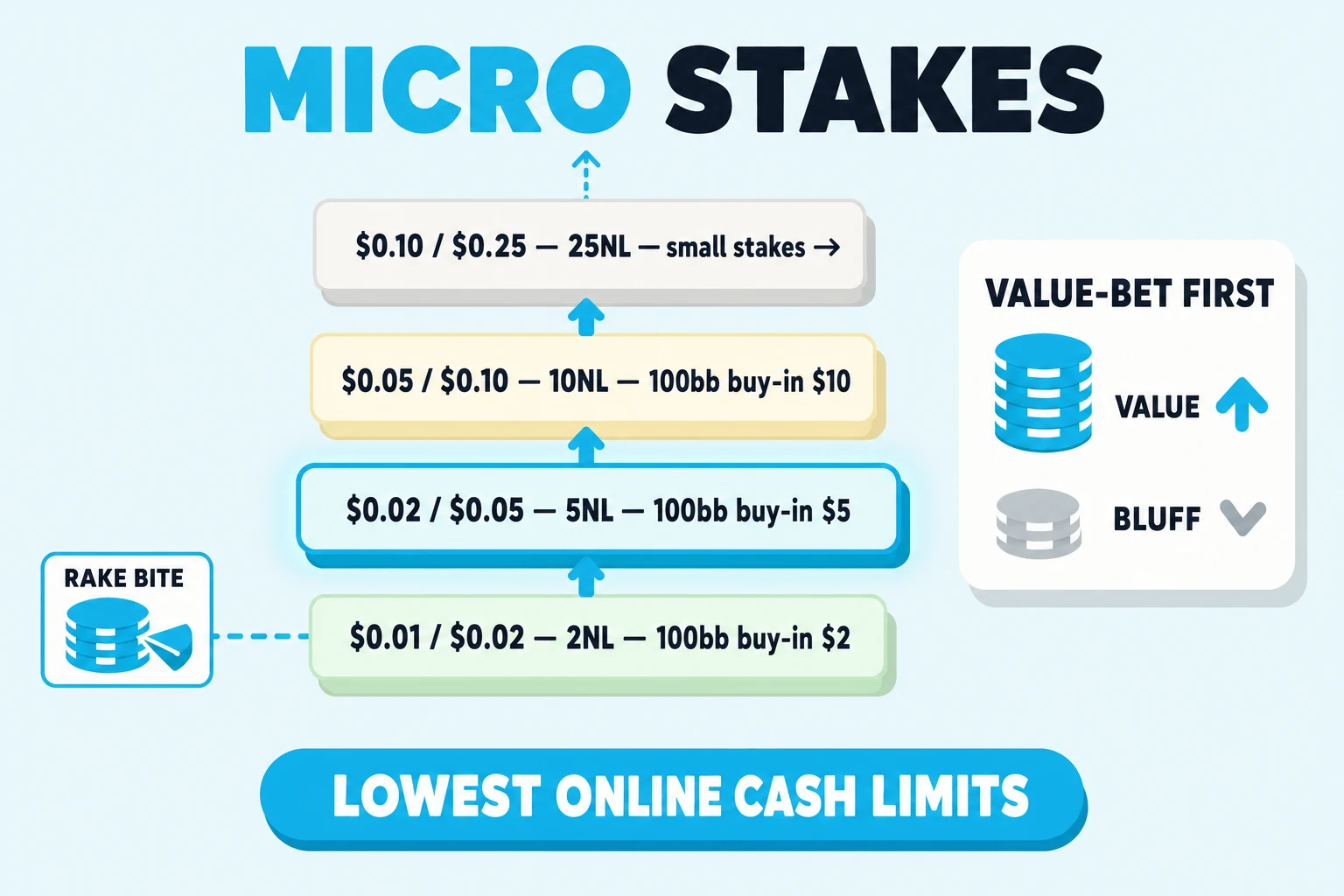
Quick way to tell micro from small or low stakes
- Micro: the lowest paid online tier — roughly $0.01/$0.02 through $0.05/$0.10. Tiny buy-ins, very loose pool, rake bites a meaningful share of pots.
- Small / low stakes: the next bracket up — typically $0.10/$0.25 and $0.25/$0.50 online, and live games like $1/$2 cash. Pots get bigger and rake takes a smaller share.
- Mid stakes and up: $1/$2 online and beyond, where the pool tightens up and exploitative shortcuts stop working as well.
The lines between micro, small, and low stakes are not standardized across rooms. Different cardrooms and books draw the boundary in slightly different places. What stays consistent is direction: as stakes go up, the rake-to-pot ratio shrinks and the average opponent gets harder.
Related terms
- Rake: the per-pot fee that hits micro pots hardest as a share of the gross.
- Big blind: the unit micro stakes are quoted in (2NL = a $0.02 big blind).
- Blinds: the seeded forced bets that name every cash format from micro on up.
- Stack depth: why a $2 buy-in at 2NL still plays like a 100bb table.
- Expected value: the long-run scoreboard rake and loose calls quietly compress at micro.
- Pot odds: the call-math that shifts when the net pot is a smaller share of the gross.
- Value bet: the line that pays the most against the loose, sticky micro pool.
- Calling station: the player archetype that shows up in volume at these limits.
How stakes notation works
Cash-game stakes are named by their two blinds, with a slash between them. A $0.01/$0.02 game means a $0.01 small blind and a $0.02 big blind. The compact NL form drops the slash and quotes the maximum buy-in in dollars as a single number: 2NL means the $2 buy-in tier, which is the same $0.01/$0.02 game when the standard 100bb buy-in convention is used. The table below shows the most common micro and adjacent low-stakes labels that way.
| Label | Blinds | 100bb buy-in |
|---|---|---|
| 2NL | $0.01/$0.02 | $2 |
| 5NL | $0.02/$0.05 | $5 |
| 10NL | $0.05/$0.10 | $10 |
| 25NL | $0.10/$0.25 | $25 |
| 50NL | $0.25/$0.50 | $50 |
| 100NL | $0.50/$1.00 | $100 |
Live cardrooms usually quote stakes by blinds only ($1/$2, $2/$5) and rarely by NL shorthand. The NL form is the online convention, which is why micro stakes — almost entirely an online phenomenon — usually wear that label.
When this matters most
The micro label changes more than how much money is on the table. It changes which lines pay and which lines waste chips.
- When you pick a learning ladder. The natural progression is micro → low → small → mid. Each rung has a different population and a different rake-to-pot ratio. Treating 2NL strategy and 50NL strategy as the same is one of the fastest ways to stall out.
- When you size your bankroll. Micro buy-ins are small enough that variance is more about hand counts and patience than dollar swings. Bankroll guidance at micro is closer to “play enough hands” than “ride out a deep downswing.”
- When you adjust to the pool. Micro tables are full of calling stations and inexperienced players who do not fold often enough. Bluffs need folds. The first lever you pull at micro is bet for value, almost always; cut multi-street bluffs.
- When you account for rake. A capped rake takes a much bigger share of a small pot than a big one. At 2NL, the cap is a real factor in the math under every marginal call.
- When you set goals. The aim at micro is not to “beat the rake forever.” It is to build a feedback loop: enough hands, simple lines that pay against loose opponents, and an honest read on whether you are ready to move up.
Example: a 5NL pot
You are playing 5NL ($0.02/$0.05). The room takes 5% rake capped at $0.50. A loose recreational player limps under the gun for $0.05. You raise to $0.20 from the cutoff with ♠A♠Q. The big blind calls. The limper calls. Three players take the flop and the pot is $0.62.
Flop ♠Q♣9♥4. The big blind checks. The limper checks. You bet $0.40 for value, just under two-thirds of the pot. Both players call. Pot is now $1.82.
Turn ♣7. Both players check to you. You bet $1.00 (a little over half pot) for thin value against second pair, third pair, and small flush draws. The big blind folds. The limper calls. Pot is $3.82.
River ♥2, a clean blank. The limper checks. You bet $1.50 for thin value. The limper calls and shows ♣Q♦8 for top pair, weaker kicker.
- Gross pot at showdown: $0.62 preflop + $1.20 flop + $2.00 turn + $3.00 river = $6.82.
- Rake taken: 5% of $6.82 is about $0.34, well under the $0.50 cap.
- Net pot you scoop: $6.48.
A few things to notice. The whole hand turned on three small value bets against a player who would not fold once they had a piece. No bluff was attempted; no fancy turn check-raise; no overbet. The rake took roughly $0.34, which feels small until you stack hours of these pots. The line works because of who the opponent is, not because the math at 5NL is special.
Common mistakes at micro stakes
1) Borrowing a strategy built for higher stakes
Solver-style ranges that work at 100NL or 200NL leave value on the table at 2NL. Players at micro do not 3-bet thin enough, do not float light enough, and do not fold to triple barrels. Translating a 100NL game plan straight onto 2NL is how thoughtful players lose to looser ones for months.
2) Bluffing into a pool that does not fold
Multi-street bluffs need a believable threat and an opponent who can fold. Micro pools have plenty of players who will call any single bet with bottom pair and any draw, regardless of board, sizing, or your own action history. The fix is usually narrower than people expect: bluff less, value bet more — including thin value with second and third pair on safe rivers.
3) Treating stakes notation as a guarantee
“2NL is easy” is a story, not a math result. The label tells you the blinds and the buy-in tier; it does not promise a beatable game once rake, time, and study cost are subtracted. Pools tighten up, rake structures vary, and a winning line at one room can be a break-even line at another.
4) Forgetting rake on every marginal call
Capped rake is a heavier share of a small pot than a big one. At 2NL or 5NL, a thin flop call that breaks even at gross pot odds is a small loser at net pot odds. The right reflex is the one rake recommends: when a call is borderline at a micro table, lean toward folding, and lean toward the line that wins the pot earlier rather than later.
FAQ
Are 2NL, 5NL, and 10NL all considered micro stakes?
Yes, in the most common usage. The micro range is the lowest online cash tier, usually anchored from about $0.01/$0.02 up to around $0.05/$0.10. The exact ceiling varies by room and by author. Some sources extend “micro” up through $0.10/$0.25 (25NL); others draw the line earlier. What stays consistent is that 2NL, 5NL, and 10NL are micro on every common definition.
Can I “beat micro stakes” through study alone?
Beating micro is more about volume and discipline than about a single insight. The pool is loose enough that simple, tight, value-heavy play does well; the rake is heavy enough that thin marginal calls do not. There is no fixed promise about results, and any room with a heavier rake structure can compress winners’ margins to a few big blinds per hundred hands. The honest answer: study the spots that come up most, play enough hands to see the long run, and treat moving up as a question of skill and bankroll, not of label.
Why do my micro-stakes sessions feel swingier than the dollars look?
Two reasons. Online sessions cover many more hands per hour than live sessions, so variance shows up in fewer real hours of play. And the average winning edge at micro and small online cash is small — top winners are often in the range of a few big blinds per hundred hands. A bad day or a cooler-heavy session can swing dozens of buy-ins of variance even when the long-run picture is fine.